

CHROMOSOMAL EVOLUTION AND SPECIATION
117
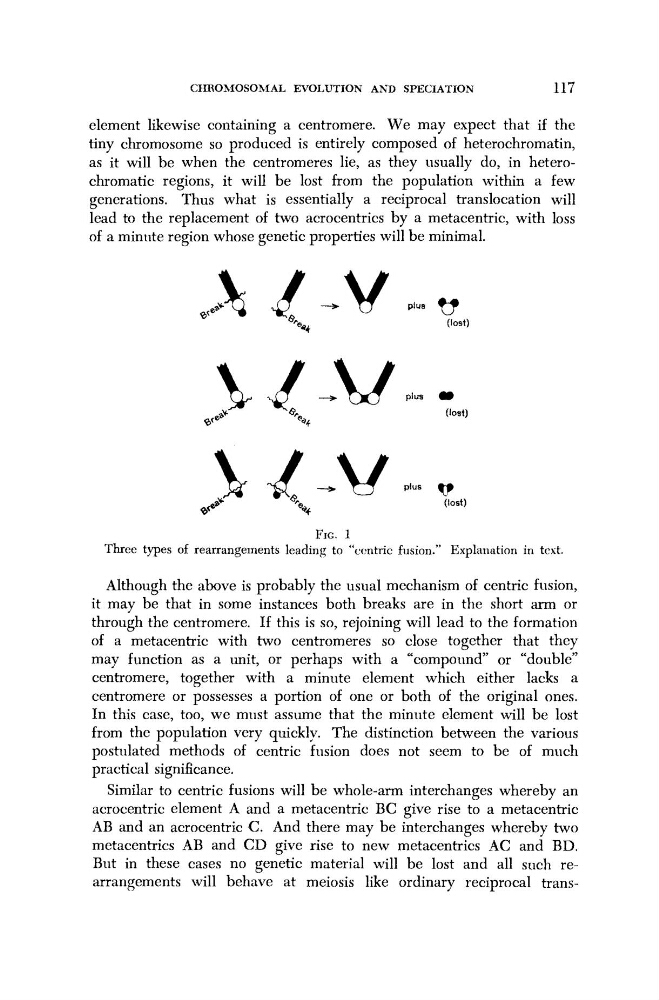
element likewise containing a centromere. We may expect that if the
tiny chromosome so produced is entirely composed of heterochromatin,
as it will be when the centromeres lie, as they usually do, in heterochromatic regions, it will be lost from the population within a few
generations. Thus what is essentially a reciprocal translocation will
lead to the replacement of two acrocentrics by a metacentric, with loss
of a minute region whose genetic properties will be minimal.
plus
(lost)
4*
\
<
lost
>
FIG. 1
Three types of rearrangements leading to "centric fusion." Explanation in text.
Although the above is probably the usual mechanism of centric fusion,
it may be that in some instances both breaks are in the short arm or
through the centromere. If this is so, rejoining will lead to the formation
of a metacentric with two centromeres so close together that they
may function as a unit, or perhaps with a "compound" or "double"
centromere, together with a minute element which either lacks a
centromere or possesses a portion of one or both of the original ones.
In this case, too, we must assume that the minute element will be lost
from the population very quickly. The distinction between the various
postulated methods of centric fusion does not seem to be of much
practical significance.
Similar to centric fusions will be whole-arm interchanges whereby an
acrocentric element A and a metacentric BC give rise to a metacentric
AB and an acrocentric C. And there may be interchanges whereby two
metacentrics AB and CD give rise to new metacentrics AC and BD.
But in these cases no genetic material will be lost and all such rearrangements will behave at meiosis like ordinary reciprocal trans-
117
element likewise containing a centromere. We may expect that if the
tiny chromosome so produced is entirely composed of heterochromatin,
as it will be when the centromeres lie, as they usually do, in heterochromatic regions, it will be lost from the population within a few
generations. Thus what is essentially a reciprocal translocation will
lead to the replacement of two acrocentrics by a metacentric, with loss
of a minute region whose genetic properties will be minimal.
plus
(lost)
4*
\
<
lost
>
FIG. 1
Three types of rearrangements leading to "centric fusion." Explanation in text.
Although the above is probably the usual mechanism of centric fusion,
it may be that in some instances both breaks are in the short arm or
through the centromere. If this is so, rejoining will lead to the formation
of a metacentric with two centromeres so close together that they
may function as a unit, or perhaps with a "compound" or "double"
centromere, together with a minute element which either lacks a
centromere or possesses a portion of one or both of the original ones.
In this case, too, we must assume that the minute element will be lost
from the population very quickly. The distinction between the various
postulated methods of centric fusion does not seem to be of much
practical significance.
Similar to centric fusions will be whole-arm interchanges whereby an
acrocentric element A and a metacentric BC give rise to a metacentric
AB and an acrocentric C. And there may be interchanges whereby two
metacentrics AB and CD give rise to new metacentrics AC and BD.
But in these cases no genetic material will be lost and all such rearrangements will behave at meiosis like ordinary reciprocal trans-