

2. M E T H O D S
61
can again be removed by treatment with trypsin, so that their numbers
can be estimated from time to time and their growth rate measured.
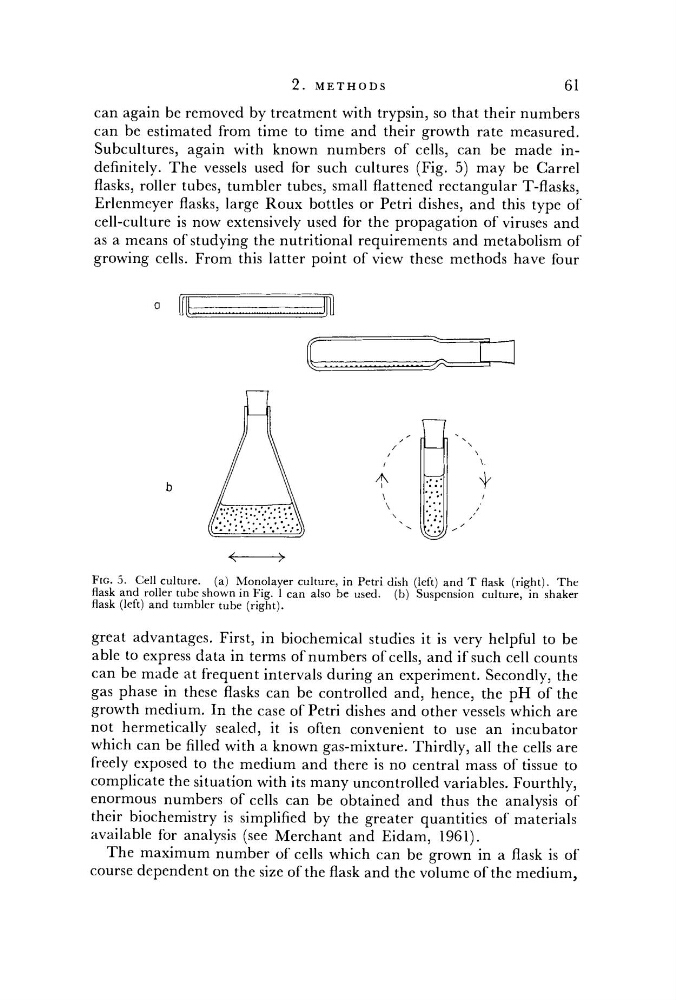
Subcultures, again with known numbers of cells, can be made indefinitely. The vessels used for such cultures (Fig. 5) may be Carrel
flasks, roller tubes, tumbler tubes, small flattened rectangular T-flasks,
Erlenmeyer flasks, large Roux bottles or Petri dishes, and this type of
cell-culture is now extensively used for the propagation of viruses and
as a means of studying the nutritional requirements and metabolism of
growing cells. From this latter point of view these methods have four
FIG. 5 . Cell culture, (a) Monolayer culture, in Petri dish (left) and T flask (right). The
flask and roller tube shown in Fig. 1 can also be used, (b) Suspension culture, in shaker
flask (left) and tumbler tube (right).
great advantages. First, in biochemical studies it is very helpful to be
able to express data in terms of numbers of cells, and if such cell counts
can be made at frequent intervals during an experiment. Secondly, the
gas phase in these flasks can be controlled and, hence, the p H of the
growth medium. In the case of Petri dishes and other vessels which are
not hermetically sealed, it is often convenient to use an incubator
which can be filled with a known gas-mixture. Thirdly, all the cells are
freely exposed to the medium and there is no central mass of tissue to
complicate the situation with its many uncontrolled variables. Fourthly,
enormous numbers of cells can be obtained and thus the analysis of
their biochemistry is simplified by the greater quantities of materials
available for analysis (see Merchant and Eidam, 1961).
The maximum number of cells which can be grown in a flask is of
course dependent on the size of the flask and the volume of the medium,
a
b
61
can again be removed by treatment with trypsin, so that their numbers
can be estimated from time to time and their growth rate measured.
Subcultures, again with known numbers of cells, can be made indefinitely. The vessels used for such cultures (Fig. 5) may be Carrel
flasks, roller tubes, tumbler tubes, small flattened rectangular T-flasks,
Erlenmeyer flasks, large Roux bottles or Petri dishes, and this type of
cell-culture is now extensively used for the propagation of viruses and
as a means of studying the nutritional requirements and metabolism of
growing cells. From this latter point of view these methods have four
FIG. 5 . Cell culture, (a) Monolayer culture, in Petri dish (left) and T flask (right). The
flask and roller tube shown in Fig. 1 can also be used, (b) Suspension culture, in shaker
flask (left) and tumbler tube (right).
great advantages. First, in biochemical studies it is very helpful to be
able to express data in terms of numbers of cells, and if such cell counts
can be made at frequent intervals during an experiment. Secondly, the
gas phase in these flasks can be controlled and, hence, the p H of the
growth medium. In the case of Petri dishes and other vessels which are
not hermetically sealed, it is often convenient to use an incubator
which can be filled with a known gas-mixture. Thirdly, all the cells are
freely exposed to the medium and there is no central mass of tissue to
complicate the situation with its many uncontrolled variables. Fourthly,
enormous numbers of cells can be obtained and thus the analysis of
their biochemistry is simplified by the greater quantities of materials
available for analysis (see Merchant and Eidam, 1961).
The maximum number of cells which can be grown in a flask is of
course dependent on the size of the flask and the volume of the medium,
a
b