

16. A C T I O N S OF H O R M O N E S
645
are derived. This inhibition may be due to a disturbance of oxidative
phosphorylation by the hormone.
In organ cultures of bone, the effects of thyroxine and its related
compound T 3 depend on the growth-rate of the rudiments in vivo.
Thus T 3 retards the growth of fast-growing bones, but either does not
affect or stimulates that of the slow-growing rudiments.
V I I I . T H E E F F E C T S OF P A R A T H Y R O I D H O R M O N E ON B O N E
A. H I S T O L O G I C A L A N D M O R P H O L O G I C A L C H A N G E S
It is well known that patients with tumours of the parathyroid
frequently suffer spontaneous fractures of their long bones, a fact which
suggests a connexion between the gland and bone growth. Gaillard
(1955b, 1959, 1960) who studied the effect of the parathyroid gland on
organ cultures of parietal- and limb-bone from mouse embryos showed
that there is a direct link between the parathyroid gland and bone
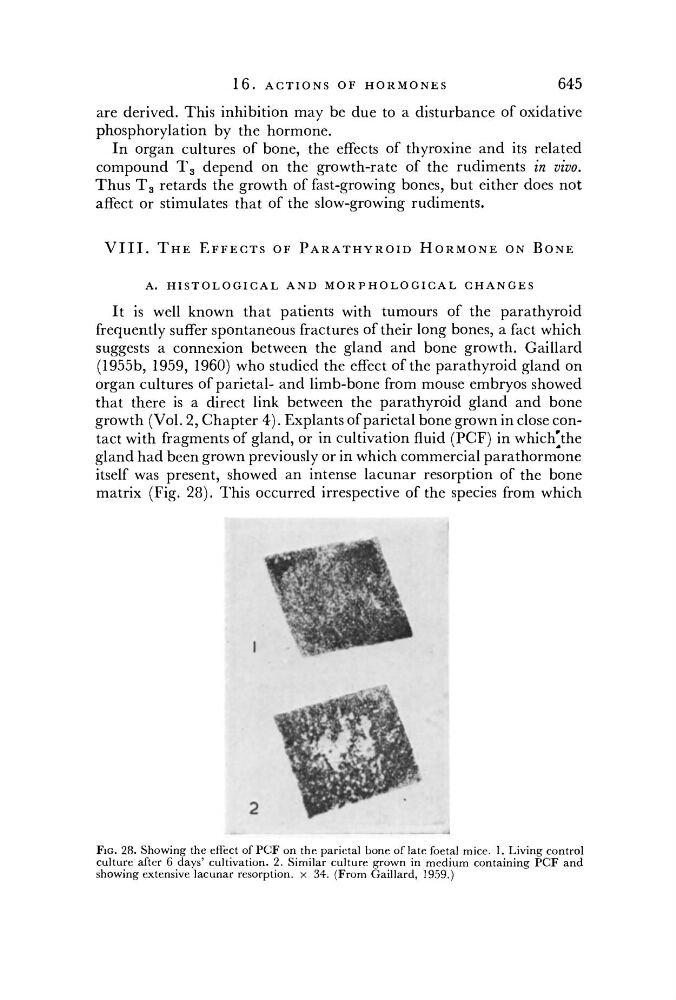
growth (Vol. 2, Chapter 4). Explants of parietal bone grown in close contact with fragments of gland, or in cultivation fluid (PCF) in which'the
gland had been grown previously or in which commercial parathormone
itself was present, showed an intense lacunar resorption of the bone
matrix (Fig. 28). This occurred irrespective of the species from which
2
FIG. 28. Showing the effect of PCF on the parietal bone of late foetal mice. 1. Living control
culture after 6 days' cultivation. 2. Similar culture grown in medium containing PCF and
showing extensive lacunar resorption, x 34. (From Gaillard, 1959.)
D