

15. EMBRYOGENESIS in
VltTO
581
the Fl hybrids of this cross have pigmented eyes and agouti fur,
characteristics which are not present in young LAB Grey.
Autopsies were made at different stages of gestation: they showed
that embryos resulting from the fusion of two eggs are not bigger than
normal. Ten young were born, eight embryos were removed alive on
the day before the last day of gestation; two of the eighteen were still
alive at the time of publication; they were 2 and 5 weeks old respectively. All followed normal development and looked normal except
for the anomalies which we shall discuss later. O f fourteen young on
which autopsies were done and which were examined microscopically,
there were two females, nine males, and three animals presenting
various degrees of intersexuality. It is possible that some of the males
had more subtle symptoms of heterosexuality, and that, because of
the dominance of male hormones in Mammalia, the females might
have been more or less completely transformed.
But, in the three cases of intersexuality, dominance was certainly
incomplete. One of the cases reported by the author presents a real
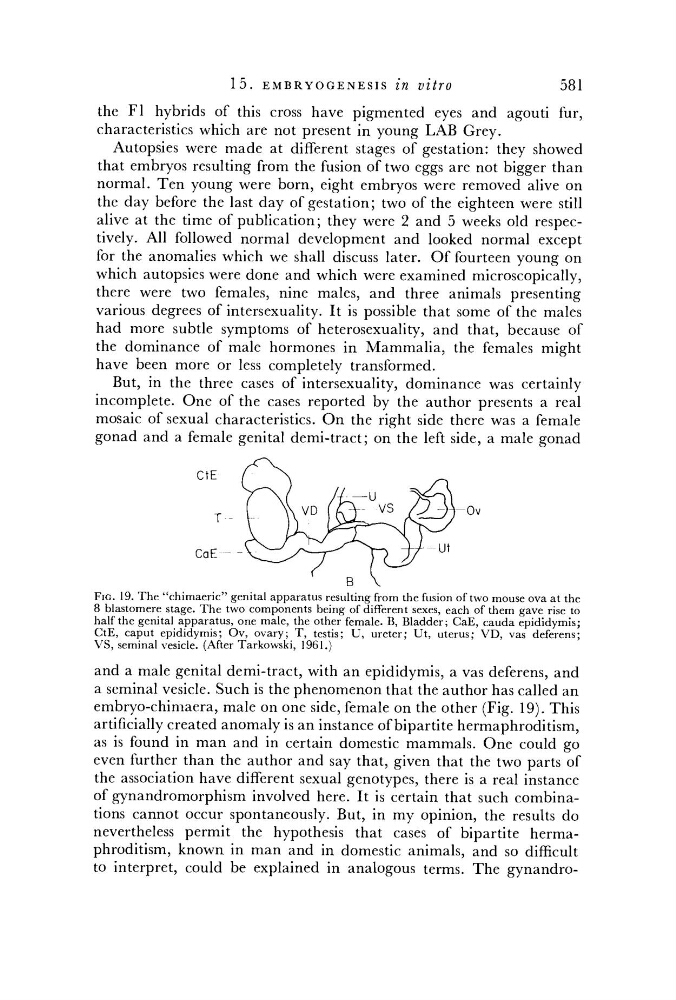
mosaic of sexual characteristics. On the right side there was a female
gonad and a female genital demi-tract; on the left side, a male gonad
FIG. 19. The "chimaeric" genital apparatus resulting from the fusion of two mouse ova at the
8 blastomere stage. The two components being of different sexes, each of them gave rise to
half the genital apparatus, one male, the other female. B, Bladder; CaE, cauda epididymis;
CtE, caput epididymis; Ov, ovary; T, testis; U, ureter; Ut, uterus; V D , vas deferens;
VS, seminal vesicle. (After Tarkowski, 1961.)
and a male genital demi-tract, with an epididymis, a vas deferens, and
a seminal vesicle. Such is the phenomenon that the author has called an
embryo-chimaera, male on one side, female on the other (Fig. 19). This
artificially created anomaly is an instance of bipartite hermaphroditism,
as is found in man and in certain domestic mammals. One could go
even further than the author and say that, given that the two parts of
the association have different sexual genotypes, there is a real instance
of gynandromorphism involved here. It is certain that such combinations cannot occur spontaneously. But, in my opinion, the results do
nevertheless permit the hypothesis that cases of bipartite hermaphroditism, known in man and in domestic animals, and so difficult
to interpret, could be explained in analogous terms. The gynandroCaE
CtEOv
VltTO
581
the Fl hybrids of this cross have pigmented eyes and agouti fur,
characteristics which are not present in young LAB Grey.
Autopsies were made at different stages of gestation: they showed
that embryos resulting from the fusion of two eggs are not bigger than
normal. Ten young were born, eight embryos were removed alive on
the day before the last day of gestation; two of the eighteen were still
alive at the time of publication; they were 2 and 5 weeks old respectively. All followed normal development and looked normal except
for the anomalies which we shall discuss later. O f fourteen young on
which autopsies were done and which were examined microscopically,
there were two females, nine males, and three animals presenting
various degrees of intersexuality. It is possible that some of the males
had more subtle symptoms of heterosexuality, and that, because of
the dominance of male hormones in Mammalia, the females might
have been more or less completely transformed.
But, in the three cases of intersexuality, dominance was certainly
incomplete. One of the cases reported by the author presents a real
mosaic of sexual characteristics. On the right side there was a female
gonad and a female genital demi-tract; on the left side, a male gonad
FIG. 19. The "chimaeric" genital apparatus resulting from the fusion of two mouse ova at the
8 blastomere stage. The two components being of different sexes, each of them gave rise to
half the genital apparatus, one male, the other female. B, Bladder; CaE, cauda epididymis;
CtE, caput epididymis; Ov, ovary; T, testis; U, ureter; Ut, uterus; V D , vas deferens;
VS, seminal vesicle. (After Tarkowski, 1961.)
and a male genital demi-tract, with an epididymis, a vas deferens, and
a seminal vesicle. Such is the phenomenon that the author has called an
embryo-chimaera, male on one side, female on the other (Fig. 19). This
artificially created anomaly is an instance of bipartite hermaphroditism,
as is found in man and in certain domestic mammals. One could go
even further than the author and say that, given that the two parts of
the association have different sexual genotypes, there is a real instance
of gynandromorphism involved here. It is certain that such combinations cannot occur spontaneously. But, in my opinion, the results do
nevertheless permit the hypothesis that cases of bipartite hermaphroditism, known in man and in domestic animals, and so difficult
to interpret, could be explained in analogous terms. The gynandroCaE
CtEOv