

15. E M B R Y O G E N E S I S in vitro
563
terior region of the blastoderm. In all cases, the posterior region gave
rise to a greater proportion of embryonic developments than either the
anterior or the median regions. This is shown in Fig. 16. It is interesting
to note that isolated fragments of blastoderm are capable of forming
normal embryos, whilst whole blastoderms whose morphogenetic
movements are inhibited by a local obstacle are no longer capable of
forming embryos. This is due to the fact that isolated pieces re-constitute
a coherent system of morphogenetic movements as soon as they are
liberated from the constraint exercised by their neighbouring parts.
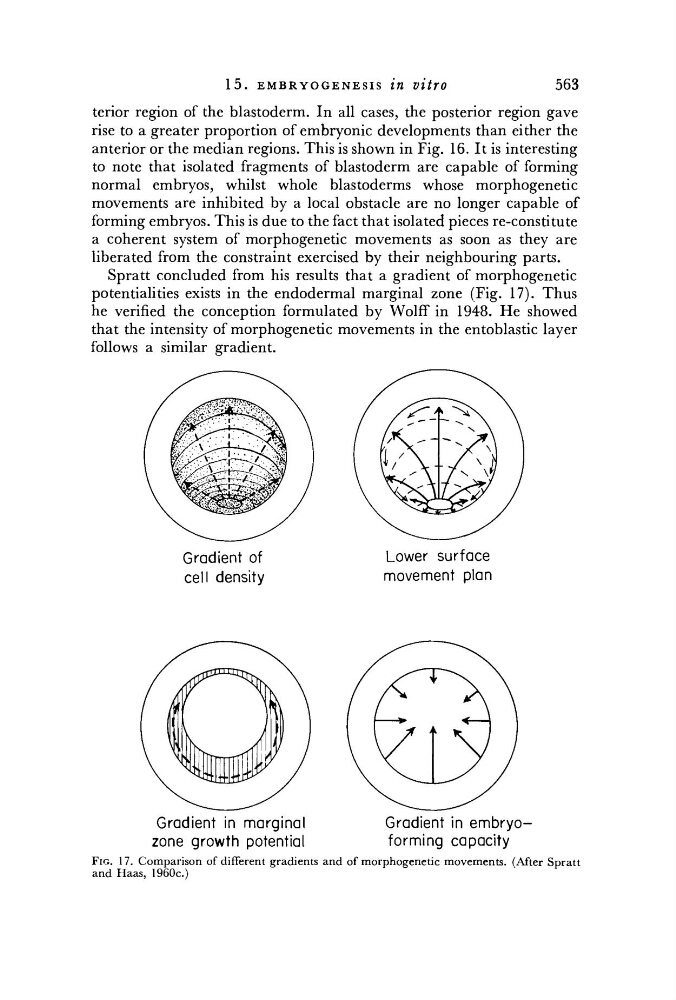
Spratt concluded from his results that a gradient of morphogenetic
potentialities exists in the endodermal marginal zone (Fig. 17). Thus
he verified the conception formulated by Wolff in 1948. He showed
that the intensity of morphogenetic movements in the entoblastic layer
follows a similar gradient.
Gradient of
Lower surface
cell density
movement plan
Gradient in marginal
Gradient in embryozone growth potential
forming capacity
FIG. 17. Comparison of different gradients and of morphogenetic movements. (After Spratt
and Haas, 1960c.)
563
terior region of the blastoderm. In all cases, the posterior region gave
rise to a greater proportion of embryonic developments than either the
anterior or the median regions. This is shown in Fig. 16. It is interesting
to note that isolated fragments of blastoderm are capable of forming
normal embryos, whilst whole blastoderms whose morphogenetic
movements are inhibited by a local obstacle are no longer capable of
forming embryos. This is due to the fact that isolated pieces re-constitute
a coherent system of morphogenetic movements as soon as they are
liberated from the constraint exercised by their neighbouring parts.
Spratt concluded from his results that a gradient of morphogenetic
potentialities exists in the endodermal marginal zone (Fig. 17). Thus
he verified the conception formulated by Wolff in 1948. He showed
that the intensity of morphogenetic movements in the entoblastic layer
follows a similar gradient.
Gradient of
Lower surface
cell density
movement plan
Gradient in marginal
Gradient in embryozone growth potential
forming capacity
FIG. 17. Comparison of different gradients and of morphogenetic movements. (After Spratt
and Haas, 1960c.)