

548
E T I E N N E
W O L F F
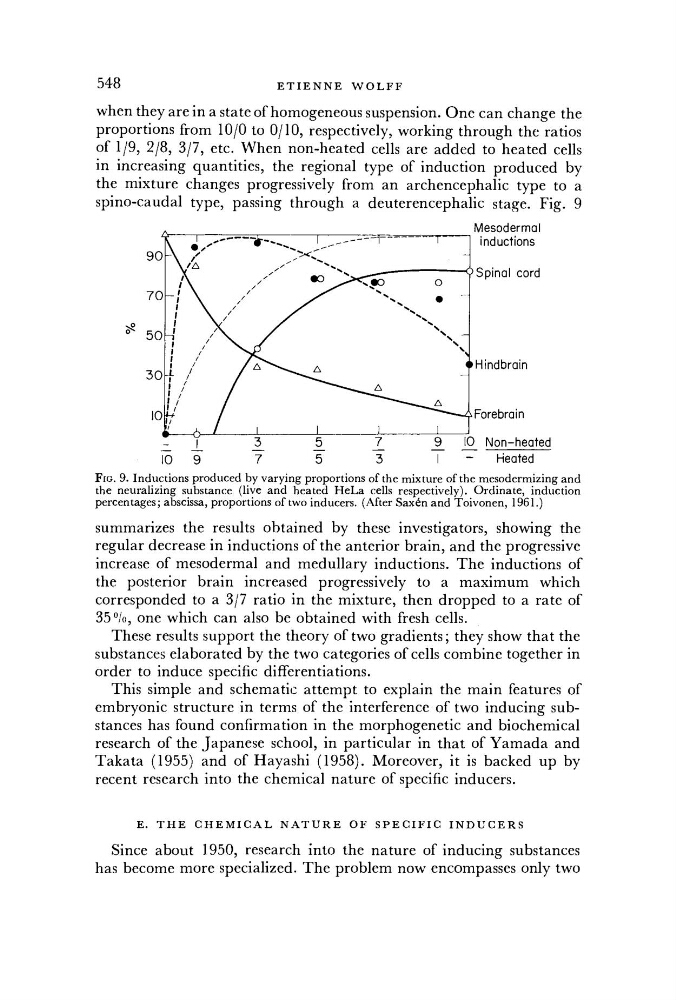
when they are in a state of homogeneous suspension. One can change the
proportions from 10/0 to 0/10, respectively, working through the ratios
of 1/9, 2/8, 3/7, etc. When non-heated cells are added to heated cells
in increasing quantities, the regional type of induction produced by
the mixture changes progressively from an archencephalic type to a
spino-caudal type, passing through a deuterencephalic stage. Fig. 9
-_ _[_
3_
5_
7_
9_
10 Non-heated
10
9
7
5
3
I
Heated
FIG. 9. Inductions produced by varying proportions of the mixture of the mesodermizing and
the neuralizing substance (live and heated HeLa cells respectively). Ordinate, induction
percentages; abscissa, proportions of two inducers. (After Saxen and Toivonen, 1961.)
summarizes the results obtained by these investigators, showing the
regular decrease in inductions of the anterior brain, and the progressive
increase of mesodermal and medullary inductions. The inductions of
the posterior brain increased progressively to a maximum which
corresponded to a 3/7 ratio in the mixture, then dropped to a rate of
35°/o, one which can also be obtained with fresh cells.
These results support the theory of two gradients; they show that the
substances elaborated by the two categories of cells combine together in
order to induce specific differentiations.
This simple and schematic attempt to explain the main features of
embryonic structure in terms of the interference of two inducing substances has found confirmation in the morphogenetic and biochemical
research of the Japanese school, in particular in that of Yamada and
Takata (1955) and of Hayashi (1958). Moreover, it is backed up by
recent research into the chemical nature of specific inducers.
E . T H E
C H E M I C A L
N A T U R E O F S P E C I F I C
I N D U C E R S
Since about 1950, research into the nature of inducing substances
has become more specialized. The problem now encompasses only two
E T I E N N E
W O L F F
when they are in a state of homogeneous suspension. One can change the
proportions from 10/0 to 0/10, respectively, working through the ratios
of 1/9, 2/8, 3/7, etc. When non-heated cells are added to heated cells
in increasing quantities, the regional type of induction produced by
the mixture changes progressively from an archencephalic type to a
spino-caudal type, passing through a deuterencephalic stage. Fig. 9
-_ _[_
3_
5_
7_
9_
10 Non-heated
10
9
7
5
3
I
Heated
FIG. 9. Inductions produced by varying proportions of the mixture of the mesodermizing and
the neuralizing substance (live and heated HeLa cells respectively). Ordinate, induction
percentages; abscissa, proportions of two inducers. (After Saxen and Toivonen, 1961.)
summarizes the results obtained by these investigators, showing the
regular decrease in inductions of the anterior brain, and the progressive
increase of mesodermal and medullary inductions. The inductions of
the posterior brain increased progressively to a maximum which
corresponded to a 3/7 ratio in the mixture, then dropped to a rate of
35°/o, one which can also be obtained with fresh cells.
These results support the theory of two gradients; they show that the
substances elaborated by the two categories of cells combine together in
order to induce specific differentiations.
This simple and schematic attempt to explain the main features of
embryonic structure in terms of the interference of two inducing substances has found confirmation in the morphogenetic and biochemical
research of the Japanese school, in particular in that of Yamada and
Takata (1955) and of Hayashi (1958). Moreover, it is backed up by
recent research into the chemical nature of specific inducers.
E . T H E
C H E M I C A L
N A T U R E O F S P E C I F I C
I N D U C E R S
Since about 1950, research into the nature of inducing substances
has become more specialized. The problem now encompasses only two