

14. C E L L A G G R E G A T E S
499
Steinberg, 1962). The aggregation-inhibiting effect of suboptimal temperatures can be amplified by higher rotation frequencies. It is also
enhanced when the dissociated cells are washed by centrifugation before
dispersion in the cold culture medium. The culture medium used in
testing the effects of temperature on aggregation contains Eagle's basal
medium, serum, and embryo extract and is thus provided with physiologically adequate amounts of calcium and magnesium ("standard
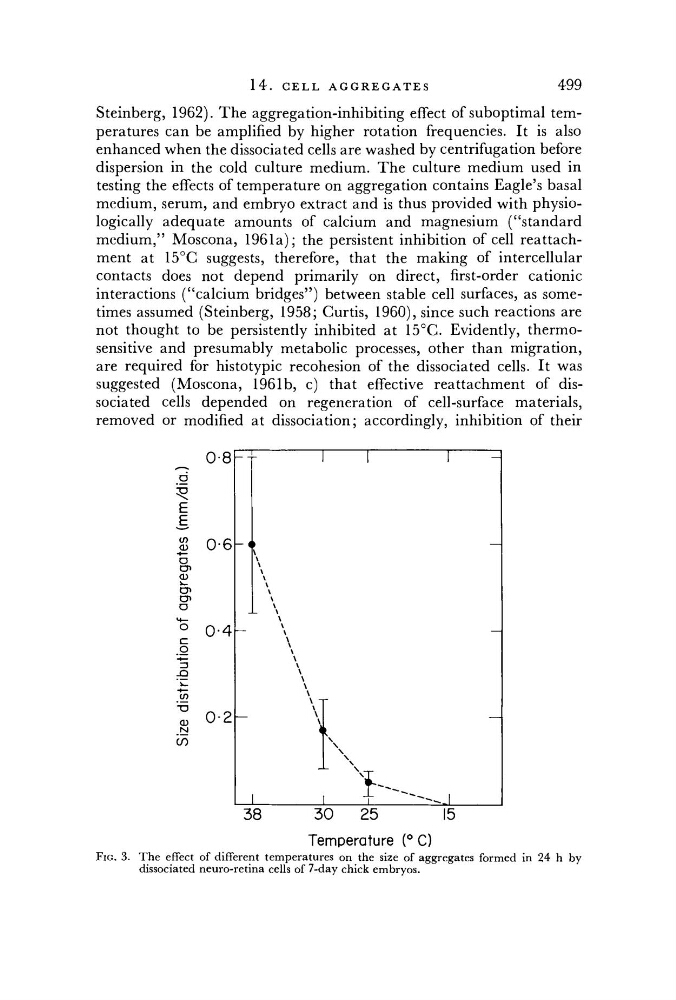
medium," Moscona, 1961a); the persistent inhibition of cell reattachment at 15°C suggests, therefore, that the making of intercellular
contacts does not depend primarily on direct, first-order cationic
interactions ("calcium bridges") between stable cell surfaces, as sometimes assumed (Steinberg, 1958; Curtis, 1960), since such reactions are
not thought to be persistently inhibited at 15°C. Evidently, thermosensitive and presumably metabolic processes, other than migration,
are required for histotypic recohesion of the dissociated cells. It was
suggested (Moscona, 1961b, c) that effective reattachment of dissociated cells depended on regeneration of cell-surface materials,
removed or modified at dissociation; accordingly, inhibition of their
a
E
E
CO
a
CP
CD
^_
CP
CP
D
c
o
to
CD
M
CO
0 - 8
0 - 6 h
0 - 4 h
0 - 2
3 0
2 5
Temperature (° C)
FIG. 3. The effect of different temperatures on the size of aggregates formed in 24 h by
dissociated neuro-retina cells of 7-day chick embryos.
499
Steinberg, 1962). The aggregation-inhibiting effect of suboptimal temperatures can be amplified by higher rotation frequencies. It is also
enhanced when the dissociated cells are washed by centrifugation before
dispersion in the cold culture medium. The culture medium used in
testing the effects of temperature on aggregation contains Eagle's basal
medium, serum, and embryo extract and is thus provided with physiologically adequate amounts of calcium and magnesium ("standard
medium," Moscona, 1961a); the persistent inhibition of cell reattachment at 15°C suggests, therefore, that the making of intercellular
contacts does not depend primarily on direct, first-order cationic
interactions ("calcium bridges") between stable cell surfaces, as sometimes assumed (Steinberg, 1958; Curtis, 1960), since such reactions are
not thought to be persistently inhibited at 15°C. Evidently, thermosensitive and presumably metabolic processes, other than migration,
are required for histotypic recohesion of the dissociated cells. It was
suggested (Moscona, 1961b, c) that effective reattachment of dissociated cells depended on regeneration of cell-surface materials,
removed or modified at dissociation; accordingly, inhibition of their
a
E
E
CO
a
CP
CD
^_
CP
CP
D
c
o
to
CD
M
CO
0 - 8
0 - 6 h
0 - 4 h
0 - 2
3 0
2 5
Temperature (° C)
FIG. 3. The effect of different temperatures on the size of aggregates formed in 24 h by
dissociated neuro-retina cells of 7-day chick embryos.