

430
T . G. HSU
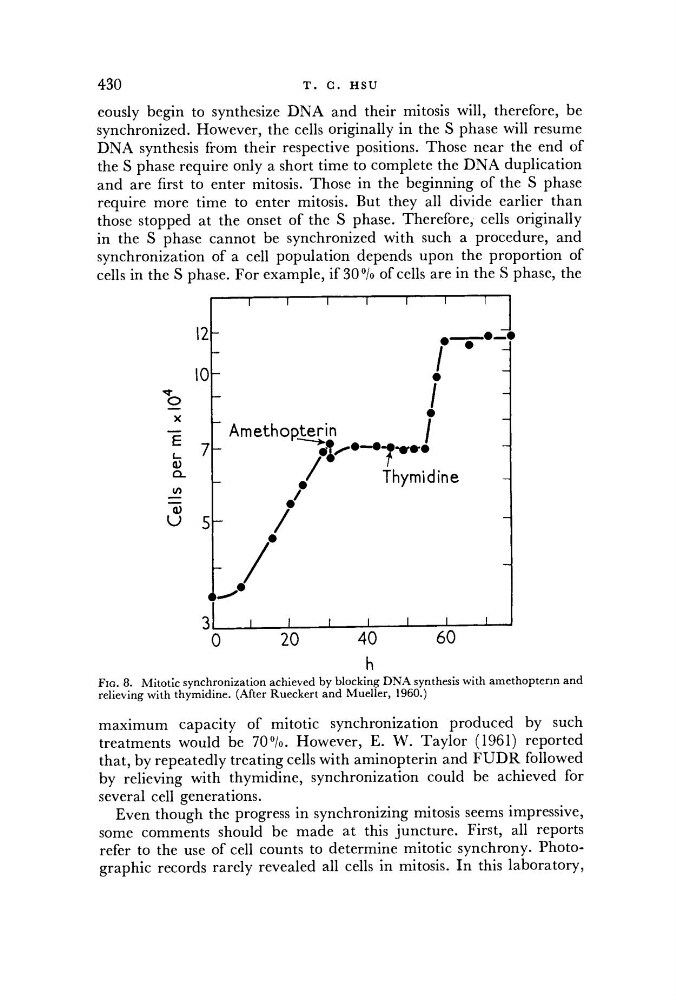
eously begin to synthesize D N A and their mitosis will, therefore, be
synchronized. However, the cells originally in the S phase will resume
DNA synthesis from their respective positions. Those near the end of
the S phase require only a short time to complete the D N A duplication
and are first to enter mitosis. Those in the beginning of the S phase
require more time to enter mitosis. But they all divide earlier than
those stopped at the onset of the S phase. Therefore, cells originally
in the S phase cannot be synchronized with such a procedure, and
synchronization of a cell population depends upon the proportion of
cells in the S phase. For example, if 30 °/o of cells are in the S phase, the
O
x
CL
I2h
10'
7
A m e t h o p t e r i n
7
I
Thymidine
/
0
20
40
60
FIG. 8. Mitotic synchronization achieved by blocking D N A synthesis with amethopterin and
relieving with thymidine. (After Rueckert and Mueller, 1960.)
maximum capacity of mitotic synchronization produced by such
treatments would be 70%. However, E. W . Taylor (1961) reported
that, by repeatedly treating cells with aminopterin and F U D R followed
by relieving with thymidine, synchronization could be achieved for
several cell generations.
Even though the progress in synchronizing mitosis seems impressive,
some comments should be made at this juncture. First, all reports
refer to the use of cell counts to determine mitotic synchrony. Photographic records rarely revealed all cells in mitosis. In this laboratory,
T . G. HSU
eously begin to synthesize D N A and their mitosis will, therefore, be
synchronized. However, the cells originally in the S phase will resume
DNA synthesis from their respective positions. Those near the end of
the S phase require only a short time to complete the D N A duplication
and are first to enter mitosis. Those in the beginning of the S phase
require more time to enter mitosis. But they all divide earlier than
those stopped at the onset of the S phase. Therefore, cells originally
in the S phase cannot be synchronized with such a procedure, and
synchronization of a cell population depends upon the proportion of
cells in the S phase. For example, if 30 °/o of cells are in the S phase, the
O
x
CL
I2h
10'
7
A m e t h o p t e r i n
7
I
Thymidine
/
0
20
40
60
FIG. 8. Mitotic synchronization achieved by blocking D N A synthesis with amethopterin and
relieving with thymidine. (After Rueckert and Mueller, 1960.)
maximum capacity of mitotic synchronization produced by such
treatments would be 70%. However, E. W . Taylor (1961) reported
that, by repeatedly treating cells with aminopterin and F U D R followed
by relieving with thymidine, synchronization could be achieved for
several cell generations.
Even though the progress in synchronizing mitosis seems impressive,
some comments should be made at this juncture. First, all reports
refer to the use of cell counts to determine mitotic synchrony. Photographic records rarely revealed all cells in mitosis. In this laboratory,