

4 2 6
T . G. HSU
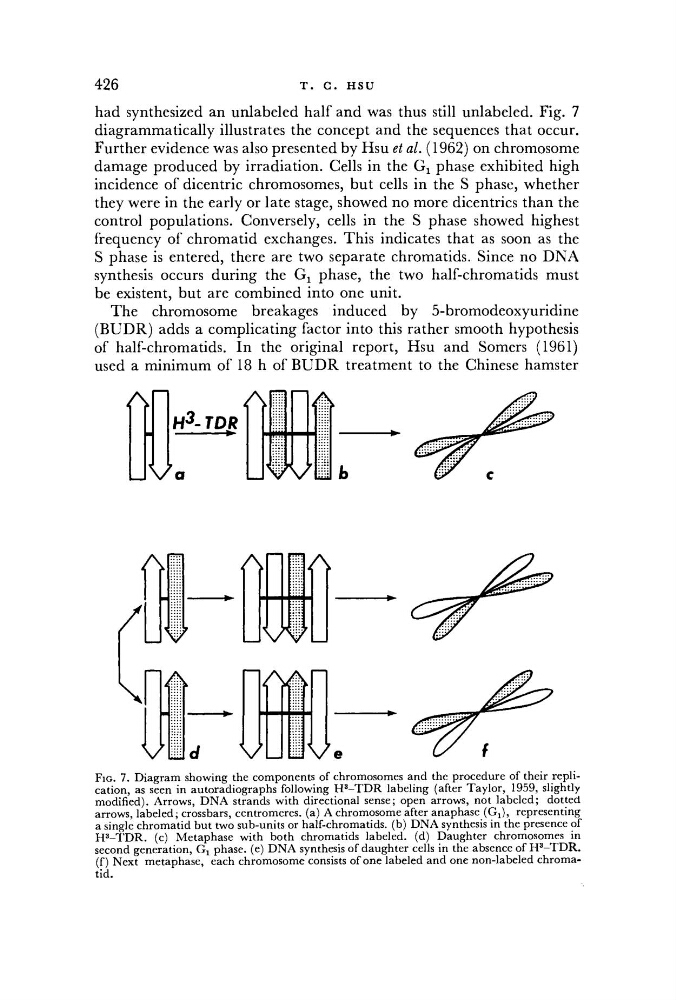
had synthesized an unlabeled half and was thus still unlabeled. Fig. 7
diagrammatically illustrates the concept and the sequences that occur.
Further evidence was also presented by Hsu et al. (1962) on chromosome
damage produced by irradiation. Cells in the G 1 phase exhibited high
incidence of dicentric chromosomes, but cells in the S phase, whether
they were in the early or late stage, showed no more dicentrics than the
control populations. Conversely, cells in the S phase showed highest
frequency of chromatid exchanges. This indicates that as soon as the
S phase is entered, there are two separate chromatids. Since no D N A
synthesis occurs during the G x phase, the two half-chromatids must
be existent, but are combined into one unit.
The chromosome breakages induced by 5-bromodeoxyuridine
(BUDR) adds a complicating factor into this rather smooth hypothesis
of half-chromatids. In the original report, Hsu and Somers (1961)
used a minimum of 18 h of B U D R treatment to the Chinese hamster
FIG. 7. Diagram showing the components of chromosomes and the procedure of their replication, as seen in autoradiographs following H
3
- T D R labeling (after Taylor, 1959, slightly
modified). Arrows, D N A strands with directional sense; open arrows, not labeled; dotted
arrows, labeled; crossbars, centromeres, (a) A chromosome after anaphase (G x ), representing
a single chromatid but two sub-units or half-chromatids. (b) DNA synthesis in the presence of
H
3
- T D R . (c) Metaphase with both chromatids labeled, (d) Daughter chromosomes in
second generation, G x phase, (e) DNA synthesis of daughter cells in the absence of H
3
- T D R .
(f) Next metaphase, each chromosome consists of one labeled and one non-labeled chromatid.
T . G. HSU
had synthesized an unlabeled half and was thus still unlabeled. Fig. 7
diagrammatically illustrates the concept and the sequences that occur.
Further evidence was also presented by Hsu et al. (1962) on chromosome
damage produced by irradiation. Cells in the G 1 phase exhibited high
incidence of dicentric chromosomes, but cells in the S phase, whether
they were in the early or late stage, showed no more dicentrics than the
control populations. Conversely, cells in the S phase showed highest
frequency of chromatid exchanges. This indicates that as soon as the
S phase is entered, there are two separate chromatids. Since no D N A
synthesis occurs during the G x phase, the two half-chromatids must
be existent, but are combined into one unit.
The chromosome breakages induced by 5-bromodeoxyuridine
(BUDR) adds a complicating factor into this rather smooth hypothesis
of half-chromatids. In the original report, Hsu and Somers (1961)
used a minimum of 18 h of B U D R treatment to the Chinese hamster
FIG. 7. Diagram showing the components of chromosomes and the procedure of their replication, as seen in autoradiographs following H
3
- T D R labeling (after Taylor, 1959, slightly
modified). Arrows, D N A strands with directional sense; open arrows, not labeled; dotted
arrows, labeled; crossbars, centromeres, (a) A chromosome after anaphase (G x ), representing
a single chromatid but two sub-units or half-chromatids. (b) DNA synthesis in the presence of
H
3
- T D R . (c) Metaphase with both chromatids labeled, (d) Daughter chromosomes in
second generation, G x phase, (e) DNA synthesis of daughter cells in the absence of H
3
- T D R .
(f) Next metaphase, each chromosome consists of one labeled and one non-labeled chromatid.