

12. G E N E T I C C Y T O L O G Y
423
dying (or, rather, dead) concept. Cytological data are strong enough
to show that cells synthesizing new chromosomes (or D N A ) do not
necessarily divide. Levan and Hauschka (1953) found the process of
endoreduplication characteristic for a mouse tumor. These cells may
replicate their entire chromosome complement one or more times and
become polyploids, yet they may or may not enter mitosis. If they
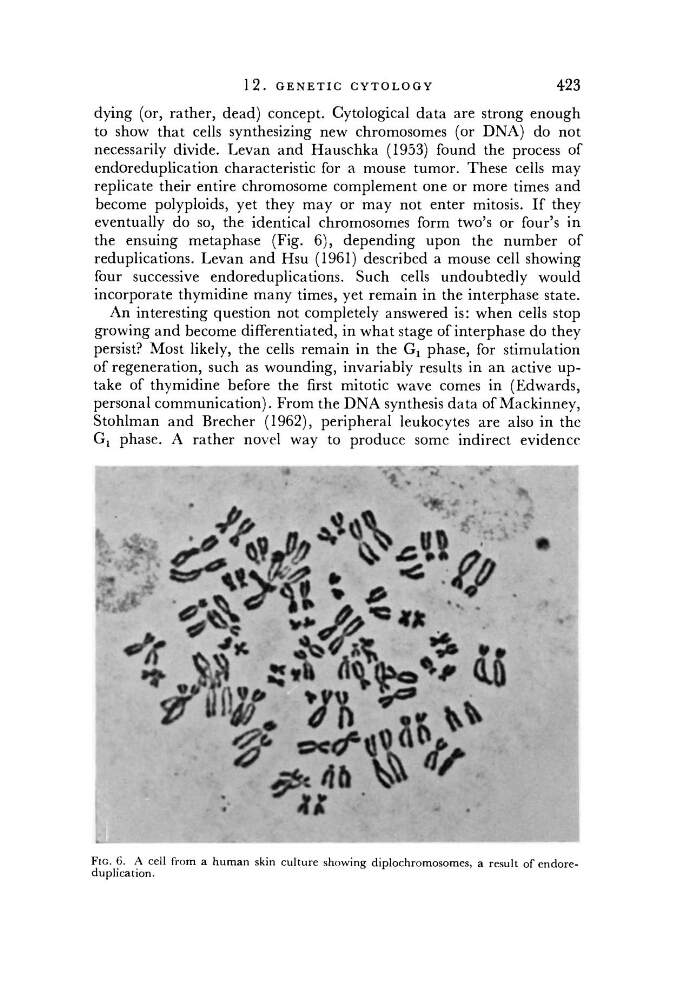
eventually do so, the identical chromosomes form two's or four's in
the ensuing metaphase (Fig. 6), depending upon the number of
reduplications. Levan and Hsu (1961) described a mouse cell showing
four successive endoreduplications. Such cells undoubtedly would
incorporate thymidine many times, yet remain in the interphase state.
An interesting question not completely answered is: when cells stop
growing and become differentiated, in what stage of interphase do they
persist? Most likely, the cells remain in the G x phase, for stimulation
of regeneration, such as wounding, invariably results in an active uptake of thymidine before the first mitotic wave comes in (Edwards,
personal communication). From the D N A synthesis data of Mackinney,
Stohlman and Brecher (1962), peripheral leukocytes are also in the
G x phase. A rather novel way to produce some indirect evidence
FIG. 6. A cell from a human skin culture showing diplochromosomes, a result of endoreduplication.
423
dying (or, rather, dead) concept. Cytological data are strong enough
to show that cells synthesizing new chromosomes (or D N A ) do not
necessarily divide. Levan and Hauschka (1953) found the process of
endoreduplication characteristic for a mouse tumor. These cells may
replicate their entire chromosome complement one or more times and
become polyploids, yet they may or may not enter mitosis. If they
eventually do so, the identical chromosomes form two's or four's in
the ensuing metaphase (Fig. 6), depending upon the number of
reduplications. Levan and Hsu (1961) described a mouse cell showing
four successive endoreduplications. Such cells undoubtedly would
incorporate thymidine many times, yet remain in the interphase state.
An interesting question not completely answered is: when cells stop
growing and become differentiated, in what stage of interphase do they
persist? Most likely, the cells remain in the G x phase, for stimulation
of regeneration, such as wounding, invariably results in an active uptake of thymidine before the first mitotic wave comes in (Edwards,
personal communication). From the D N A synthesis data of Mackinney,
Stohlman and Brecher (1962), peripheral leukocytes are also in the
G x phase. A rather novel way to produce some indirect evidence
FIG. 6. A cell from a human skin culture showing diplochromosomes, a result of endoreduplication.