

412
T .
G .
H S U
l 4 o r ) W r 2 l
5
6
w
a
i f
b
c
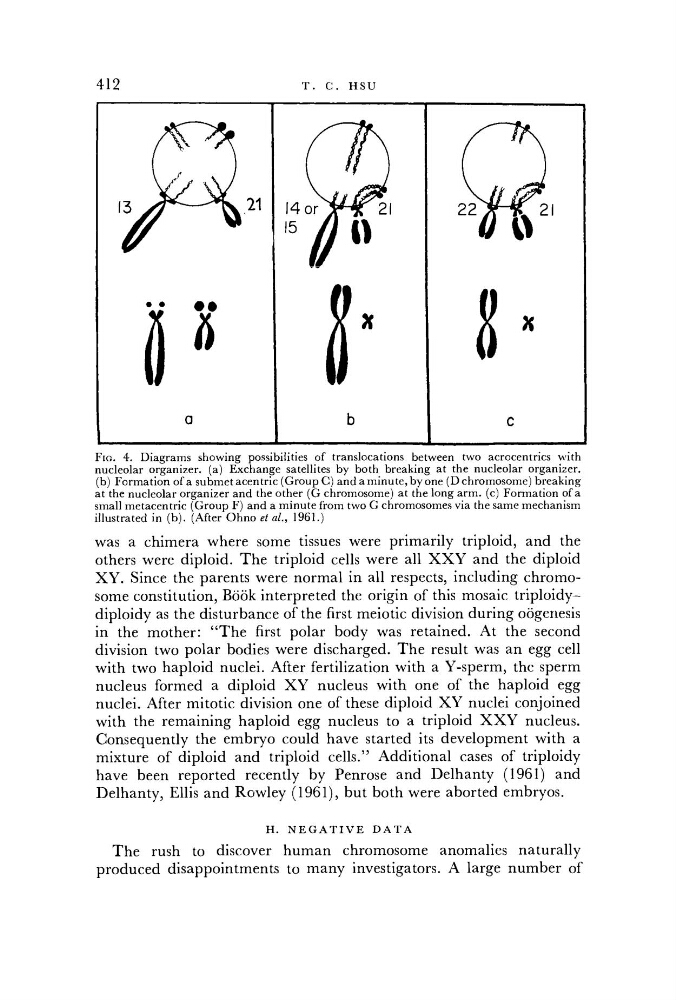
FIG. 4. Diagrams showing possibilities of translocations between two acrocentrics with
nucleolar organizer, (a) Exchange satellites by both breaking at the nucleolar organizer,
(b) Formation of a submet acentric (Group C) and a minute, by one (D chromosome) breaking
at the nucleolar organizer and the other (G chromosome) at the long arm. (c) Formation of a
small metacentric (Group F) and a minute from two G chromosomes via the same mechanism
illustrated in (b). (After Ohno et al., 1961.)
was a chimera where some tissues were primarily triploid, and the
others were diploid. The triploid cells were all X X Y and the diploid
X Y . Since the parents were normal in all respects, including chromosome constitution, Book interpreted the origin of this mosaic triploidydiploidy as the disturbance of the first meiotic division during oogenesis
in the mother: "The first polar body was retained. At the second
division two polar bodies were discharged. The result was an egg cell
with two haploid nuclei. After fertilization with a Y-sperm, the sperm
nucleus formed a diploid X Y nucleus with one of the haploid egg
nuclei. After mitotic division one of these diploid X Y nuclei conjoined
with the remaining haploid egg nucleus to a triploid X X Y nucleus.
Consequently the embryo could have started its development with a
mixture of diploid and triploid cells." Additional cases of triploidy
have been reported recently by Penrose and Delhanty (1961) and
Delhanty, Ellis and Rowley (1961), but both were aborted embryos.
H . N E G A T I V E
D A T A
The rush to discover human chromosome anomalies naturally
produced disappointments to many investigators. A large number of
T .
G .
H S U
l 4 o r ) W r 2 l
5
6
w
a
i f
b
c
FIG. 4. Diagrams showing possibilities of translocations between two acrocentrics with
nucleolar organizer, (a) Exchange satellites by both breaking at the nucleolar organizer,
(b) Formation of a submet acentric (Group C) and a minute, by one (D chromosome) breaking
at the nucleolar organizer and the other (G chromosome) at the long arm. (c) Formation of a
small metacentric (Group F) and a minute from two G chromosomes via the same mechanism
illustrated in (b). (After Ohno et al., 1961.)
was a chimera where some tissues were primarily triploid, and the
others were diploid. The triploid cells were all X X Y and the diploid
X Y . Since the parents were normal in all respects, including chromosome constitution, Book interpreted the origin of this mosaic triploidydiploidy as the disturbance of the first meiotic division during oogenesis
in the mother: "The first polar body was retained. At the second
division two polar bodies were discharged. The result was an egg cell
with two haploid nuclei. After fertilization with a Y-sperm, the sperm
nucleus formed a diploid X Y nucleus with one of the haploid egg
nuclei. After mitotic division one of these diploid X Y nuclei conjoined
with the remaining haploid egg nucleus to a triploid X X Y nucleus.
Consequently the embryo could have started its development with a
mixture of diploid and triploid cells." Additional cases of triploidy
have been reported recently by Penrose and Delhanty (1961) and
Delhanty, Ellis and Rowley (1961), but both were aborted embryos.
H . N E G A T I V E
D A T A
The rush to discover human chromosome anomalies naturally
produced disappointments to many investigators. A large number of