

1 2 . G E N E T I C C Y T O L O G Y
405
A
B
(2 22 \\ i i n
c
. a .
• 11 u a; » i i it a
•12
D
ti i* #* « i i a
13
15
16
17
18
F
G
/
*
\
,
A
N
I t
I X
4 4
* »
4
19
2 0
21
2 2
Y
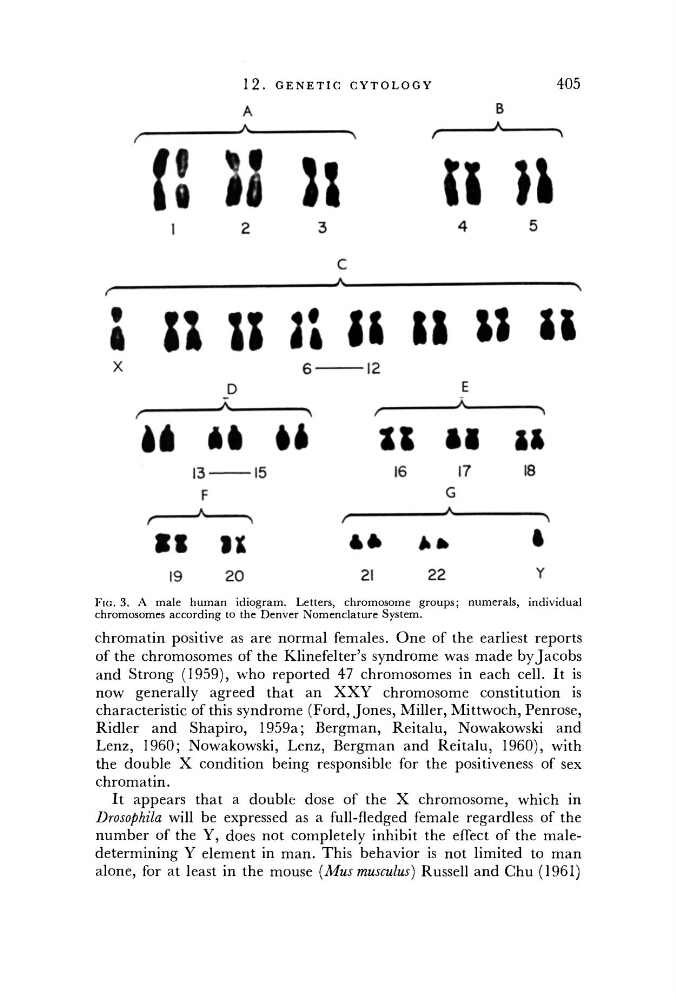
FIG. 3. A male human idiogram. Letters, chromosome groups; numerals, individual
chromosomes according to the Denver Nomenclature System.
chromatin positive as are normal females. One of the earliest reports
of the chromosomes of the Klinefelter's syndrome was made by Jacobs
and Strong (1959), who reported 47 chromosomes in each cell. It is
now generally agreed that an X X Y chromosome constitution is
characteristic of this syndrome (Ford, Jones, Miller, Mittwoch, Penrose,
Ridler and Shapiro, 1959a; Bergman, Reitalu, Nowakowski and
Lenz, 1960; Nowakowski, Lenz, Bergman and Reitalu, 1960), with
the double X condition being responsible for the positiveness of sex
chromatin.
It appears that a double dose of the X chromosome, which in
Drosophila will be expressed as a full-fledged female regardless of the
number of the Y , does not completely inhibit the effect of the maledetermining Y element in man. This behavior is not limited to man
alone, for at least in the mouse (Mus musculus) Russell and Chu (1961)
1
2
3
4
5
X
6 -
E
405
A
B
(2 22 \\ i i n
c
. a .
• 11 u a; » i i it a
•12
D
ti i* #* « i i a
13
15
16
17
18
F
G
/
*
\
,
A
N
I t
I X
4 4
* »
4
19
2 0
21
2 2
Y
FIG. 3. A male human idiogram. Letters, chromosome groups; numerals, individual
chromosomes according to the Denver Nomenclature System.
chromatin positive as are normal females. One of the earliest reports
of the chromosomes of the Klinefelter's syndrome was made by Jacobs
and Strong (1959), who reported 47 chromosomes in each cell. It is
now generally agreed that an X X Y chromosome constitution is
characteristic of this syndrome (Ford, Jones, Miller, Mittwoch, Penrose,
Ridler and Shapiro, 1959a; Bergman, Reitalu, Nowakowski and
Lenz, 1960; Nowakowski, Lenz, Bergman and Reitalu, 1960), with
the double X condition being responsible for the positiveness of sex
chromatin.
It appears that a double dose of the X chromosome, which in
Drosophila will be expressed as a full-fledged female regardless of the
number of the Y , does not completely inhibit the effect of the maledetermining Y element in man. This behavior is not limited to man
alone, for at least in the mouse (Mus musculus) Russell and Chu (1961)
1
2
3
4
5
X
6 -
E