

30
A . M O S C O N A , O . A . T R O W E L L A N D E . N . W l L L M E R
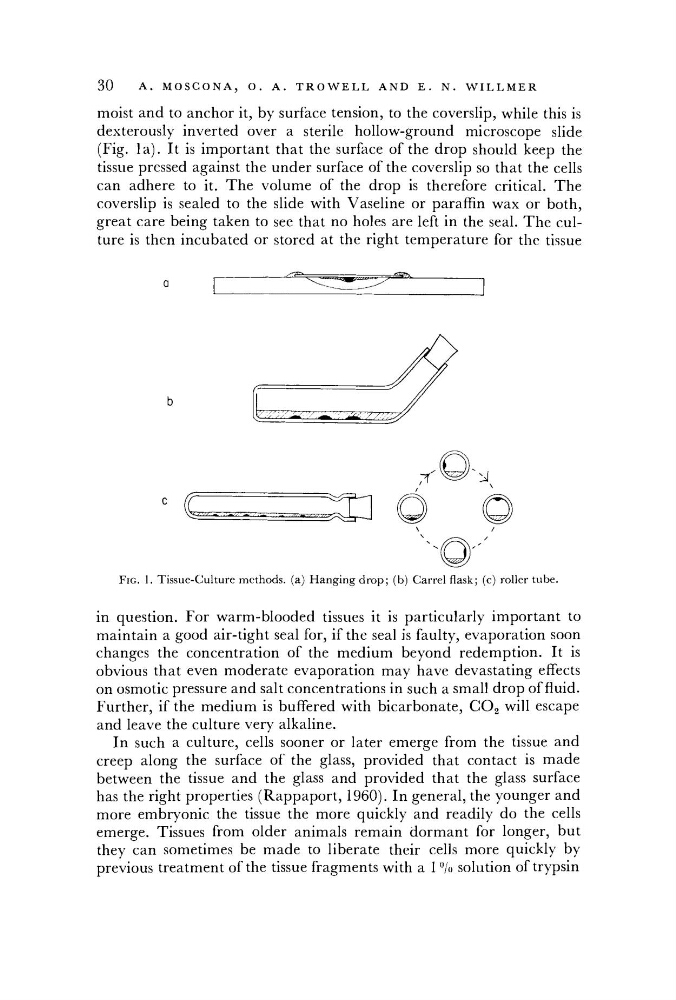
FIG. 1. Tissue-Culture methods, (a) Hanging drop; (b) Carrel flask; (c) roller tube.
in question. For warm-blooded tissues it is particularly important to
maintain a good air-tight seal for, if the seal is faulty, evaporation soon
changes the concentration of the medium beyond redemption. It is
obvious that even moderate evaporation may have devastating effects
on osmotic pressure and salt concentrations in such a small drop of fluid.
Further, if the medium is buffered with bicarbonate, C 0 2 will escape
and leave the culture very alkaline.
In such a culture, cells sooner or later emerge from the tissue and
creep along the surface of the glass, provided that contact is made
between the tissue and the glass and provided that the glass surface
has the right properties (Rappaport, 1960). In general, the younger and
more embryonic the tissue the more quickly and readily do the cells
emerge. Tissues from older animals remain dormant for longer, but
they can sometimes be made to liberate their cells more quickly by
previous treatment of the tissue fragments with a 1 % solution of trypsin
b
c
a
moist and to anchor it, by surface tension, to the coverslip, while this is
dexterously inverted over a sterile hollow-ground microscope slide
(Fig. la). It is important that the surface of the drop should keep the
tissue pressed against the under surface of the coverslip so that the cells
can adhere to it. The volume of the drop is therefore critical. The
coverslip is sealed to the slide with Vaseline or paraffin wax or both,
great care being taken to see that no holes are left in the seal. The culture is then incubated or stored at the right temperature for the tissue
A . M O S C O N A , O . A . T R O W E L L A N D E . N . W l L L M E R
FIG. 1. Tissue-Culture methods, (a) Hanging drop; (b) Carrel flask; (c) roller tube.
in question. For warm-blooded tissues it is particularly important to
maintain a good air-tight seal for, if the seal is faulty, evaporation soon
changes the concentration of the medium beyond redemption. It is
obvious that even moderate evaporation may have devastating effects
on osmotic pressure and salt concentrations in such a small drop of fluid.
Further, if the medium is buffered with bicarbonate, C 0 2 will escape
and leave the culture very alkaline.
In such a culture, cells sooner or later emerge from the tissue and
creep along the surface of the glass, provided that contact is made
between the tissue and the glass and provided that the glass surface
has the right properties (Rappaport, 1960). In general, the younger and
more embryonic the tissue the more quickly and readily do the cells
emerge. Tissues from older animals remain dormant for longer, but
they can sometimes be made to liberate their cells more quickly by
previous treatment of the tissue fragments with a 1 % solution of trypsin
b
c
a
moist and to anchor it, by surface tension, to the coverslip, while this is
dexterously inverted over a sterile hollow-ground microscope slide
(Fig. la). It is important that the surface of the drop should keep the
tissue pressed against the under surface of the coverslip so that the cells
can adhere to it. The volume of the drop is therefore critical. The
coverslip is sealed to the slide with Vaseline or paraffin wax or both,
great care being taken to see that no holes are left in the seal. The culture is then incubated or stored at the right temperature for the tissue