

1 1 . M U C O P O L Y S A C C H A R I D E S IN T I S S U E C U L T U R E
367
Tissue
Days o f
culture
concentration
/xg/ml
M u c i n
clot
Chick
21
100
+
e m b r y o
21
40
skin
21
38
—
18
41
±
Chick
21
70
+
e m b r y o
34
25
heart
41
52
+
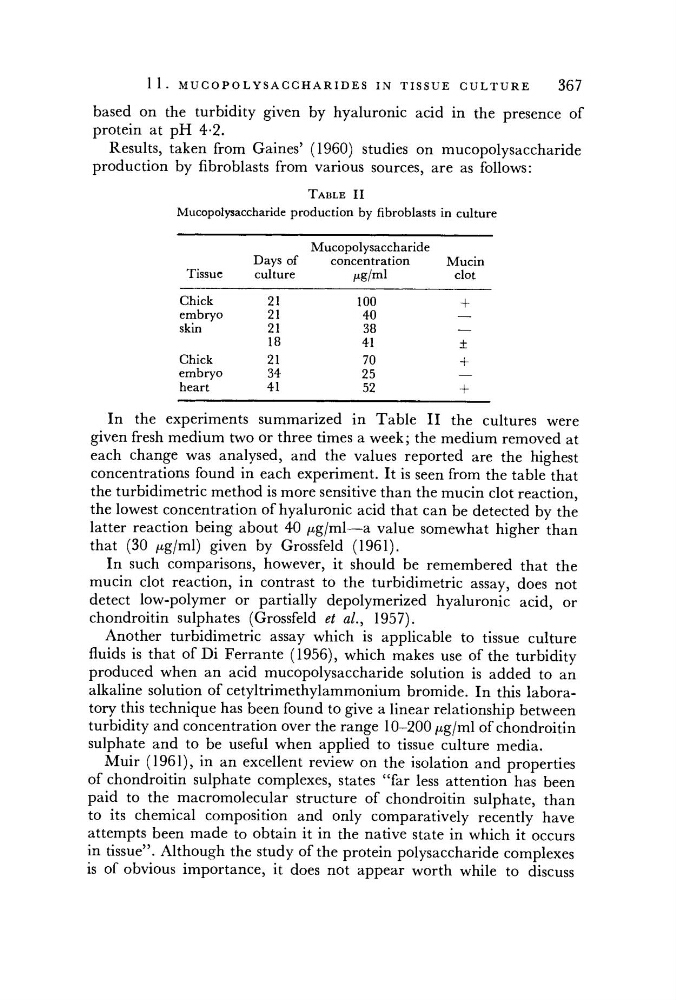
In the experiments summarized in Table II the cultures were
given fresh medium two or three times a week; the medium removed at
each change was analysed, and the values reported are the highest
concentrations found in each experiment. It is seen from the table that
the turbidimetric method is more sensitive than the mucin clot reaction,
the lowest concentration of hyaluronic acid that can be detected by the
latter reaction being about 40 /xg/ml—a value somewhat higher than
that (30 /xg/ml) given by Grossfeld (1961).
In such comparisons, however, it should be remembered that the
mucin clot reaction, in contrast to the turbidimetric assay, does not
detect low-polymer or partially depolymerized hyaluronic acid, or
chondroitin sulphates (Grossfeld et al., 1957).
Another turbidimetric assay which is applicable to tissue culture
fluids is that of Di Ferrante (1956), which makes use of the turbidity
produced when an acid mucopolysaccharide solution is added to an
alkaline solution of cetyltrimethylammonium bromide. In this laboratory this technique has been found to give a linear relationship between
turbidity and concentration over the range 10-200 /^g/ml of chondroitin
sulphate and to be useful when applied to tissue culture media.
Muir (1961), in an excellent review on the isolation and properties
of chondroitin sulphate complexes, states "far less attention has been
paid to the macromolecular structure of chondroitin sulphate, than
to its chemical composition and only comparatively recently have
attempts been made to obtain it in the native state in which it occurs
in tissue". Although the study of the protein polysaccharide complexes
is of obvious importance, it does not appear worth while to discuss
based on the turbidity given by hyaluronic acid in the presence of
protein at p H 4-2.
Results, taken from Gaines' (1960) studies on mucopolysaccharide
production by fibroblasts from various sources, are as follows:
T A B L E
II
Mucopolysaccharide production b y fibroblasts in culture
Mucopolysaccharide
367
Tissue
Days o f
culture
concentration
/xg/ml
M u c i n
clot
Chick
21
100
+
e m b r y o
21
40
skin
21
38
—
18
41
±
Chick
21
70
+
e m b r y o
34
25
heart
41
52
+
In the experiments summarized in Table II the cultures were
given fresh medium two or three times a week; the medium removed at
each change was analysed, and the values reported are the highest
concentrations found in each experiment. It is seen from the table that
the turbidimetric method is more sensitive than the mucin clot reaction,
the lowest concentration of hyaluronic acid that can be detected by the
latter reaction being about 40 /xg/ml—a value somewhat higher than
that (30 /xg/ml) given by Grossfeld (1961).
In such comparisons, however, it should be remembered that the
mucin clot reaction, in contrast to the turbidimetric assay, does not
detect low-polymer or partially depolymerized hyaluronic acid, or
chondroitin sulphates (Grossfeld et al., 1957).
Another turbidimetric assay which is applicable to tissue culture
fluids is that of Di Ferrante (1956), which makes use of the turbidity
produced when an acid mucopolysaccharide solution is added to an
alkaline solution of cetyltrimethylammonium bromide. In this laboratory this technique has been found to give a linear relationship between
turbidity and concentration over the range 10-200 /^g/ml of chondroitin
sulphate and to be useful when applied to tissue culture media.
Muir (1961), in an excellent review on the isolation and properties
of chondroitin sulphate complexes, states "far less attention has been
paid to the macromolecular structure of chondroitin sulphate, than
to its chemical composition and only comparatively recently have
attempts been made to obtain it in the native state in which it occurs
in tissue". Although the study of the protein polysaccharide complexes
is of obvious importance, it does not appear worth while to discuss
based on the turbidity given by hyaluronic acid in the presence of
protein at p H 4-2.
Results, taken from Gaines' (1960) studies on mucopolysaccharide
production by fibroblasts from various sources, are as follows:
T A B L E
II
Mucopolysaccharide production b y fibroblasts in culture
Mucopolysaccharide