

8. PROTEIN METABOLISM IN CELL LINES
291
40xU
x
A Threon-intest.
x Threon-hela
• Lysine -infest.
• Lysine-kb
• Valine - k b
o Valine -hela
e Valine -conj.
•x
5x
•o
0-001 0-002 0-005 0-01 0-02 0-05 0-1
0-2
0-5
External level of specific amino acid, mM
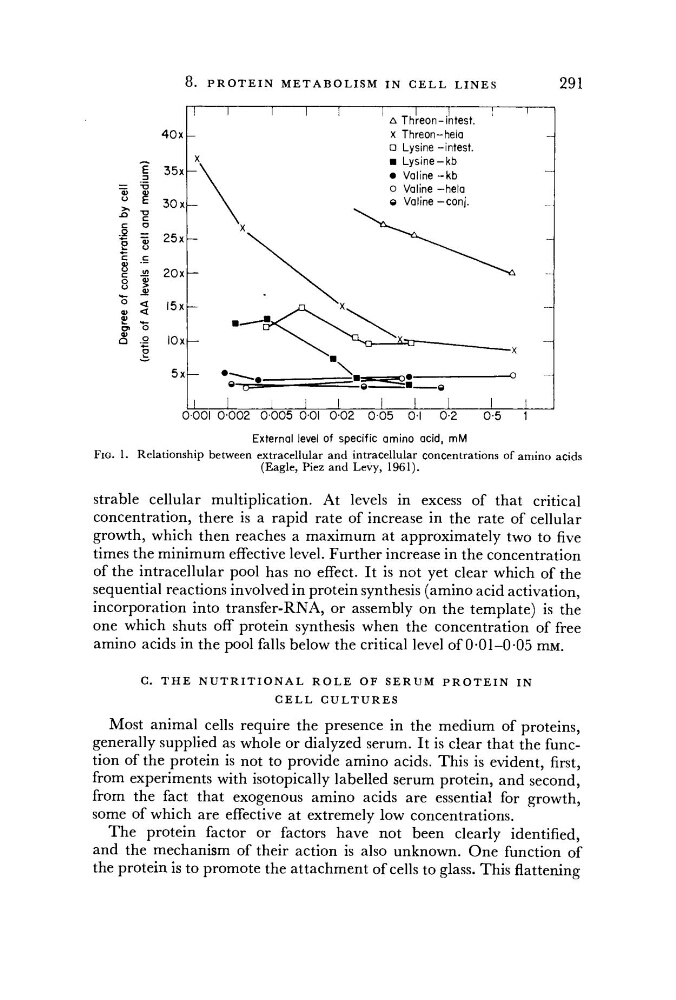
FIG. 1. Relationship between extracellular and intracellular concentrations of amino acids
(Eagle, Piez and Levy, 1961).
strable cellular multiplication. At levels in excess of that critical
concentration, there is a rapid rate of increase in the rate of cellular
growth, which then reaches a maximum at approximately two to five
times the minimum effective level. Further increase in the concentration
of the intracellular pool has no effect. It is not yet clear which of the
sequential reactions involved in protein synthesis (amino acid activation,
incorporation into transfer-RNA, or assembly on the template) is the
one which shuts off protein synthesis when the concentration of free
amino acids in the pool falls below the critical level of 0-01-0-05 mM.
C. THE NUTRITIONAL ROLE OF SERUM PROTEIN IN
CELL CULTURES
Most animal cells require the presence in the medium of proteins,
generally supplied as whole or dialyzed serum. It is clear that the function of the protein is not to provide amino acids. This is evident, first,
from experiments with isotopically labelled serum protein, and second,
from the fact that exogenous amino acids are essential for growth,
some of which are effective at extremely low concentrations.
The protein factor or factors have not been clearly identified,
and the mechanism of their action is also unknown. One function of
the protein is to promote the attachment of cells to glass. This flattening
Degree of concentration by cell
(ratio of AA levels in cell and medium)
291
40xU
x
A Threon-intest.
x Threon-hela
• Lysine -infest.
• Lysine-kb
• Valine - k b
o Valine -hela
e Valine -conj.
•x
5x
•o
0-001 0-002 0-005 0-01 0-02 0-05 0-1
0-2
0-5
External level of specific amino acid, mM
FIG. 1. Relationship between extracellular and intracellular concentrations of amino acids
(Eagle, Piez and Levy, 1961).
strable cellular multiplication. At levels in excess of that critical
concentration, there is a rapid rate of increase in the rate of cellular
growth, which then reaches a maximum at approximately two to five
times the minimum effective level. Further increase in the concentration
of the intracellular pool has no effect. It is not yet clear which of the
sequential reactions involved in protein synthesis (amino acid activation,
incorporation into transfer-RNA, or assembly on the template) is the
one which shuts off protein synthesis when the concentration of free
amino acids in the pool falls below the critical level of 0-01-0-05 mM.
C. THE NUTRITIONAL ROLE OF SERUM PROTEIN IN
CELL CULTURES
Most animal cells require the presence in the medium of proteins,
generally supplied as whole or dialyzed serum. It is clear that the function of the protein is not to provide amino acids. This is evident, first,
from experiments with isotopically labelled serum protein, and second,
from the fact that exogenous amino acids are essential for growth,
some of which are effective at extremely low concentrations.
The protein factor or factors have not been clearly identified,
and the mechanism of their action is also unknown. One function of
the protein is to promote the attachment of cells to glass. This flattening
Degree of concentration by cell
(ratio of AA levels in cell and medium)