

280
H A R R Y E A G L E A N D L E O N L E V I N T O W
Concentration
Concentration
,
*
,
,
A
C o m p o u n d
( m M ) (mg/1)
C o m p o u n d
(HIM)
(
m
g / l )
iu-Amino Acids
Arginine
0-6
105
Cystine
0-1
24
Glutamine
2-0
292
Histidine
0-2
31
Isoleucine
0-4
52
Leucine
0 4
52
Lysine
0-4
58
Methionine
0-1
15
Phenylalanine
0-2
32
Threonine
0-4
48
Tryptophan
0-05
10
Tyrosine
0-2
36
Valine
0-4
46
Carbohydrate
Glucose
5-5
1000
Salts
N a C l
KC1
C a C l 2
M g C l 2 . 6 H 2 0
N a H 2 P 0 4 . 2 H a O
N a H C 0 3
Vitamins
Choline
Folic acid
Inositol
Nicotinamide
Pantothenate
Pyridoxal
Riboflavin
Thiamine
Serum Protein
W h o l e or dialyzed
serum, 5 - 1 0 %
116
5-4
1-8 ( 0 ) *
1-0
1-1 ( 1 1 ) *
23-8
6800
400
200 ( 0 ) *
200
150 (1500)*
2000*
1
1
2
1
1
1
0-1
1
*For suspension cultures.
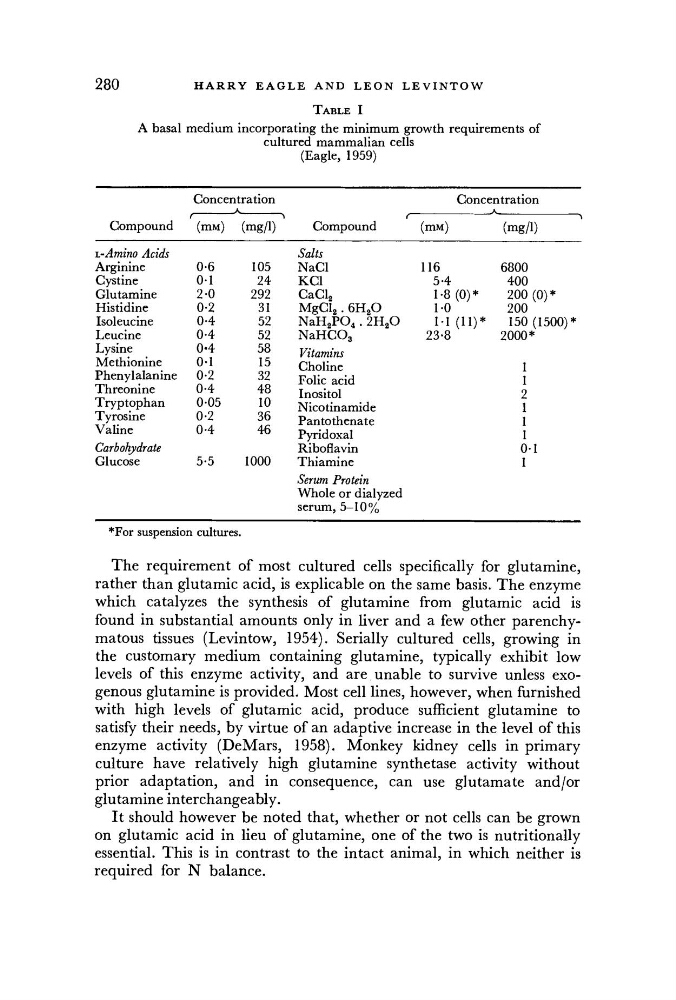
The requirement of most cultured cells specifically for glutamine,
rather than glutamic acid, is explicable on the same basis. The enzyme
which catalyzes the synthesis of glutamine from glutamic acid is
found in substantial amounts only in liver and a few other parenchymatous tissues (Levintow, 1954). Serially cultured cells, growing in
the customary medium containing glutamine, typically exhibit low
levels of this enzyme activity, and are unable to survive unless exogenous glutamine is provided. Most cell lines, however, when furnished
with high levels of glutamic acid, produce sufficient glutamine to
satisfy their needs, by virtue of an adaptive increase in the level of this
enzyme activity (DeMars, 1958). Monkey kidney cells in primary
culture have relatively high glutamine synthetase activity without
prior adaptation, and in consequence, can use glutamate and/or
glutamine interchangeably.
It should however be noted that, whether or not cells can be grown
on glutamic acid in lieu of glutamine, one of the two is nutritionally
essential. This is in contrast to the intact animal, in which neither is
required for N balance.
T A B L E I
A basal m e d i u m incorporating the m i n i m u m growth requirements o f
cultured mammalian cells
(Eagle, 1959)
H A R R Y E A G L E A N D L E O N L E V I N T O W
Concentration
Concentration
,
*
,
,
A
C o m p o u n d
( m M ) (mg/1)
C o m p o u n d
(HIM)
(
m
g / l )
iu-Amino Acids
Arginine
0-6
105
Cystine
0-1
24
Glutamine
2-0
292
Histidine
0-2
31
Isoleucine
0-4
52
Leucine
0 4
52
Lysine
0-4
58
Methionine
0-1
15
Phenylalanine
0-2
32
Threonine
0-4
48
Tryptophan
0-05
10
Tyrosine
0-2
36
Valine
0-4
46
Carbohydrate
Glucose
5-5
1000
Salts
N a C l
KC1
C a C l 2
M g C l 2 . 6 H 2 0
N a H 2 P 0 4 . 2 H a O
N a H C 0 3
Vitamins
Choline
Folic acid
Inositol
Nicotinamide
Pantothenate
Pyridoxal
Riboflavin
Thiamine
Serum Protein
W h o l e or dialyzed
serum, 5 - 1 0 %
116
5-4
1-8 ( 0 ) *
1-0
1-1 ( 1 1 ) *
23-8
6800
400
200 ( 0 ) *
200
150 (1500)*
2000*
1
1
2
1
1
1
0-1
1
*For suspension cultures.
The requirement of most cultured cells specifically for glutamine,
rather than glutamic acid, is explicable on the same basis. The enzyme
which catalyzes the synthesis of glutamine from glutamic acid is
found in substantial amounts only in liver and a few other parenchymatous tissues (Levintow, 1954). Serially cultured cells, growing in
the customary medium containing glutamine, typically exhibit low
levels of this enzyme activity, and are unable to survive unless exogenous glutamine is provided. Most cell lines, however, when furnished
with high levels of glutamic acid, produce sufficient glutamine to
satisfy their needs, by virtue of an adaptive increase in the level of this
enzyme activity (DeMars, 1958). Monkey kidney cells in primary
culture have relatively high glutamine synthetase activity without
prior adaptation, and in consequence, can use glutamate and/or
glutamine interchangeably.
It should however be noted that, whether or not cells can be grown
on glutamic acid in lieu of glutamine, one of the two is nutritionally
essential. This is in contrast to the intact animal, in which neither is
required for N balance.
T A B L E I
A basal m e d i u m incorporating the m i n i m u m growth requirements o f
cultured mammalian cells
(Eagle, 1959)