

6. C E L L D I V I S I O N
223
1
I
I
I
I
I
I
I
I
10
20
30
40
50
60
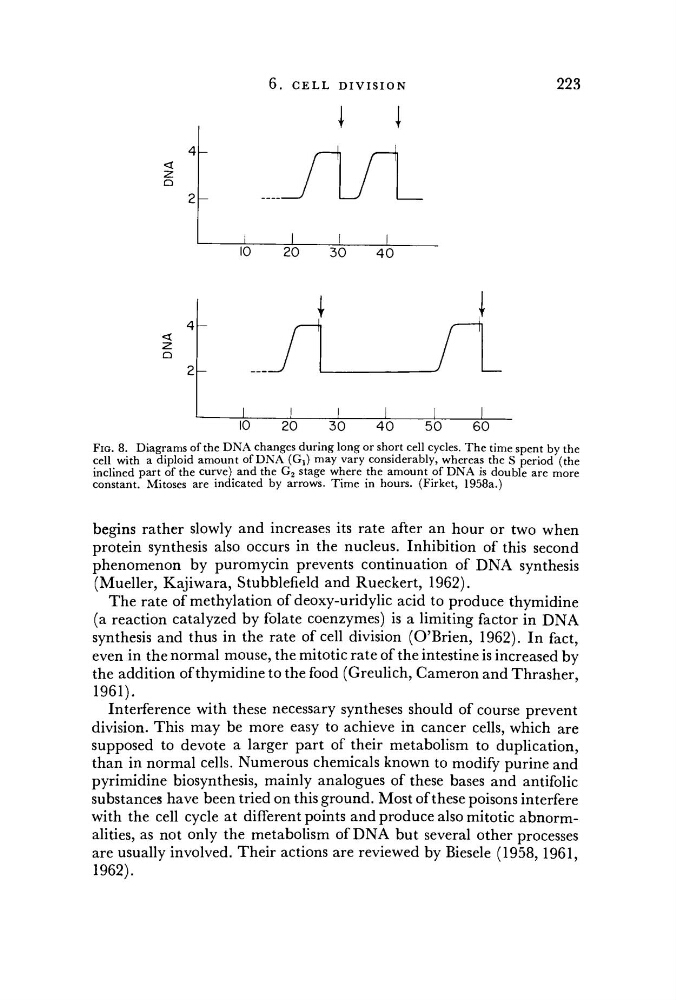
FIG. 8. Diagrams of the D N A changes during long or short cell cycles. The time spent by the
cell with a diploid amount of DNA ( G x ) may vary considerably, whereas the S period (the
inclined part of the curve) and the G 2 stage where the amount of DNA is double are more
constant. Mitoses are indicated by arrows. Time in hours. (Firket, 1958a.)
begins rather slowly and increases its rate after an hour or two when
protein synthesis also occurs in the nucleus. Inhibition of this second
phenomenon by puromycin prevents continuation of D N A synthesis
(Mueller, Kajiwara, Stubblefield and Rueckert, 1962).
The rate of methylation of deoxy-uridylic acid to produce thymidine
(a reaction catalyzed by folate coenzymes) is a limiting factor in D N A
synthesis and thus in the rate of cell division (O'Brien, 1962). In fact,
even in the normal mouse, the mitotic rate of the intestine is increased by
the addition of thymidine to the food (Greulich, Cameron and Thrasher,
1961).
Interference with these necessary syntheses should of course prevent
division. This may be more easy to achieve in cancer cells, which are
supposed to devote a larger part of their metabolism to duplication,
than in normal cells. Numerous chemicals known to modify purine and
pyrimidine biosynthesis, mainly analogues of these bases and antifolic
substances have been tried on this ground. Most of these poisons interfere
with the cell cycle at different points and produce also mitotic abnormalities, as not only the metabolism of D N A but several other processes
are usually involved. Their actions are reviewed by Biesele (1958, 1961,
1962).
DNA
DNA
223
1
I
I
I
I
I
I
I
I
10
20
30
40
50
60
FIG. 8. Diagrams of the D N A changes during long or short cell cycles. The time spent by the
cell with a diploid amount of DNA ( G x ) may vary considerably, whereas the S period (the
inclined part of the curve) and the G 2 stage where the amount of DNA is double are more
constant. Mitoses are indicated by arrows. Time in hours. (Firket, 1958a.)
begins rather slowly and increases its rate after an hour or two when
protein synthesis also occurs in the nucleus. Inhibition of this second
phenomenon by puromycin prevents continuation of D N A synthesis
(Mueller, Kajiwara, Stubblefield and Rueckert, 1962).
The rate of methylation of deoxy-uridylic acid to produce thymidine
(a reaction catalyzed by folate coenzymes) is a limiting factor in D N A
synthesis and thus in the rate of cell division (O'Brien, 1962). In fact,
even in the normal mouse, the mitotic rate of the intestine is increased by
the addition of thymidine to the food (Greulich, Cameron and Thrasher,
1961).
Interference with these necessary syntheses should of course prevent
division. This may be more easy to achieve in cancer cells, which are
supposed to devote a larger part of their metabolism to duplication,
than in normal cells. Numerous chemicals known to modify purine and
pyrimidine biosynthesis, mainly analogues of these bases and antifolic
substances have been tried on this ground. Most of these poisons interfere
with the cell cycle at different points and produce also mitotic abnormalities, as not only the metabolism of D N A but several other processes
are usually involved. Their actions are reviewed by Biesele (1958, 1961,
1962).
DNA
DNA