

Minutes
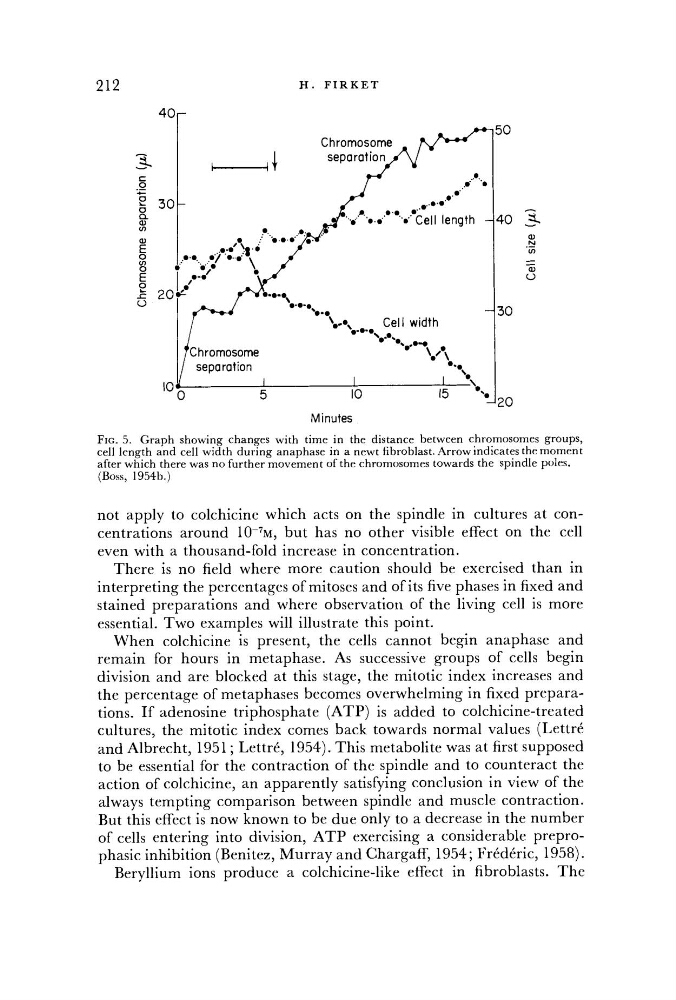
FIG. 5. Graph showing changes with time in the distance between chromosomes groups,
cell length and cell width during anaphase in a newt fibroblast. Arrow indicates the moment
after which there was no further movement of the chromosomes towards the spindle poles.
(Boss, 1954b.)
not apply to colchicine which acts on the spindle in cultures at concentrations around 10~
7
M, but has no other visible effect on the cell
even with a thousand-fold increase in concentration.
There is no field where more caution should be exercised than in
interpreting the percentages of mitoses and of its five phases in fixed and
stained preparations and where observation of the living cell is more
essential. T w o examples will illustrate this point.
When colchicine is present, the cells cannot begin anaphase and
remain for hours in metaphase. As successive groups of cells begin
division and are blocked at this stage, the mitotic index increases and
the percentage of metaphases becomes overwhelming in fixed preparations. If adenosine triphosphate (ATP) is added to colchicine-treated
cultures, the mitotic index comes back towards normal values (Lettre
and Albrecht, 1951; Lettre, 1954). This metabolite was at first supposed
to be essential for the contraction of the spindle and to counteract the
action of colchicine, an apparently satisfying conclusion in view of the
always tempting comparison between spindle and muscle contraction.
But this effect is now known to be due only to a decrease in the number
of cells entering into division, A T P exercising a considerable preprophasic inhibition (Benitez, Murray and Chargaff, 1954; Frederic, 1958).
Beryllium ions produce a colchicine-like effect in fibroblasts. The
212
H . F I R K E T
Chromosome separation [/JL)
Cell size (/x)
FIG. 5. Graph showing changes with time in the distance between chromosomes groups,
cell length and cell width during anaphase in a newt fibroblast. Arrow indicates the moment
after which there was no further movement of the chromosomes towards the spindle poles.
(Boss, 1954b.)
not apply to colchicine which acts on the spindle in cultures at concentrations around 10~
7
M, but has no other visible effect on the cell
even with a thousand-fold increase in concentration.
There is no field where more caution should be exercised than in
interpreting the percentages of mitoses and of its five phases in fixed and
stained preparations and where observation of the living cell is more
essential. T w o examples will illustrate this point.
When colchicine is present, the cells cannot begin anaphase and
remain for hours in metaphase. As successive groups of cells begin
division and are blocked at this stage, the mitotic index increases and
the percentage of metaphases becomes overwhelming in fixed preparations. If adenosine triphosphate (ATP) is added to colchicine-treated
cultures, the mitotic index comes back towards normal values (Lettre
and Albrecht, 1951; Lettre, 1954). This metabolite was at first supposed
to be essential for the contraction of the spindle and to counteract the
action of colchicine, an apparently satisfying conclusion in view of the
always tempting comparison between spindle and muscle contraction.
But this effect is now known to be due only to a decrease in the number
of cells entering into division, A T P exercising a considerable preprophasic inhibition (Benitez, Murray and Chargaff, 1954; Frederic, 1958).
Beryllium ions produce a colchicine-like effect in fibroblasts. The
212
H . F I R K E T
Chromosome separation [/JL)
Cell size (/x)