

80
A. SARAGEA ET AL.
24 000 and 38 000 daltons respectively, that are held together by weak
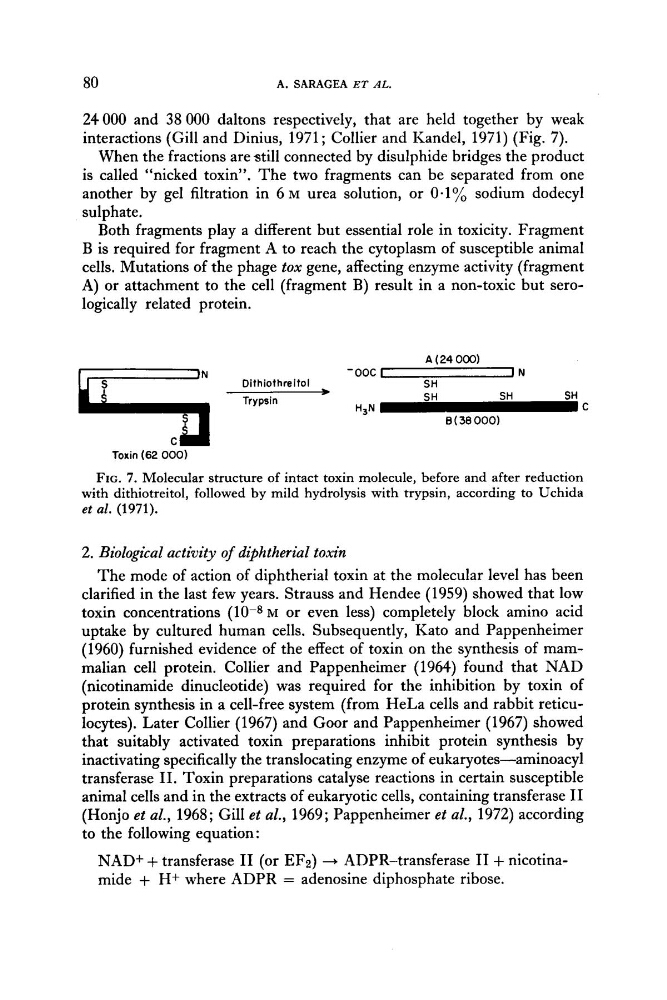
interactions (Gill and Dinius, 1971; Collier and Kandel, 1971) (Fig. 7).
When the fractions are still connected by disulphide bridges the product
is called “nicked toxin”. The two fragments can be separated from one
another by gel filtration in 6~ urea solution, or 0.1% sodium dodecyl
sulphate.
Both fragments play a different but essential role in toxicity. Fragment
B is required for fragment A to reach the cytoplasm of susceptible animal
cells. Mutations of the phage tox gene, affecting enzyme activity (fragment
A) or attachment to the cell (fragment B) result in a non-toxic but serologically related protein.
A (24 000)
SH
SH
SH
-0OC 1
-
N
Dlthiothreitol
SH
-
C
B ( 38 000)
H3N
Toxin (62 000)
FIG. 7. Molecular structure of intact toxin molecule, before and after reduction
with dithiotreitol, followed by mild hydrolysis with trypsin, according to Uchida
et al. (1971).
2. Biological activity of diphtherial toxin
The mode of action of diphtherial toxin at the molecular level has been
clarified in the last few years. Strauss and Hendee (1959) showed that low
toxin concentrations (10-8 M or even less) completely block amino acid
uptake by cultured human cells. Subsequently, Kato and Pappenheimer
(1960) furnished evidence of the effect of toxin on the synthesis of mammalian cell protein. Collier and Pappenheimer (1964) found that NAD
(nicotinamide dinucleotide) was required for the inhibition by toxin of
protein synthesis in a cell-free system (from HeLa cells and rabbit reticulocytes). Later Collier (1967) and Goor and Pappenheimer (1967) showed
that suitably activated toxin preparations inhibit protein synthesis by
inactivating specifically the translocating enzyme of eukaryotes-aminoacyl
transferase 11. Toxin preparations catalyse reactions in certain susceptible
animal cells and in the extracts of eukaryotic cells, containing transferase I1
(Honjo et al., 1968; Gill et al., 1969; Pappenheimer et al., 1972) according
to the following equation:
NAD+ + transferase I1 (or EF2) -, ADPR-transferase I1 + nicotinamide + Hf where ADPR = adenosine diphosphate ribose.
A. SARAGEA ET AL.
24 000 and 38 000 daltons respectively, that are held together by weak
interactions (Gill and Dinius, 1971; Collier and Kandel, 1971) (Fig. 7).
When the fractions are still connected by disulphide bridges the product
is called “nicked toxin”. The two fragments can be separated from one
another by gel filtration in 6~ urea solution, or 0.1% sodium dodecyl
sulphate.
Both fragments play a different but essential role in toxicity. Fragment
B is required for fragment A to reach the cytoplasm of susceptible animal
cells. Mutations of the phage tox gene, affecting enzyme activity (fragment
A) or attachment to the cell (fragment B) result in a non-toxic but serologically related protein.
A (24 000)
SH
SH
SH
-0OC 1
-
N
Dlthiothreitol
SH
-
C
B ( 38 000)
H3N
Toxin (62 000)
FIG. 7. Molecular structure of intact toxin molecule, before and after reduction
with dithiotreitol, followed by mild hydrolysis with trypsin, according to Uchida
et al. (1971).
2. Biological activity of diphtherial toxin
The mode of action of diphtherial toxin at the molecular level has been
clarified in the last few years. Strauss and Hendee (1959) showed that low
toxin concentrations (10-8 M or even less) completely block amino acid
uptake by cultured human cells. Subsequently, Kato and Pappenheimer
(1960) furnished evidence of the effect of toxin on the synthesis of mammalian cell protein. Collier and Pappenheimer (1964) found that NAD
(nicotinamide dinucleotide) was required for the inhibition by toxin of
protein synthesis in a cell-free system (from HeLa cells and rabbit reticulocytes). Later Collier (1967) and Goor and Pappenheimer (1967) showed
that suitably activated toxin preparations inhibit protein synthesis by
inactivating specifically the translocating enzyme of eukaryotes-aminoacyl
transferase 11. Toxin preparations catalyse reactions in certain susceptible
animal cells and in the extracts of eukaryotic cells, containing transferase I1
(Honjo et al., 1968; Gill et al., 1969; Pappenheimer et al., 1972) according
to the following equation:
NAD+ + transferase I1 (or EF2) -, ADPR-transferase I1 + nicotinamide + Hf where ADPR = adenosine diphosphate ribose.