

66
A. SARAGEA ET AL.
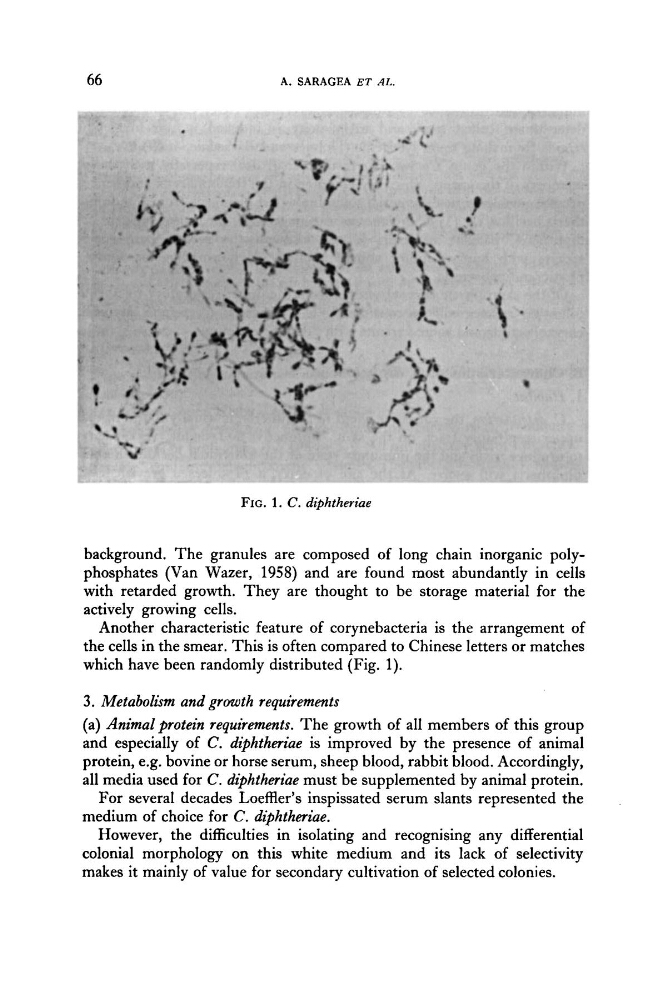
FIG. 1. C. diphtheriae
background. The granules are composed of long chain inorganic polyphosphates (Van Wazer, 1958) and are found most abundantly in cells
with retarded growth. They are thought to be storage material for the
actively growing cells.
Another characteristic feature of corynebacteria is the arrangement of
the cells in the smear. This is often compared to Chinese letters or matches
which have been randomly distributed (Fig. 1).
3. Metabolism and growth requirements
(a) Animal protein requirements. The growth of all members of this group
and especially of C. diphtheriae is improved by the presence of animal
protein, e.g. bovine or horse serum, sheep blood, rabbit blood. Accordingly,
all media used for C. diphtheriae must be supplemented by animal protein.
For several decades Loeffler’s inspissated serum slants represented the
medium of choice for C. diphtheriae.
However, the difficulties in isolating and recognising any differential
colonial morphology on this white medium and its lack of selectivity
makes it mainly of value for secondary cultivation of selected colonies.
A. SARAGEA ET AL.
FIG. 1. C. diphtheriae
background. The granules are composed of long chain inorganic polyphosphates (Van Wazer, 1958) and are found most abundantly in cells
with retarded growth. They are thought to be storage material for the
actively growing cells.
Another characteristic feature of corynebacteria is the arrangement of
the cells in the smear. This is often compared to Chinese letters or matches
which have been randomly distributed (Fig. 1).
3. Metabolism and growth requirements
(a) Animal protein requirements. The growth of all members of this group
and especially of C. diphtheriae is improved by the presence of animal
protein, e.g. bovine or horse serum, sheep blood, rabbit blood. Accordingly,
all media used for C. diphtheriae must be supplemented by animal protein.
For several decades Loeffler’s inspissated serum slants represented the
medium of choice for C. diphtheriae.
However, the difficulties in isolating and recognising any differential
colonial morphology on this white medium and its lack of selectivity
makes it mainly of value for secondary cultivation of selected colonies.