

46
H. P. R. SEELIGER AND K. HOHNE
so far have shown that only a few cultures are unidentifiable, mainly due
to roughness. Seeliger (1958, 1961) divided Paterson’s 0 group 3 into
4a and 4b, on the basis of differences in the somatic antigens. A further
subdivision on the basis of different somatic antigens by Donker-Voet
(1954, 1957, 1959) and Seeliger (1972) resulted in the distinction of further
antigen combinations (see Table VI). Serotype 5 was described by Ivanov
(1962) who studied listeriosis in sheep. This serotype 5 (Cooper et al., 1973)
possesses an 0-factor which was not present in serotypes 1 to 4a through
4e. It differs also from other listeriae by its very pronounced haemolytic
action. Additional serotypes 3c, 6 , 7 and Murraya murrayi were described by Donker-Voet (1966) and Stuart and Welshimer (1974).
The present knowledge on the antigenic structure of L. monocytogenes
is summarised in Table VI.
The situation became complicated when by the detection of nonhaemolysing, avirulent strains with the biochemical make-up of Listeria
and showing a close serological relationship, serotypes 4f, 4g and 6 were
recognised jointly by Seeliger and Donker-Voet.
For many reasons not to be discussed here it appears that these serotypes
which so far have never been isolated from pathological material of human
or animal origin, but frequently from faecal material and environmental
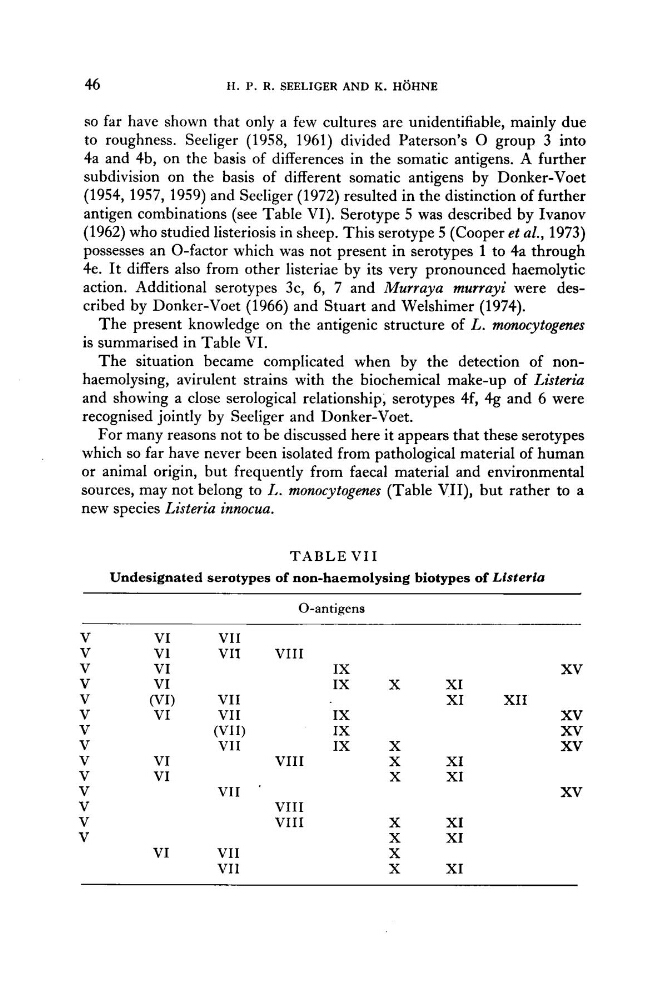
sources, may not belong to L. monocytogenes (Table VII), but rather to a
new species Listeria innocua.
T A B L E V I I
Undesignated serotypes of non-haemolysing biotypes of Listeria
0-antigens
V
V
V
V
V
V
V
V
V
V
V
V
V
V
VI
VII
v 1
VII
VIII
VI
IX
VI
IX
X
(VI)
VII
VI
VI I
IX
( V W
IX
VII
IX
X
VI
VIII
X
VI
X
VII .
VIII
VIII
X
X
VI
VII
X
VI 1
X
xv
XI
XI
XI1
xv
xv
xv
XI
XI
XV
XI
XI
XI
H. P. R. SEELIGER AND K. HOHNE
so far have shown that only a few cultures are unidentifiable, mainly due
to roughness. Seeliger (1958, 1961) divided Paterson’s 0 group 3 into
4a and 4b, on the basis of differences in the somatic antigens. A further
subdivision on the basis of different somatic antigens by Donker-Voet
(1954, 1957, 1959) and Seeliger (1972) resulted in the distinction of further
antigen combinations (see Table VI). Serotype 5 was described by Ivanov
(1962) who studied listeriosis in sheep. This serotype 5 (Cooper et al., 1973)
possesses an 0-factor which was not present in serotypes 1 to 4a through
4e. It differs also from other listeriae by its very pronounced haemolytic
action. Additional serotypes 3c, 6 , 7 and Murraya murrayi were described by Donker-Voet (1966) and Stuart and Welshimer (1974).
The present knowledge on the antigenic structure of L. monocytogenes
is summarised in Table VI.
The situation became complicated when by the detection of nonhaemolysing, avirulent strains with the biochemical make-up of Listeria
and showing a close serological relationship, serotypes 4f, 4g and 6 were
recognised jointly by Seeliger and Donker-Voet.
For many reasons not to be discussed here it appears that these serotypes
which so far have never been isolated from pathological material of human
or animal origin, but frequently from faecal material and environmental
sources, may not belong to L. monocytogenes (Table VII), but rather to a
new species Listeria innocua.
T A B L E V I I
Undesignated serotypes of non-haemolysing biotypes of Listeria
0-antigens
V
V
V
V
V
V
V
V
V
V
V
V
V
V
VI
VII
v 1
VII
VIII
VI
IX
VI
IX
X
(VI)
VII
VI
VI I
IX
( V W
IX
VII
IX
X
VI
VIII
X
VI
X
VII .
VIII
VIII
X
X
VI
VII
X
VI 1
X
xv
XI
XI
XI1
xv
xv
xv
XI
XI
XV
XI
XI
XI