

X. METHODS IN CAMPYLOBACTER
445
VI. SEROLOGICAL IDENTIFICATION OF
CAMPYLOBACTER
A. 0 Antigens
According to the investigations of Smibert (1970), the hydrolysates of
whole cells of 50 strains of the three C. fetus subspecies contain small
amounts of meso-diaminopimelic acid (DAP). The rneso-DAP cannot be
detected in purified cell walls. The carbohydrate composition of the cell
walls of C. fetus subsp. fetus shows galactose and mannose, apart from one
strain with galactose and glucose. Most strains of C. fetus subsp. intestinalis
have galactose and mannose, some strains possess galactose and rhamnose ;
however, one strain had galactose alone and another galactose, glucose and
mannose. Most of the C. fetus subsp. jejuni strains had galactose and glucose; two strains contained galactose, glucose and mannose; one strain
galactose alone.
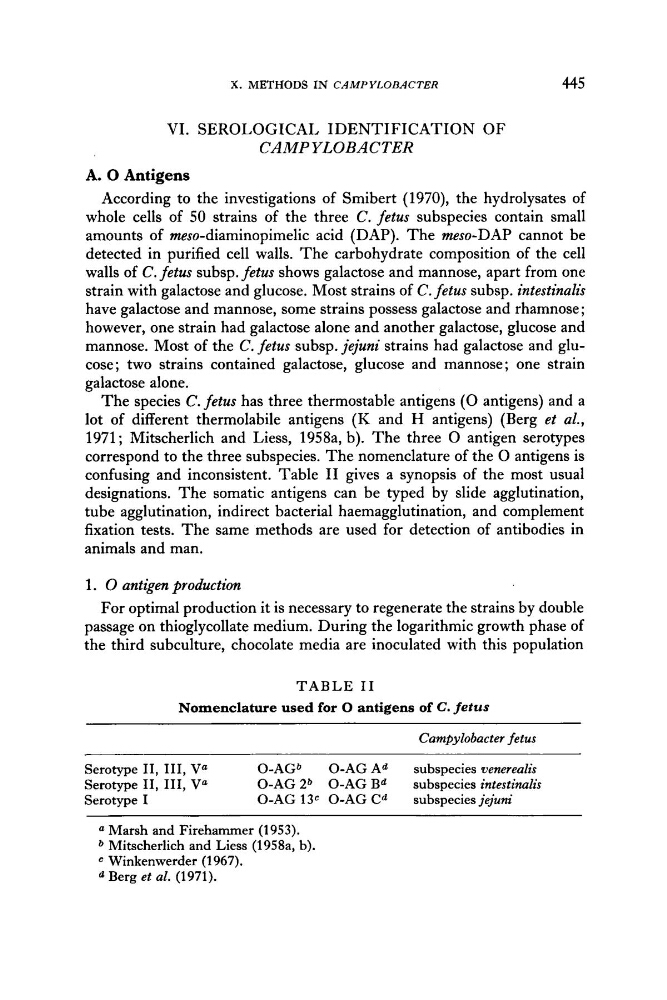
The species C. fetus has three thermostable antigens (0 antigens) and a
lot of different thermolabile antigens (K and H antigens) (Berg et al.,
1971; Mitscherlich and Liess, 1958a, b). The three 0 antigen serotypes
correspond to the three subspecies. The nomenclature of the 0 antigens is
confusing and inconsistent. Table I1 gives a synopsis of the most usual
designations. The somatic antigens can be typed by slide agglutination,
tube agglutination, indirect bacterial haemagglutination, and complement
fixation tests. The same methods are used for detection of antibodies in
animals and man.
1. 0 antigen production
For optimal production it is necessary to regenerate the strains by double
passage on thioglycollate medium. During the logarithmic growth phase of
the third subculture, chocolate media are inoculated with this population
T A B L E I 1
Nomenclature used for 0 antigens of C. fetus
Campylobacter fetus
Serotype 11, 111, Va
0-AGb
0 - A G Ad
subspecies venerealis
Serotype 11, 111, V a
0-AG 26 0-AG Bd
subspecies intestinalis
Serotype I
0-AG 13c 0-AG Cd
subspecies jejuni
a Marsh and Firehammer (1953).
b Mitscherlich and Liess (1958a, b).
c Winkenwerder (1967).
d Berg et al. (1971).
445
VI. SEROLOGICAL IDENTIFICATION OF
CAMPYLOBACTER
A. 0 Antigens
According to the investigations of Smibert (1970), the hydrolysates of
whole cells of 50 strains of the three C. fetus subspecies contain small
amounts of meso-diaminopimelic acid (DAP). The rneso-DAP cannot be
detected in purified cell walls. The carbohydrate composition of the cell
walls of C. fetus subsp. fetus shows galactose and mannose, apart from one
strain with galactose and glucose. Most strains of C. fetus subsp. intestinalis
have galactose and mannose, some strains possess galactose and rhamnose ;
however, one strain had galactose alone and another galactose, glucose and
mannose. Most of the C. fetus subsp. jejuni strains had galactose and glucose; two strains contained galactose, glucose and mannose; one strain
galactose alone.
The species C. fetus has three thermostable antigens (0 antigens) and a
lot of different thermolabile antigens (K and H antigens) (Berg et al.,
1971; Mitscherlich and Liess, 1958a, b). The three 0 antigen serotypes
correspond to the three subspecies. The nomenclature of the 0 antigens is
confusing and inconsistent. Table I1 gives a synopsis of the most usual
designations. The somatic antigens can be typed by slide agglutination,
tube agglutination, indirect bacterial haemagglutination, and complement
fixation tests. The same methods are used for detection of antibodies in
animals and man.
1. 0 antigen production
For optimal production it is necessary to regenerate the strains by double
passage on thioglycollate medium. During the logarithmic growth phase of
the third subculture, chocolate media are inoculated with this population
T A B L E I 1
Nomenclature used for 0 antigens of C. fetus
Campylobacter fetus
Serotype 11, 111, Va
0-AGb
0 - A G Ad
subspecies venerealis
Serotype 11, 111, V a
0-AG 26 0-AG Bd
subspecies intestinalis
Serotype I
0-AG 13c 0-AG Cd
subspecies jejuni
a Marsh and Firehammer (1953).
b Mitscherlich and Liess (1958a, b).
c Winkenwerder (1967).
d Berg et al. (1971).