

418
E. A. FREUNDT ET A L .
T A B L E V I
(a) Titration of antigen for anticomplementary activity
HC50 units of complement
Dilution of
antigen
3
2
1
4
0
1 :2
1 :4
1 :8
1:16
1:32
1 :64
1 : 128
1 : 256
0 (control)
0 (control)
1
2
3
4
4
0
1
3
4
4
0
0
2
4
4
0
0
2
4
4
0
0
2
4
4
0
0
2
4
4
0
0
2
4
4
0
0
2
4
4
0
0
2
4
4
0
0
2
4
4
Anticomplementary
Anticomplementary
Satisfactory
Satisfactory
Satisfactory
Satisfactory
Satisfactory
Satisfactory
(b) Titration of serum for anticomplementary or procomplementary
activity
Reciprocal of serum dilution
10
20
40
80
-
Serum + 3 HC50
Serum without
complement
0
0
0
0 Not anticomplementary
complement
4
4
4
4 Not procomplementary
suspensions boiled in saline instead of water were highly anticomplementary. The anticomplementary activity of suspensions of M . pneumoniae
has also been eliminated by heating at 56°C for 2 h or at 100°C for 5 min
(Kenny and Grayston, 1965). Unfortunately not all species retain their
serological activity after such treatment, and boiled aqueous suspensions
of many species give much lower titres with homologous antisera than
unheated antigens (Lemcke, 1961).
(g) Tests for anticomplementary activity. It is essential that neither the
antigen nor the antiserum used in a test should, when tested separately,
be capable of fixing complement. It is often convenient to run tests of
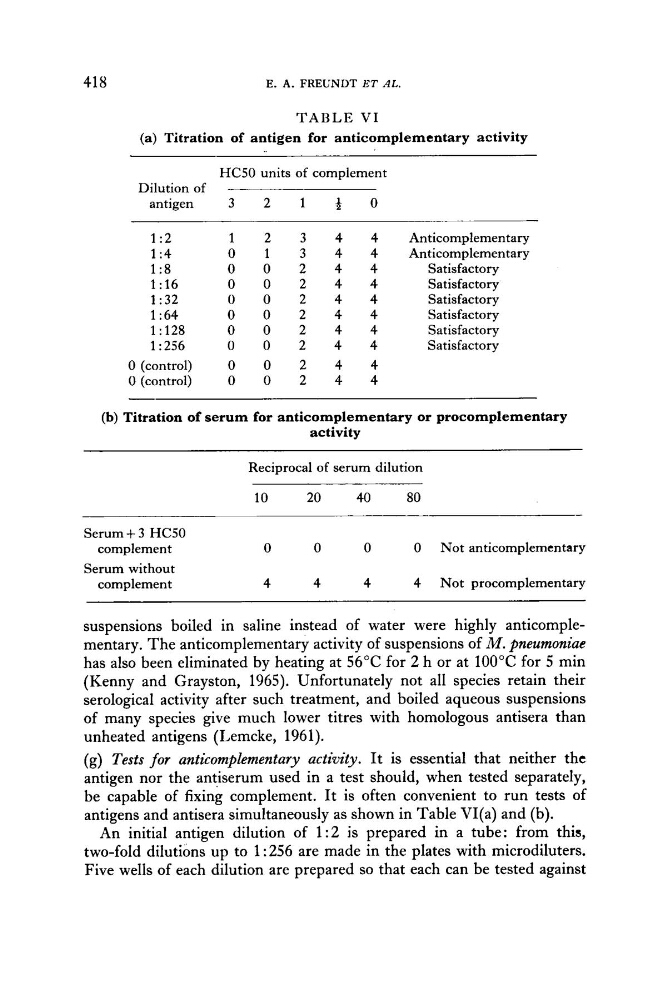
antigens and antisera simultaneously as shown in Table VI(a) and (b).
An initial antigen dilution of 1:2 is prepared in a tube: from this,
two-fold dilutions up to 1 :256 are made in the plates with microdiluters.
Five wells of each dilution are prepared so that each can be tested against
E. A. FREUNDT ET A L .
T A B L E V I
(a) Titration of antigen for anticomplementary activity
HC50 units of complement
Dilution of
antigen
3
2
1
4
0
1 :2
1 :4
1 :8
1:16
1:32
1 :64
1 : 128
1 : 256
0 (control)
0 (control)
1
2
3
4
4
0
1
3
4
4
0
0
2
4
4
0
0
2
4
4
0
0
2
4
4
0
0
2
4
4
0
0
2
4
4
0
0
2
4
4
0
0
2
4
4
0
0
2
4
4
Anticomplementary
Anticomplementary
Satisfactory
Satisfactory
Satisfactory
Satisfactory
Satisfactory
Satisfactory
(b) Titration of serum for anticomplementary or procomplementary
activity
Reciprocal of serum dilution
10
20
40
80
-
Serum + 3 HC50
Serum without
complement
0
0
0
0 Not anticomplementary
complement
4
4
4
4 Not procomplementary
suspensions boiled in saline instead of water were highly anticomplementary. The anticomplementary activity of suspensions of M . pneumoniae
has also been eliminated by heating at 56°C for 2 h or at 100°C for 5 min
(Kenny and Grayston, 1965). Unfortunately not all species retain their
serological activity after such treatment, and boiled aqueous suspensions
of many species give much lower titres with homologous antisera than
unheated antigens (Lemcke, 1961).
(g) Tests for anticomplementary activity. It is essential that neither the
antigen nor the antiserum used in a test should, when tested separately,
be capable of fixing complement. It is often convenient to run tests of
antigens and antisera simultaneously as shown in Table VI(a) and (b).
An initial antigen dilution of 1:2 is prepared in a tube: from this,
two-fold dilutions up to 1 :256 are made in the plates with microdiluters.
Five wells of each dilution are prepared so that each can be tested against