

410
E. A. FREUNDT ET AL.
part of F I T C to 80 parts of protein. Non-conjugated fluorescein is removed
by filtration through a Sephadex G-25 column equilibrated with 0-01 M
phosphate buffered saline at pH 7.2. The molecular relationship between
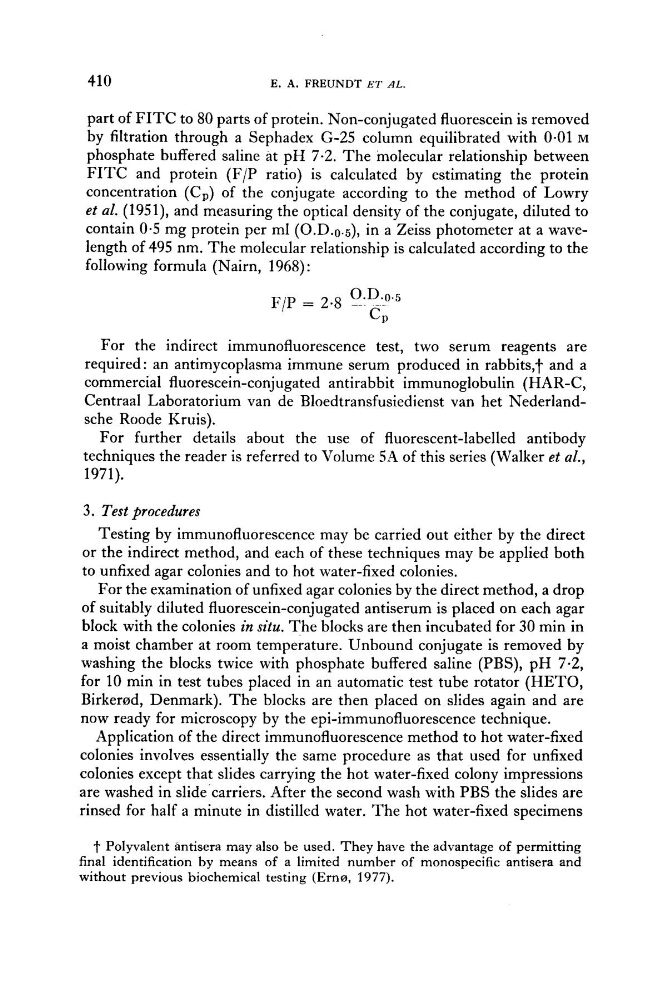
FITC and protein (F/P ratio) is calculated by estimating the protein
concentration (C,) of the conjugate according to the method of Lowry
et al. (1951), and measuring the optical density of the conjugate, diluted to
contain 0.5 mg protein per ml (O.D.O.~), in a Zeiss photometer at a wavelength of 495 nm. The molecular relationship is calculated according to the
following formula (Nairn, 1968):
O.D.0.5
F/P = 2.8 ~~ ~
CP
For the indirect immunofluorescence test, two serum reagents are
required: an antimycoplasma immune serum produced in rabbits,-f. and a
commercial fluorescein-conjugated antirabbit immunoglobulin (HAR-C,
Centraal Laboratorium van de Bloedtransfusiedienst van het Nederlandsche Roode Kruis).
For further details about the use of fluorescent-labelled antibody
techniques the reader is referred to Volume 5A of this series (Walker et al.,
1971).
3. Test procedures
Testing by immunofluorescence may be carried out either by the direct
or the indirect method, and each of these techniques may be applied both
to unfixed agar colonies and to hot water-fixed colonies.
For the examination of unfixed agar colonies by the direct method, a drop
of suitably diluted fluorescein-conjugated antiserum is placed on each agar
block with the colonies in situ. The blocks are then incubated for 30 min in
a moist chamber at room temperature. Unbound conjugate is removed by
washing the blocks twice with phosphate buffered saline (PBS), p H 7.2,
for 10 min in test tubes placed in an automatic test tube rotator (HETO,
Birkernd, Denmark). The blocks are then placed on slides again and are
now ready for microscopy by the epi-immunofluorescence technique.
Application of the direct immunofluorescence method to hot water-fixed
colonies involves essentially the same procedure as that used for unfixed
colonies except that slides carrying the hot water-fixed colony impressions
are washed in slide'carriers. After the second wash with PBS the slides are
rinsed for half a minute in distilled water. The hot water-fixed specimens
-f. Polyvalent antisera may also be used. They have the advantage of permitting
final identification by means of a limited number of monospecific antisera and
without previous biochemical testing (Ern@, 1977).
E. A. FREUNDT ET AL.
part of F I T C to 80 parts of protein. Non-conjugated fluorescein is removed
by filtration through a Sephadex G-25 column equilibrated with 0-01 M
phosphate buffered saline at pH 7.2. The molecular relationship between
FITC and protein (F/P ratio) is calculated by estimating the protein
concentration (C,) of the conjugate according to the method of Lowry
et al. (1951), and measuring the optical density of the conjugate, diluted to
contain 0.5 mg protein per ml (O.D.O.~), in a Zeiss photometer at a wavelength of 495 nm. The molecular relationship is calculated according to the
following formula (Nairn, 1968):
O.D.0.5
F/P = 2.8 ~~ ~
CP
For the indirect immunofluorescence test, two serum reagents are
required: an antimycoplasma immune serum produced in rabbits,-f. and a
commercial fluorescein-conjugated antirabbit immunoglobulin (HAR-C,
Centraal Laboratorium van de Bloedtransfusiedienst van het Nederlandsche Roode Kruis).
For further details about the use of fluorescent-labelled antibody
techniques the reader is referred to Volume 5A of this series (Walker et al.,
1971).
3. Test procedures
Testing by immunofluorescence may be carried out either by the direct
or the indirect method, and each of these techniques may be applied both
to unfixed agar colonies and to hot water-fixed colonies.
For the examination of unfixed agar colonies by the direct method, a drop
of suitably diluted fluorescein-conjugated antiserum is placed on each agar
block with the colonies in situ. The blocks are then incubated for 30 min in
a moist chamber at room temperature. Unbound conjugate is removed by
washing the blocks twice with phosphate buffered saline (PBS), p H 7.2,
for 10 min in test tubes placed in an automatic test tube rotator (HETO,
Birkernd, Denmark). The blocks are then placed on slides again and are
now ready for microscopy by the epi-immunofluorescence technique.
Application of the direct immunofluorescence method to hot water-fixed
colonies involves essentially the same procedure as that used for unfixed
colonies except that slides carrying the hot water-fixed colony impressions
are washed in slide'carriers. After the second wash with PBS the slides are
rinsed for half a minute in distilled water. The hot water-fixed specimens
-f. Polyvalent antisera may also be used. They have the advantage of permitting
final identification by means of a limited number of monospecific antisera and
without previous biochemical testing (Ern@, 1977).