

398
E. A. FREUNDT E?’ AL.
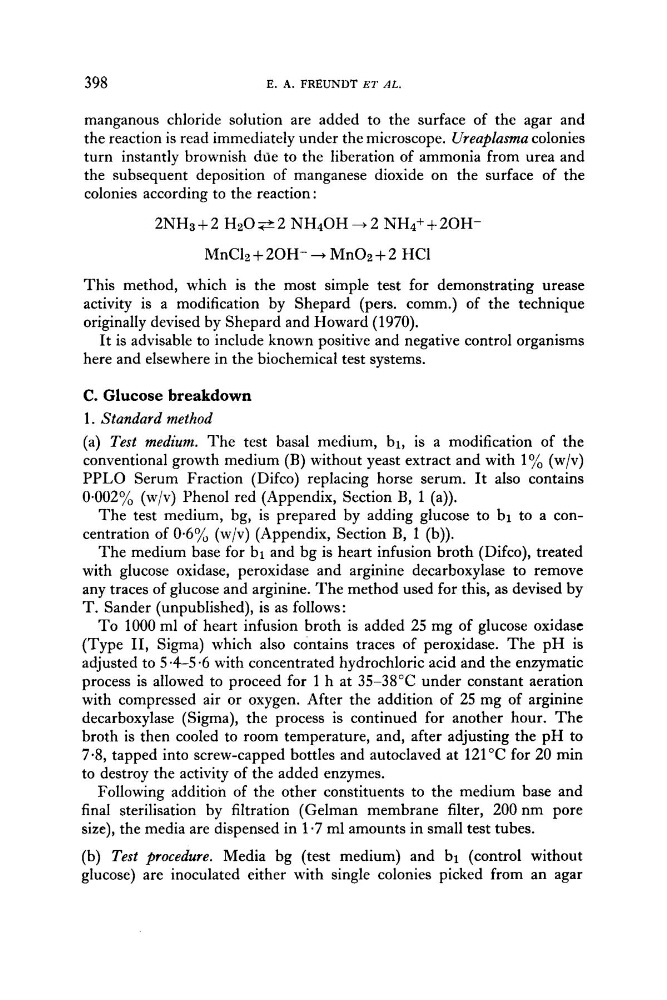
manganous chloride solution are added to the surface of the agar and
the reaction is read immediately under the microscope. Ureaplasma colonies
turn instantly brownish due to the liberation of ammonia from urea and
the subsequent deposition of manganese dioxide on the surface of the
colonies according to the reaction:
2NH3 + 2 HzO Z 2 NH40H + 2 NH4+ + 2 0 H -
MnClz + 20H- + MnOz + 2 HCl
This method, which is the most simple test for demonstrating urease
activity is a modification by Shepard (pers. comm.) of the technique
originally devised by Shepard and Howard (1970).
It is advisable to include known positive and negative control organisms
here and elsewhere in the biochemical test systems.
C. Glucose breakdown
1. Standard method
(a) Test medium. The test basal medium, bl, is a modification of the
conventional growth medium (B) without yeast extract and with lo/, (w/v)
PPLO Serum Fraction (Difco) replacing horse serum. It also contains
0.002% (w/v) Phenol red (Appendix, Section B, 1 (a)).
The test medium, bg, is prepared by adding glucose to b l to a concentration of 0.6% (w/v) (Appendix, Section B, 1 (b)).
The medium base for bl and bg is heart infusion broth (Difco), treated
with glucose oxidase, peroxidase and arginine decarboxylase to remove
any traces of glucose and arginine. The method used for this, as devised by
T. Sander (unpublished), is as follows:
To 1000 ml of heart infusion broth is added 25 mg of glucose oxidase
(Type 11, Sigma) which also contains traces of peroxidase. The p H is
adjusted to 5 4-5 6 with concentrated hydrochloric acid and the enzymatic
process is allowed to proceed for 1 h at 35-38°C under constant aeration
with compressed air or oxygen. After the addition of 25 mg of arginine
decarboxylase (Sigma), the process is continued for another hour. The
broth is then cooled to room temperature, and, after adjusting the pH to
7.8, tapped into screw-capped bottles and autoclaved at 121°C for 20 min
to destroy the activity of the added enzymes.
Following addition of the other constituents to the medium base and
final sterilisation by filtration (Gelman membrane filter, 200 nm pore
size), the media are dispensed in 1 -7 ml amounts in small test tubes.
(b) Test procedure. Media bg (test medium) and bl (control without
glucose) are inoculated either with single colonies picked from an agar
E. A. FREUNDT E?’ AL.
manganous chloride solution are added to the surface of the agar and
the reaction is read immediately under the microscope. Ureaplasma colonies
turn instantly brownish due to the liberation of ammonia from urea and
the subsequent deposition of manganese dioxide on the surface of the
colonies according to the reaction:
2NH3 + 2 HzO Z 2 NH40H + 2 NH4+ + 2 0 H -
MnClz + 20H- + MnOz + 2 HCl
This method, which is the most simple test for demonstrating urease
activity is a modification by Shepard (pers. comm.) of the technique
originally devised by Shepard and Howard (1970).
It is advisable to include known positive and negative control organisms
here and elsewhere in the biochemical test systems.
C. Glucose breakdown
1. Standard method
(a) Test medium. The test basal medium, bl, is a modification of the
conventional growth medium (B) without yeast extract and with lo/, (w/v)
PPLO Serum Fraction (Difco) replacing horse serum. It also contains
0.002% (w/v) Phenol red (Appendix, Section B, 1 (a)).
The test medium, bg, is prepared by adding glucose to b l to a concentration of 0.6% (w/v) (Appendix, Section B, 1 (b)).
The medium base for bl and bg is heart infusion broth (Difco), treated
with glucose oxidase, peroxidase and arginine decarboxylase to remove
any traces of glucose and arginine. The method used for this, as devised by
T. Sander (unpublished), is as follows:
To 1000 ml of heart infusion broth is added 25 mg of glucose oxidase
(Type 11, Sigma) which also contains traces of peroxidase. The p H is
adjusted to 5 4-5 6 with concentrated hydrochloric acid and the enzymatic
process is allowed to proceed for 1 h at 35-38°C under constant aeration
with compressed air or oxygen. After the addition of 25 mg of arginine
decarboxylase (Sigma), the process is continued for another hour. The
broth is then cooled to room temperature, and, after adjusting the pH to
7.8, tapped into screw-capped bottles and autoclaved at 121°C for 20 min
to destroy the activity of the added enzymes.
Following addition of the other constituents to the medium base and
final sterilisation by filtration (Gelman membrane filter, 200 nm pore
size), the media are dispensed in 1 -7 ml amounts in small test tubes.
(b) Test procedure. Media bg (test medium) and bl (control without
glucose) are inoculated either with single colonies picked from an agar