

VIII. METHODS FOR TYPING MYCOBACTERIA
357
IV. EPIDEMIOLOGICAL STUDIES ON MYCOBACTERIA
USING PHAGE TYPING
A significant development occurred when Baess (1966) reported the
isolation of phage BK1 from soil taken from poultry runs where the hens
were infected with Mycobacterium avium. The host bacterium was the F-21
(ATCC 607) strain of Mycobacterium smegmatis. Of 82 wild strains of M .
tuberculosis tested the majority were highly resistant or not lysed by BKI at
any concentration. This phage was very stable and gave highly reproducible
results that were read with ease because the plaque that was produced was
large and clear. At that point BK1 and Redmond’s GS4E were the two
phages with the greatest potential for subdividing the species, as required
for epidemiologic studies.
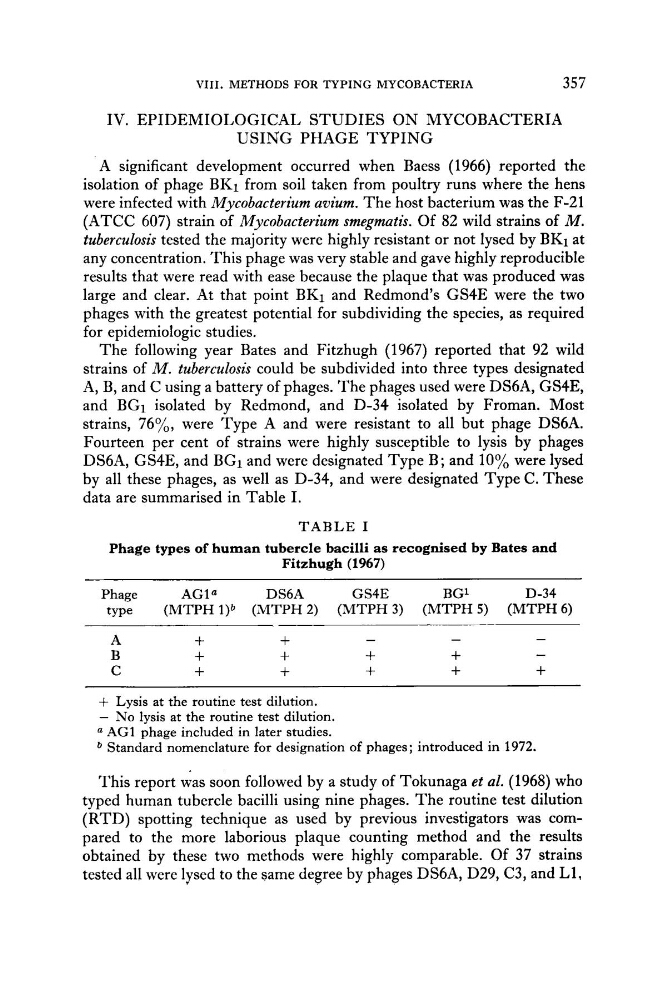
The following year Bates and Fitzhugh (1967) reported that 92 wild
strains of M . tuberculosis could be subdivided into three types designated
A, B, and C using a battery of phages. The phages used were DS6A, GS4E,
and BG1 isolated by Redmond, and D-34 isolated by Froman. Most
strains, 76%, were Type A and were resistant to all but phage DS6A.
Fourteen per cent of strains were highly susceptible to lysis by phages
DS6A, GS4E, and BG1 and were designated Type B; and 10% were lysed
by all these phages, as well as D-34, and were designated Type C. These
data are summarised in Table I.
T A B L E I
Phage types of human tubercle bacilli as recognised by Bates and
Fitzhugh (1967)
Phage
AG1a
DS6A
GS4E
BG1
D-34
type
(MTPH l)b (MTPH 2) (MTPH 3) (MTPH 5) (MTPH 6)
A
+
+
B
+
+
+
+
C
+
+
+
+
+
-
-
-
-
+ Lysis at the routine test dilution.
- No lysis at the routine test dilution.
a AGl phage included in later studies.
Standard nomenclature for designation of phages; introduced in 1972.
This report was soon followed by a study of Tokunaga et al. (1968) who
typed human tubercle bacilli using nine phages. The routine test dilution
(RTD) spotting technique as used by previous investigators was compared to the more laborious plaque counting method and the results
obtained by these two methods were highly comparable. Of 37 strains
tested all were lysed to the same degree by phages DS6A, D29, C3, and L1,
357
IV. EPIDEMIOLOGICAL STUDIES ON MYCOBACTERIA
USING PHAGE TYPING
A significant development occurred when Baess (1966) reported the
isolation of phage BK1 from soil taken from poultry runs where the hens
were infected with Mycobacterium avium. The host bacterium was the F-21
(ATCC 607) strain of Mycobacterium smegmatis. Of 82 wild strains of M .
tuberculosis tested the majority were highly resistant or not lysed by BKI at
any concentration. This phage was very stable and gave highly reproducible
results that were read with ease because the plaque that was produced was
large and clear. At that point BK1 and Redmond’s GS4E were the two
phages with the greatest potential for subdividing the species, as required
for epidemiologic studies.
The following year Bates and Fitzhugh (1967) reported that 92 wild
strains of M . tuberculosis could be subdivided into three types designated
A, B, and C using a battery of phages. The phages used were DS6A, GS4E,
and BG1 isolated by Redmond, and D-34 isolated by Froman. Most
strains, 76%, were Type A and were resistant to all but phage DS6A.
Fourteen per cent of strains were highly susceptible to lysis by phages
DS6A, GS4E, and BG1 and were designated Type B; and 10% were lysed
by all these phages, as well as D-34, and were designated Type C. These
data are summarised in Table I.
T A B L E I
Phage types of human tubercle bacilli as recognised by Bates and
Fitzhugh (1967)
Phage
AG1a
DS6A
GS4E
BG1
D-34
type
(MTPH l)b (MTPH 2) (MTPH 3) (MTPH 5) (MTPH 6)
A
+
+
B
+
+
+
+
C
+
+
+
+
+
-
-
-
-
+ Lysis at the routine test dilution.
- No lysis at the routine test dilution.
a AGl phage included in later studies.
Standard nomenclature for designation of phages; introduced in 1972.
This report was soon followed by a study of Tokunaga et al. (1968) who
typed human tubercle bacilli using nine phages. The routine test dilution
(RTD) spotting technique as used by previous investigators was compared to the more laborious plaque counting method and the results
obtained by these two methods were highly comparable. Of 37 strains
tested all were lysed to the same degree by phages DS6A, D29, C3, and L1,