

I. TYPING METHODS FOR CLOSTRIDIUM
15
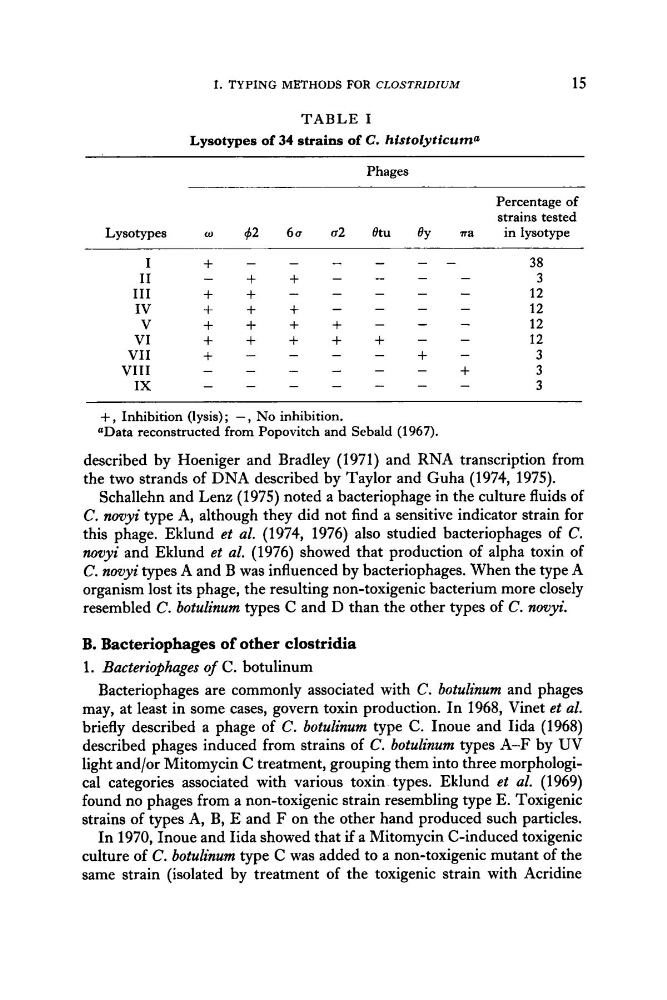
T A B L E I
Lysotypes of 34 strains of C. histolyticuma
Phages
Lysotypes
o
42
I
+ -
I1
- +
I11
+ +
IV
+ +
V
+ +
VI
+ +
VII
+ -
-
-
VIII
IX
-
-
60
Percentage of
strains tested
a2
B t u
By
ma
in iysotype
-
+
+
+
+
-
38
3
12
12
12
12
3
3
3
+ , Inhibition (lysis); - , No inhibition.
aData reconstructed from Popovitch and Sebald (1967).
described by Hoeniger and Bradley (1971) and RNA transcription from
the two strands of DNA described by Taylor and Guha (1974, 1975).
Schallehn and Lenz (1975) noted a bacteriophage in the culture fluids of
C. novyi type A, although they did not find a sensitive indicator strain for
this phage. Eklund et al. (1974, 1976) also studied bacteriophages of C.
novyi and Eklund et al. (1976) showed that production of alpha toxin of
C. novyi types A and B was influenced by bacteriophages. When the type A
organism lost its phage, the resulting non-toxigenic bacterium more closely
resembled C. botulinum types C and D than the other types of C. novyi.
B. Bacteriophages of other clostridia
1. Bacteriophages of C . botulinum
Bacteriophages are commonly associated with C. botulinum and phages
may, at least in some cases, govern toxin production. In 1968, Vinet et al.
briefly described a phage of C. botulinum type C . Inoue and Iida (1968)
described phages induced from strains of C. botulinum types A-F by UV
light and/or Mitomycin C treatment, grouping them into three morphological categories associated with various toxin types. Eklund et al. (1969)
found no phages from a non-toxigenic strain resembling type E. Toxigenic
strains of types A, B, E and F on the other hand produced such particles.
In 1970, Inoue and Iida showed that if a Mitomycin C-induced toxigenic
culture of C. botulinum type C was added to a non-toxigenic mutant of the
same strain (isolated by treatment of the toxigenic strain with Acridine
15
T A B L E I
Lysotypes of 34 strains of C. histolyticuma
Phages
Lysotypes
o
42
I
+ -
I1
- +
I11
+ +
IV
+ +
V
+ +
VI
+ +
VII
+ -
-
-
VIII
IX
-
-
60
Percentage of
strains tested
a2
B t u
By
ma
in iysotype
-
+
+
+
+
-
38
3
12
12
12
12
3
3
3
+ , Inhibition (lysis); - , No inhibition.
aData reconstructed from Popovitch and Sebald (1967).
described by Hoeniger and Bradley (1971) and RNA transcription from
the two strands of DNA described by Taylor and Guha (1974, 1975).
Schallehn and Lenz (1975) noted a bacteriophage in the culture fluids of
C. novyi type A, although they did not find a sensitive indicator strain for
this phage. Eklund et al. (1974, 1976) also studied bacteriophages of C.
novyi and Eklund et al. (1976) showed that production of alpha toxin of
C. novyi types A and B was influenced by bacteriophages. When the type A
organism lost its phage, the resulting non-toxigenic bacterium more closely
resembled C. botulinum types C and D than the other types of C. novyi.
B. Bacteriophages of other clostridia
1. Bacteriophages of C . botulinum
Bacteriophages are commonly associated with C. botulinum and phages
may, at least in some cases, govern toxin production. In 1968, Vinet et al.
briefly described a phage of C. botulinum type C . Inoue and Iida (1968)
described phages induced from strains of C. botulinum types A-F by UV
light and/or Mitomycin C treatment, grouping them into three morphological categories associated with various toxin types. Eklund et al. (1969)
found no phages from a non-toxigenic strain resembling type E. Toxigenic
strains of types A, B, E and F on the other hand produced such particles.
In 1970, Inoue and Iida showed that if a Mitomycin C-induced toxigenic
culture of C. botulinum type C was added to a non-toxigenic mutant of the
same strain (isolated by treatment of the toxigenic strain with Acridine