

VI. IDENTIFICATION OF ACTINOM YCES AND ARACHNIA
295
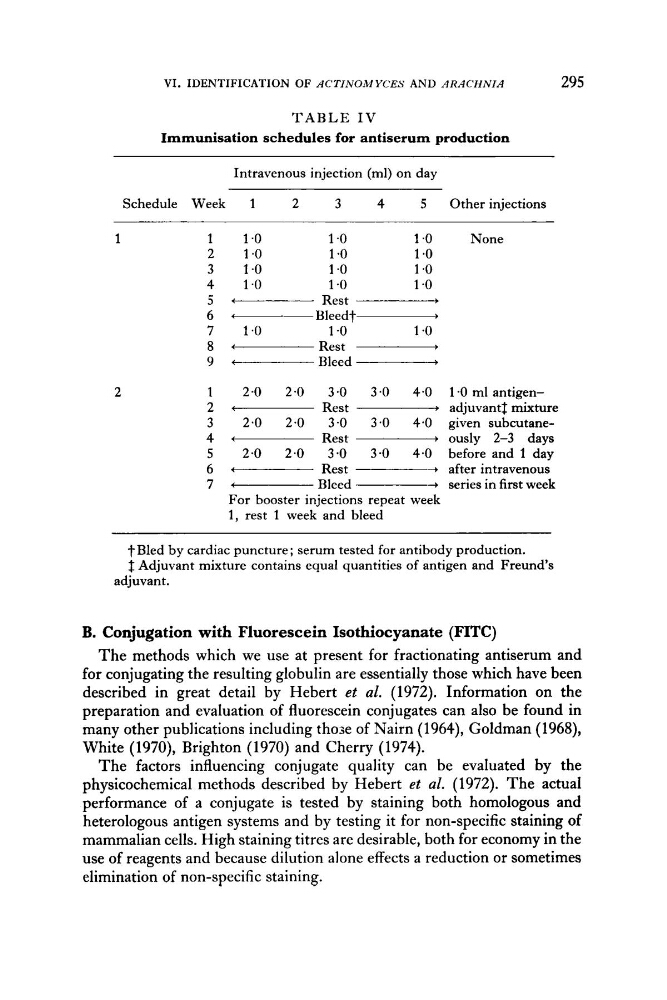
T A B L E I V
Immunisation schedules for antiserum production
Intravenous injection (ml) on day
Schedule Week
1
2
3
4
5
Other injections
1
1
2
3
4
5
6
7
8
1 .o
1 .o
1 .o
None
1 .o
1 .o
1 .o
1 .o
1 .o
1 .o
1 .o
1 .o
1 .o
<
Rest
+
<
Bleed+
>
1 .o
1 .o
1 .o
4
Rest
P
2
1
2.0
2.0
3.0
3.0
4.0 1.0 ml antigen2 <
Rest
* adjuvant1 mixture
3
2.0
2.0
3.0
3.0
4.0 given subcutane4 - Rest - ously 2-3 days
5
2.0
2.0
3.0
3.0
4.0 before and 1 day
6 t - - - Rest
+ after intravenous
7 i
Bleed - series in first week
For booster injections repeat week
1, rest 1 week and bleed
-f Bled by cardiac puncture; serum tested for antibody production.
1 Adjuvant mixture contains equal quantities of antigen and Freund’s
adjuvant.
B. Conjugation with Fluorescein Isothiocyanate (FITC)
T h e methods which we use at present for fractionating antiserum and
for conjugating the resulting globulin are essentially those which have been
described in great detail by Hebert et al. (1972). Information on the
preparation and evaluation of fluorescein conjugates can also be found in
many other publications including those of Nairn (1964), Goldman (1968),
White (1970), Brighton (1970) and Cherry (1974).
The factors influencing conjugate quality can be evaluated by the
physicochemical methods described by Hebert et al. (1972). The actual
performance of a conjugate is tested by staining both homologous and
heterologous antigen systems and by testing it for non-specific staining of
mammalian cells. High staining titres are desirable, both for economy in the
use of reagents and because dilution alone effects a reduction or sometimes
elimination of non-specific staining.
295
T A B L E I V
Immunisation schedules for antiserum production
Intravenous injection (ml) on day
Schedule Week
1
2
3
4
5
Other injections
1
1
2
3
4
5
6
7
8
1 .o
1 .o
1 .o
None
1 .o
1 .o
1 .o
1 .o
1 .o
1 .o
1 .o
1 .o
1 .o
<
Rest
+
<
Bleed+
>
1 .o
1 .o
1 .o
4
Rest
P
2
1
2.0
2.0
3.0
3.0
4.0 1.0 ml antigen2 <
Rest
* adjuvant1 mixture
3
2.0
2.0
3.0
3.0
4.0 given subcutane4 - Rest - ously 2-3 days
5
2.0
2.0
3.0
3.0
4.0 before and 1 day
6 t - - - Rest
+ after intravenous
7 i
Bleed - series in first week
For booster injections repeat week
1, rest 1 week and bleed
-f Bled by cardiac puncture; serum tested for antibody production.
1 Adjuvant mixture contains equal quantities of antigen and Freund’s
adjuvant.
B. Conjugation with Fluorescein Isothiocyanate (FITC)
T h e methods which we use at present for fractionating antiserum and
for conjugating the resulting globulin are essentially those which have been
described in great detail by Hebert et al. (1972). Information on the
preparation and evaluation of fluorescein conjugates can also be found in
many other publications including those of Nairn (1964), Goldman (1968),
White (1970), Brighton (1970) and Cherry (1974).
The factors influencing conjugate quality can be evaluated by the
physicochemical methods described by Hebert et al. (1972). The actual
performance of a conjugate is tested by staining both homologous and
heterologous antigen systems and by testing it for non-specific staining of
mammalian cells. High staining titres are desirable, both for economy in the
use of reagents and because dilution alone effects a reduction or sometimes
elimination of non-specific staining.