

VI. IDENTIFICATION OF ACTINOM YCES AND ARACHNIA
289
Actinobacterium meyerii by Prevot have been studied (Holmberg and Nord,
1975; Smith, 1975) and found to be different from other Actinomyces
species.
Identification of Actinomyces and Arachnia isolates is often difficult
because of problems in obtaining and maintaining pure cultures, a requirement for special media and procedures such as end product analysis, and
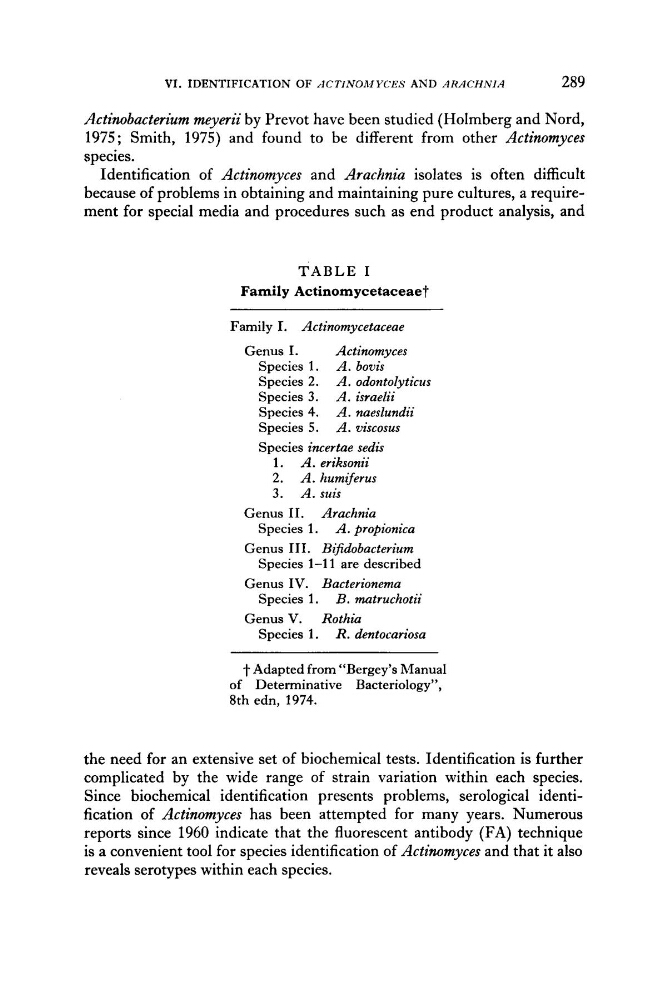
T A B L E I
Family Actinomycetaceaet
Family I. Actinomycetaceae
Genus I.
Actinomyces
Species 1. A . bovis
Species 2 . A . odontolyticus
Species 3 . A . israelii
Species 4. A . naeslundii
Species 5 . A. viscosus
Species incertae sedis
1. A . eriksonii
2 . A . humiferus
3. A . suis
Genus 11. Arachnia
Species 1. A . propionica
Genus 111. Bifidobacterium
Species 1-1 1 are described
Genus IV. Bacterionema
Species 1. B. matruchotii
Genus V. Rothia
Species 1. R. dentocariosa
t Adapted from “Bergey’s Manual
of Determinative Bacteriology”,
8th edn, 1974.
the need for an extensive set of biochemical tests. Identification is further
complicated by the wide range of strain variation within each species.
Since biochemical identification presents problems, serological identification of Actinomyces has been attempted for many years. Numerous
reports since 1960 indicate that the fluorescent antibody (FA) technique
is a convenient tool for species identification of Actinomyces and that it also
reveals serotypes within each species.
289
Actinobacterium meyerii by Prevot have been studied (Holmberg and Nord,
1975; Smith, 1975) and found to be different from other Actinomyces
species.
Identification of Actinomyces and Arachnia isolates is often difficult
because of problems in obtaining and maintaining pure cultures, a requirement for special media and procedures such as end product analysis, and
T A B L E I
Family Actinomycetaceaet
Family I. Actinomycetaceae
Genus I.
Actinomyces
Species 1. A . bovis
Species 2 . A . odontolyticus
Species 3 . A . israelii
Species 4. A . naeslundii
Species 5 . A. viscosus
Species incertae sedis
1. A . eriksonii
2 . A . humiferus
3. A . suis
Genus 11. Arachnia
Species 1. A . propionica
Genus 111. Bifidobacterium
Species 1-1 1 are described
Genus IV. Bacterionema
Species 1. B. matruchotii
Genus V. Rothia
Species 1. R. dentocariosa
t Adapted from “Bergey’s Manual
of Determinative Bacteriology”,
8th edn, 1974.
the need for an extensive set of biochemical tests. Identification is further
complicated by the wide range of strain variation within each species.
Since biochemical identification presents problems, serological identification of Actinomyces has been attempted for many years. Numerous
reports since 1960 indicate that the fluorescent antibody (FA) technique
is a convenient tool for species identification of Actinomyces and that it also
reveals serotypes within each species.