

276
T. BERGAN
country. The lesser discrimination afforded by the N2A scheme compared
to N8 is reflected in a larger number of strains within each of the patterns
listed for the former discrimination alternative.
One word of caution is necessary regarding the size of plaques in relation
to RTD. Phages may exhibit large plaques on their host-propagating
strains, but small plaques on other strains. In some instances, small plaques
with one phage may be a characteristic of a particular infecting strain so
that it may serve as an additional marker of the epidemic strains. Occasionally, a phage pattern is not easily interpreted or converted into any given
pattern. Phage patterns not listed among the reference types are designated
N S T (no specific type) or NC (not characterised). Strains without any
phage reactions are indicated by N T (non-typable).
8. Phage type frequencies
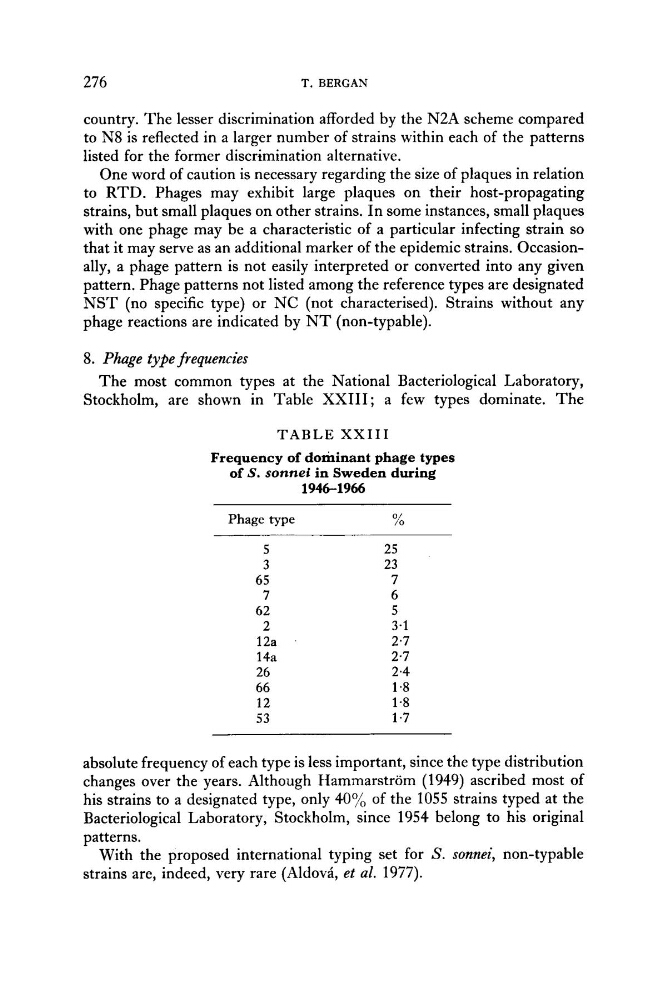
The most common types at the National Bacteriological Laboratory,
Stockholm, are shown in Table XXIII; a few types dominate. The
T A B L E X X I I I
Frequency of dominant phage types
of S. sonnei in Sweden during
1946-1966
Phage type
%
5
3
65
7
62
2
12a
14a
26
66
12
53
25
23
7
6
5
3.1
2.7
2.7
2.4
1.8
1.8
1.7
absolute frequency of each type is less important, since the type distribution
changes over the years. Although Hammarstrom (1949) ascribed most of
his strains to a designated type, only 40% of the 1055 strains typed at the
Bacteriological Laboratory, Stockholm, since 1954 belong to his original
patterns.
With the proposed international typing set for S . sonnei, non-typable
strains are, indeed, very rare (Aldovri, et al. 1977).
T. BERGAN
country. The lesser discrimination afforded by the N2A scheme compared
to N8 is reflected in a larger number of strains within each of the patterns
listed for the former discrimination alternative.
One word of caution is necessary regarding the size of plaques in relation
to RTD. Phages may exhibit large plaques on their host-propagating
strains, but small plaques on other strains. In some instances, small plaques
with one phage may be a characteristic of a particular infecting strain so
that it may serve as an additional marker of the epidemic strains. Occasionally, a phage pattern is not easily interpreted or converted into any given
pattern. Phage patterns not listed among the reference types are designated
N S T (no specific type) or NC (not characterised). Strains without any
phage reactions are indicated by N T (non-typable).
8. Phage type frequencies
The most common types at the National Bacteriological Laboratory,
Stockholm, are shown in Table XXIII; a few types dominate. The
T A B L E X X I I I
Frequency of dominant phage types
of S. sonnei in Sweden during
1946-1966
Phage type
%
5
3
65
7
62
2
12a
14a
26
66
12
53
25
23
7
6
5
3.1
2.7
2.7
2.4
1.8
1.8
1.7
absolute frequency of each type is less important, since the type distribution
changes over the years. Although Hammarstrom (1949) ascribed most of
his strains to a designated type, only 40% of the 1055 strains typed at the
Bacteriological Laboratory, Stockholm, since 1954 belong to his original
patterns.
With the proposed international typing set for S . sonnei, non-typable
strains are, indeed, very rare (Aldovri, et al. 1977).