

272
T. BERGAN
T A B L E X I X
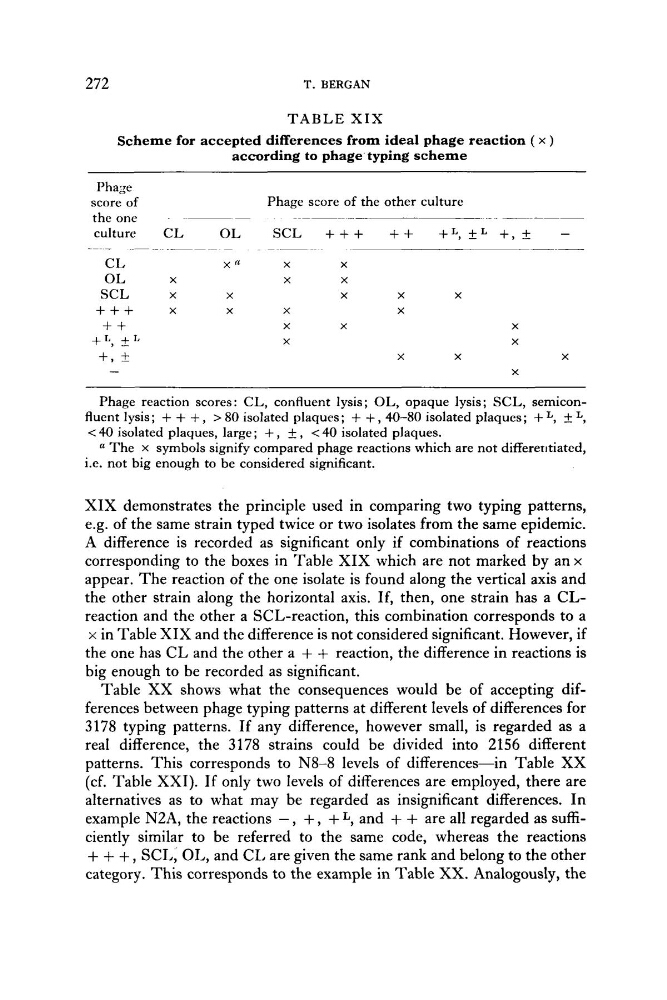
Scheme for accepted differences from ideal phage reaction ( x )
according to phage typing scheme
Phage
score of
the one
culture
C L
O L
SCL
+ + +
+ +
+ L , t ”
+, ?
- ~ - ~
-
Phage score of the other culture
-
~~
SCL
+ + + + + + L , f L + , f -
_
_
~
_
_
~
~~
X
X
X
X
X
X
X
X
X
X
X
X
X
X
X
X
X
X
Phage reaction scores: CL, confluent lysis; OL, opaque lysis; SCL, semiconfluent lysis; + + + , > 80 isolated plaques; + + , 40-80 isolated plaques; + L, k L,
< 40 isolated plaques, large; + , k , < 40 isolated plaques.
a The x symbols signify compared phage reactions which are not differentiated,
i.e. not big enough to be considered significant.
XIX demonstrates the principle used in comparing two typing patterns,
e.g. of the same strain typed twice or two isolates from the same epidemic.
A difference is recorded as significant only if combinations of reactions
corresponding to the boxes in Table XIX which are not marked by an x
appear. The reaction of the one isolate is found along the vertical axis and
the other strain along the horizontal axis. If, then, one strain has a CLreaction and the other a SCL-reaction, this combination corresponds to a
x in Table XIX and the difference is not considered significant. However, if
the one has C L and the other a + + reaction, the difference in reactions is
big enough to be recorded as significant.
Table XX shows what the consequences would be of accepting differences between phage typing patterns at different levels of differences for
3178 typing patterns. If any difference, however small, is regarded as a
real difference, the 3178 strains could be divided into 2156 different
patterns. This corresponds to N8-8 levels of differences-in Table XX
(cf. Table XXI). If only two levels of differences are employed, there are
alternatives as to what may be regarded as insignificant differences. I n
example NZA, the reactions - , + , + L, and + + are all regarded as sufficiently similar to be referred to the same code, whereas the reactions
+ + + , SCL, OL, and CL, are given the same rank and belong to the other
category. This corresponds to the example in Table XX. Analogously, the
T. BERGAN
T A B L E X I X
Scheme for accepted differences from ideal phage reaction ( x )
according to phage typing scheme
Phage
score of
the one
culture
C L
O L
SCL
+ + +
+ +
+ L , t ”
+, ?
- ~ - ~
-
Phage score of the other culture
-
~~
SCL
+ + + + + + L , f L + , f -
_
_
~
_
_
~
~~
X
X
X
X
X
X
X
X
X
X
X
X
X
X
X
X
X
X
Phage reaction scores: CL, confluent lysis; OL, opaque lysis; SCL, semiconfluent lysis; + + + , > 80 isolated plaques; + + , 40-80 isolated plaques; + L, k L,
< 40 isolated plaques, large; + , k , < 40 isolated plaques.
a The x symbols signify compared phage reactions which are not differentiated,
i.e. not big enough to be considered significant.
XIX demonstrates the principle used in comparing two typing patterns,
e.g. of the same strain typed twice or two isolates from the same epidemic.
A difference is recorded as significant only if combinations of reactions
corresponding to the boxes in Table XIX which are not marked by an x
appear. The reaction of the one isolate is found along the vertical axis and
the other strain along the horizontal axis. If, then, one strain has a CLreaction and the other a SCL-reaction, this combination corresponds to a
x in Table XIX and the difference is not considered significant. However, if
the one has C L and the other a + + reaction, the difference in reactions is
big enough to be recorded as significant.
Table XX shows what the consequences would be of accepting differences between phage typing patterns at different levels of differences for
3178 typing patterns. If any difference, however small, is regarded as a
real difference, the 3178 strains could be divided into 2156 different
patterns. This corresponds to N8-8 levels of differences-in Table XX
(cf. Table XXI). If only two levels of differences are employed, there are
alternatives as to what may be regarded as insignificant differences. I n
example NZA, the reactions - , + , + L, and + + are all regarded as sufficiently similar to be referred to the same code, whereas the reactions
+ + + , SCL, OL, and CL, are given the same rank and belong to the other
category. This corresponds to the example in Table XX. Analogously, the