

V. BACTERIOPHAGE TYPING OF SHIGELLA
217
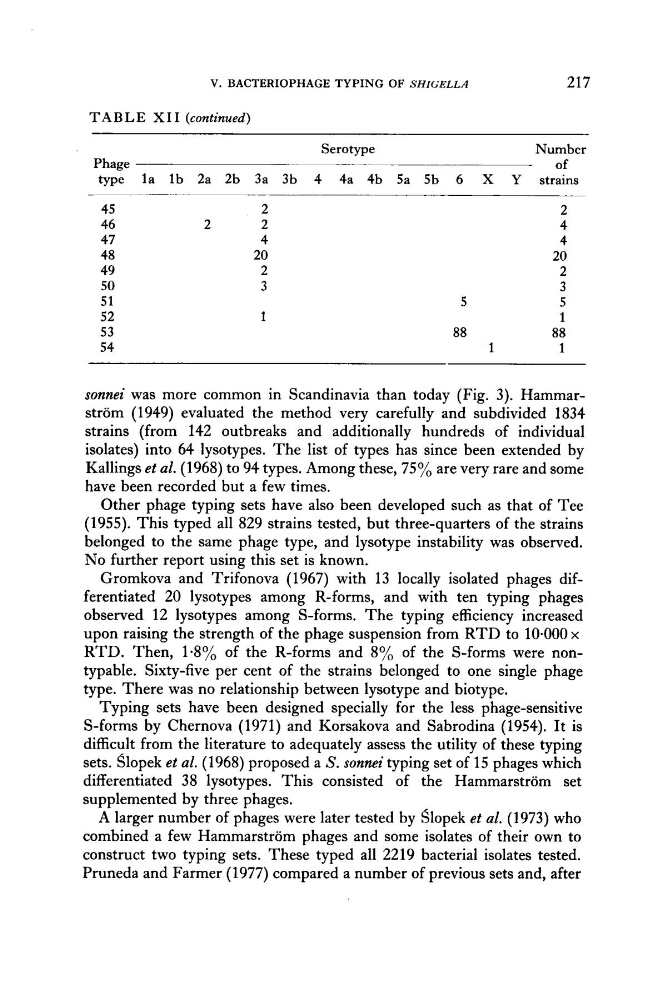
T A B L E XI1 (continued)
Serotype
Number
Phage
of
type l a l b 2a 2b 3a 3b 4 4a 4b 5a 5b 6 X Y strains
45
46
47
48
49
50
51
52
53
54
2
2
2
4
20
2
3
1
2
4
4
20
2
3
5
5
1
88
88
1
1
sonnei was more common in Scandinavia than today (Fig. 3). Hammarstrom (1949) evaluated the method very carefully and subdivided 1834
strains (from 142 outbreaks and additionally hundreds of individual
isolates) into 64 lysotypes. The list of types has since been extended by
Kallings et al. (1968) to 94 types. Among these, 75% are very rare and some
have been recorded but a few times.
Other phage typing sets have also been developed such as that of Tee
(1955). This typed all 829 strains tested, but three-quarters of the strains
belonged to the same phage type, and lysotype instability was observed.
No further report using this set is known.
Gromkova and Trifonova (1967) with 13 locally isolated phages differentiated 20 lysotypes among R-forms, and with ten typing phages
observed 12 lysotypes among S-forms. The typing efficiency increased
upon raising the strength of the phage suspension from RTD to 10.000 x
RTD. Then, 1.8% of the R-forms and 8% of the S-forms were nontypable. Sixty-five per cent of the strains belonged to one single phage
type. There was no relationship between lysotype and biotype.
Typing sets have been designed specially for the less phage-sensitive
S-forms by Chernova (1971) and Korsakova and Sabrodina (1954). It is
difficult from the literature to adequately assess the utility of these typing
sets. Slopek et al. (1968) proposed a S. sonnei typing set of 15 phages which
differentiated 38 lysotypes. This consisted of the Hammarstrom set
supplemented by three phages.
A larger number of phages were later tested by Slopek et al. (1973) who
combined a few Hammarstrom phages and some isolates of their own to
construct two typing sets. These typed all 2219 bacterial isolates tested.
Pruneda and Farmer (1977) compared a number of previous sets and, after
217
T A B L E XI1 (continued)
Serotype
Number
Phage
of
type l a l b 2a 2b 3a 3b 4 4a 4b 5a 5b 6 X Y strains
45
46
47
48
49
50
51
52
53
54
2
2
2
4
20
2
3
1
2
4
4
20
2
3
5
5
1
88
88
1
1
sonnei was more common in Scandinavia than today (Fig. 3). Hammarstrom (1949) evaluated the method very carefully and subdivided 1834
strains (from 142 outbreaks and additionally hundreds of individual
isolates) into 64 lysotypes. The list of types has since been extended by
Kallings et al. (1968) to 94 types. Among these, 75% are very rare and some
have been recorded but a few times.
Other phage typing sets have also been developed such as that of Tee
(1955). This typed all 829 strains tested, but three-quarters of the strains
belonged to the same phage type, and lysotype instability was observed.
No further report using this set is known.
Gromkova and Trifonova (1967) with 13 locally isolated phages differentiated 20 lysotypes among R-forms, and with ten typing phages
observed 12 lysotypes among S-forms. The typing efficiency increased
upon raising the strength of the phage suspension from RTD to 10.000 x
RTD. Then, 1.8% of the R-forms and 8% of the S-forms were nontypable. Sixty-five per cent of the strains belonged to one single phage
type. There was no relationship between lysotype and biotype.
Typing sets have been designed specially for the less phage-sensitive
S-forms by Chernova (1971) and Korsakova and Sabrodina (1954). It is
difficult from the literature to adequately assess the utility of these typing
sets. Slopek et al. (1968) proposed a S. sonnei typing set of 15 phages which
differentiated 38 lysotypes. This consisted of the Hammarstrom set
supplemented by three phages.
A larger number of phages were later tested by Slopek et al. (1973) who
combined a few Hammarstrom phages and some isolates of their own to
construct two typing sets. These typed all 2219 bacterial isolates tested.
Pruneda and Farmer (1977) compared a number of previous sets and, after