

210
T. BERGAN
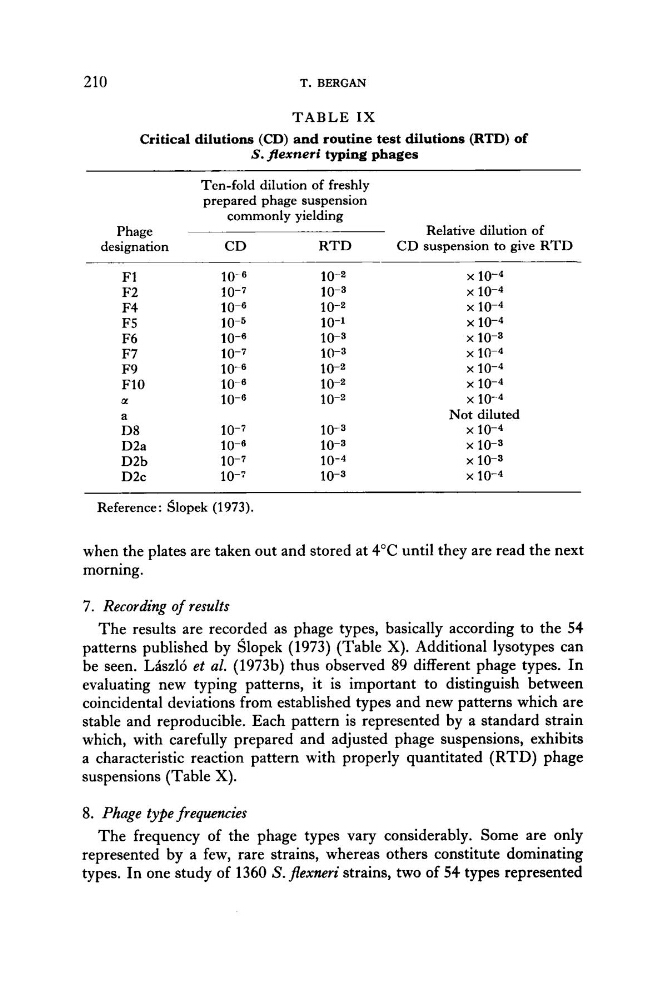
T A B L E I X
Critical dilutions (CD) and routine test dilutions (RTD) of
S. pexneri typing phages
Ten-fold dilution of freshly
prepared phage suspension
commonly yielding
Phage
Relative dilution of
designation
C D
R T D
C D suspension to give RTD
F1
F2
F4
F5
F6
F7
F9
F10
a
D8
D2a
D2b
D2c
a
10-6
10-6
10-6
10-6
10-6
10-6
10-7
10-5
10-7
10-7
10-7
10-6
10-7
10-2
10-2
10-1
10-3
10-3
10-3
10-2
10-2
10-2
10-3
10-3
10-4
10-3
x 10-4
x 10-4
x 10-4
x 10-4
x 10-3
x 10-4
x 10-4
x 10-4
x 10-4
x 10-4
x 10-3
x 10-3
x 10-4
Not diluted
Reference: Slopek (1973).
when the plates are taken out and stored at 4°C until they are read the next
morning.
7. Recording of results
The results are recorded as phage types, basically according to the 54
patterns published by Slopek (1973) (Table X). Additional lysotypes can
be seen. LBsz16 et al. (197315) thus observed 89 different phage types. In
evaluating new typing patterns, it is important to distinguish between
coincidental deviations from established types and new patterns which are
stable and reproducible. Each pattern is represented by a standard strain
which, with carefully prepared and adjusted phage suspensions, exhibits
a characteristic reaction pattern with properly quantitated (RTD) phage
suspensions (Table X).
8. Phage type frequencies
The frequency of the phage types vary considerably. Some are only
represented by a few, rare strains, whereas others constitute dominating
types. In one study of 1360 S. flexneri strains, two of 54 types represented
T. BERGAN
T A B L E I X
Critical dilutions (CD) and routine test dilutions (RTD) of
S. pexneri typing phages
Ten-fold dilution of freshly
prepared phage suspension
commonly yielding
Phage
Relative dilution of
designation
C D
R T D
C D suspension to give RTD
F1
F2
F4
F5
F6
F7
F9
F10
a
D8
D2a
D2b
D2c
a
10-6
10-6
10-6
10-6
10-6
10-6
10-7
10-5
10-7
10-7
10-7
10-6
10-7
10-2
10-2
10-1
10-3
10-3
10-3
10-2
10-2
10-2
10-3
10-3
10-4
10-3
x 10-4
x 10-4
x 10-4
x 10-4
x 10-3
x 10-4
x 10-4
x 10-4
x 10-4
x 10-4
x 10-3
x 10-3
x 10-4
Not diluted
Reference: Slopek (1973).
when the plates are taken out and stored at 4°C until they are read the next
morning.
7. Recording of results
The results are recorded as phage types, basically according to the 54
patterns published by Slopek (1973) (Table X). Additional lysotypes can
be seen. LBsz16 et al. (197315) thus observed 89 different phage types. In
evaluating new typing patterns, it is important to distinguish between
coincidental deviations from established types and new patterns which are
stable and reproducible. Each pattern is represented by a standard strain
which, with carefully prepared and adjusted phage suspensions, exhibits
a characteristic reaction pattern with properly quantitated (RTD) phage
suspensions (Table X).
8. Phage type frequencies
The frequency of the phage types vary considerably. Some are only
represented by a few, rare strains, whereas others constitute dominating
types. In one study of 1360 S. flexneri strains, two of 54 types represented