

V. BACTERIOPHAGE TYPING OF S H I G E I L A
193
T A B L E V I I
Properties of typing phages of international typing set of S. fIexneri
Host
Phage
serogating
Phage strain Morphological
gical
strain
Original
designations
type
type
(serotype)
source
F1
A-1-1
l a (Weil) S. Slopek, hen faeces
F2
B-1-1
F
4a (Weil) S. Slopek, hen faeces
F4
B-1-1
B
2b (Weil) S. Slopek, hen faeces
F5
B-1-1
D
2b (Weil) S. Slopek, hen faeces
F6
A-1-1
D
l b (Weil) S. Slopek, hen faeces
F7
c - I I I- 1
S. Slopek, hen faeces
F9
B-1-1
B
2a (Weil) S. Slopek, hen faeces
F10
c-111-1
A
6 (435) E. Hammarstrom [origina
B-I 2
A
4 (Istrati) G. Istrati
a
c-111-1
4 (118) G. Istrati
D8
c-111-1
B
l b (Milch) H. Milch, lysogenic bacteria
D2a
c-111-1
*
4g (106) H. Milch, lysogenic bacteria
D2b
B-1-1
*
3a (109) H. Milch, lysogenic bacteria
D2c
c-11-1
*
1 b (449) H. Milch, lysogenic bacteria
ally called X), hen faeces
The F1, F5, F6, F4, and F9 bacteriophages were isolated in 1942 by Slopek and
The F2 bacteriophage was isolated in 1955 by Mulczyk and Kucharewicz and
The F7 bacteriophage was isolated in 1957 by Mulczyk and adapted to S. flexnwi
* The parent preparation from which the D2a, D2G, and D2c were isolated,
References: Krzywy and Slopek (1974); Mulczyk and Slopek (1961); Slopek
adapted to S. jlexneri serotypes la, 5 , 2a, 2b, and 4 respectively.
adapted to S. jlexneri serotype 4a.
serotype 2c.
belonged to phage serotype F.
(1973); Slopek and Mulczyk (1961).
(c) Maintenance of bacterial strains. Three parts egg (white and yolk) and
one part physiological saline. Sterilised by heating to 85°C three days in a
row.
(d) Subcultivation. Any medium suitable for growing enterobacteria may
be used to prepare precultures before typing.
4. Propagation of phages
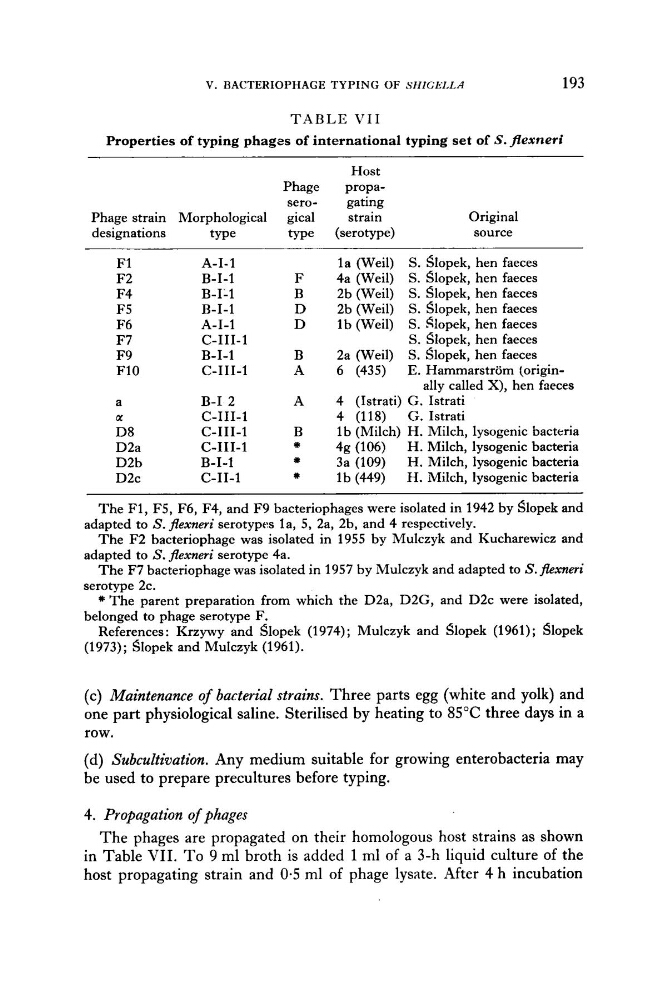
The phages are propagated on their homologous host strains as shown
in Table VII. T o 9 ml broth is added 1 ml of a 3-h liquid culture of the
host propagating strain and 0.5 ml of phage lysate. After 4 h incubation
193
T A B L E V I I
Properties of typing phages of international typing set of S. fIexneri
Host
Phage
serogating
Phage strain Morphological
gical
strain
Original
designations
type
type
(serotype)
source
F1
A-1-1
l a (Weil) S. Slopek, hen faeces
F2
B-1-1
F
4a (Weil) S. Slopek, hen faeces
F4
B-1-1
B
2b (Weil) S. Slopek, hen faeces
F5
B-1-1
D
2b (Weil) S. Slopek, hen faeces
F6
A-1-1
D
l b (Weil) S. Slopek, hen faeces
F7
c - I I I- 1
S. Slopek, hen faeces
F9
B-1-1
B
2a (Weil) S. Slopek, hen faeces
F10
c-111-1
A
6 (435) E. Hammarstrom [origina
B-I 2
A
4 (Istrati) G. Istrati
a
c-111-1
4 (118) G. Istrati
D8
c-111-1
B
l b (Milch) H. Milch, lysogenic bacteria
D2a
c-111-1
*
4g (106) H. Milch, lysogenic bacteria
D2b
B-1-1
*
3a (109) H. Milch, lysogenic bacteria
D2c
c-11-1
*
1 b (449) H. Milch, lysogenic bacteria
ally called X), hen faeces
The F1, F5, F6, F4, and F9 bacteriophages were isolated in 1942 by Slopek and
The F2 bacteriophage was isolated in 1955 by Mulczyk and Kucharewicz and
The F7 bacteriophage was isolated in 1957 by Mulczyk and adapted to S. flexnwi
* The parent preparation from which the D2a, D2G, and D2c were isolated,
References: Krzywy and Slopek (1974); Mulczyk and Slopek (1961); Slopek
adapted to S. jlexneri serotypes la, 5 , 2a, 2b, and 4 respectively.
adapted to S. jlexneri serotype 4a.
serotype 2c.
belonged to phage serotype F.
(1973); Slopek and Mulczyk (1961).
(c) Maintenance of bacterial strains. Three parts egg (white and yolk) and
one part physiological saline. Sterilised by heating to 85°C three days in a
row.
(d) Subcultivation. Any medium suitable for growing enterobacteria may
be used to prepare precultures before typing.
4. Propagation of phages
The phages are propagated on their homologous host strains as shown
in Table VII. T o 9 ml broth is added 1 ml of a 3-h liquid culture of the
host propagating strain and 0.5 ml of phage lysate. After 4 h incubation