

IV. INVESTIGATION OF C. DIPHTHERIAE
121
ulcerans and C. ovis (Maximescu et al., 1974a, b) were carried out with a
view to detecting other characters that would contribute to a correct
circumscription of each species. The authors tried to find a phagesensitivity
“marker” to define the borderline between the species.
During an early period, C. ulcerans and C. ovis were rarely lysed by
C. diphtheriae typing phages; C. ulcerans could not be classified into known
lytic “patterns”. I n contrast, C. ulcerans typing phages were more active.
C. ulcerans phages are known to be species specific and stable (Henriksen,
1955).
The phages proved useful for lysosensitivity testing since all available
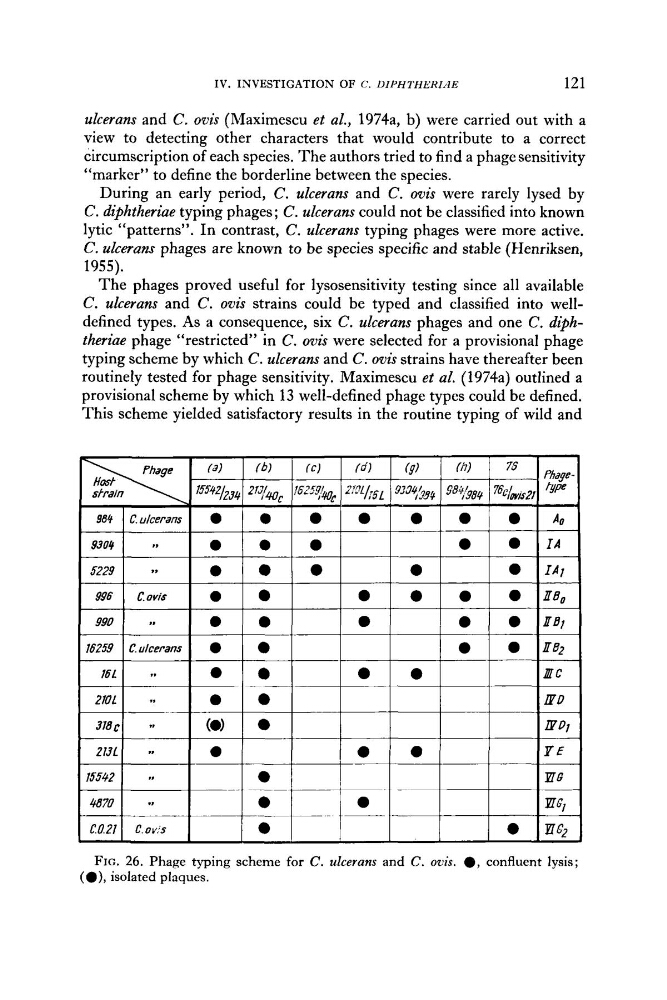
C. ulcerans and C. ovis strains could be typed and classified into welldefined types. As a consequence, six C. ulcerans phages and one C. diphtheriae phage “restricted” in C. ovis were selected for a provisional phage
typing scheme by which C. ulcerans and C . ovis strains have thereafter been
routinely tested for phage sensitivity. Maximescu et al. (1974a) outlined a
provisional scheme by which 13 well-defined phage types could be defined.
This scheme yielded satisfactory results in the routine typing of wild and
-
984
9304
5229
996
990
16259
16L
2lOL
318 c
213L
15542
4870
c.0.21
-
-
__
-
-
-
-
~
-
-
-
-
-
I
I .
nc,
FIG. 26. Phage typing scheme for C. ulcerans and C. ovis. 0 , confluent lysis;
(a), isolated plaques.
121
ulcerans and C. ovis (Maximescu et al., 1974a, b) were carried out with a
view to detecting other characters that would contribute to a correct
circumscription of each species. The authors tried to find a phagesensitivity
“marker” to define the borderline between the species.
During an early period, C. ulcerans and C. ovis were rarely lysed by
C. diphtheriae typing phages; C. ulcerans could not be classified into known
lytic “patterns”. I n contrast, C. ulcerans typing phages were more active.
C. ulcerans phages are known to be species specific and stable (Henriksen,
1955).
The phages proved useful for lysosensitivity testing since all available
C. ulcerans and C. ovis strains could be typed and classified into welldefined types. As a consequence, six C. ulcerans phages and one C. diphtheriae phage “restricted” in C. ovis were selected for a provisional phage
typing scheme by which C. ulcerans and C . ovis strains have thereafter been
routinely tested for phage sensitivity. Maximescu et al. (1974a) outlined a
provisional scheme by which 13 well-defined phage types could be defined.
This scheme yielded satisfactory results in the routine typing of wild and
-
984
9304
5229
996
990
16259
16L
2lOL
318 c
213L
15542
4870
c.0.21
-
-
__
-
-
-
-
~
-
-
-
-
-
I
I .
nc,
FIG. 26. Phage typing scheme for C. ulcerans and C. ovis. 0 , confluent lysis;
(a), isolated plaques.