

110
A. SARAGEA E T A L .
The sensitive strains could be divided by the set of 20 bacteriocinogenic strains listed in 16 bacteriocin groups (A to P). The strains
belonging to group A are sensitive to bacteriocinogenic strain 1 ; those
contained in group B are resistant to bacteriocins of strain 1 and obligatorily sensitive to the bacteriocin of strain 2 (see Fig. 20). Twelve of the
16 bacteriocin groups were further subdivided into several types. For
instance the A1, A2, Aa, etc. bacteriocin types all belonged to bacteriocin
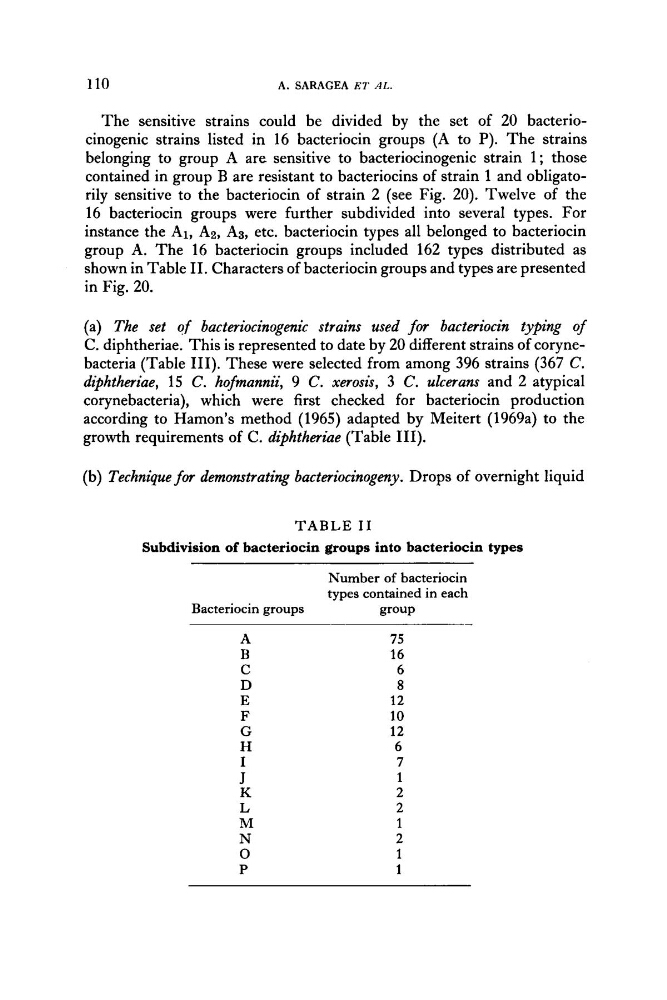
group A. The 16 bacteriocin groups included 162 types distributed as
shown in Table 11. Characters of bacteriocin groups and types are presented
in Fig. 20.
(a) The set of bacteriocinogenic strains used for bacteriocin typing of
C. diphtheriae. This is represented to date by 20 different strains of corynebacteria (Table 111). These were selected from among 396 strains (367 C.
diphtheriae, 15 C. hofmannii, 9 C. xerosis, 3 C. ulcerans and 2 atypical
corynebacteria), which were first checked for bacteriocin production
according to Hamon’s method (1965) adapted by Meitert (1969a) to the
growth requirements of C. diphtheriae (Table 111).
(b) Technique fbr demonstrating bacteriocinogeny. Drops of overnight liquid
T A B L E I 1
Subdivision of bacteriocin groups into bacteriocin types
Number of bacteriocin
types contained in each
Bacteriocin groups
group
A
B
C
D
E
F
G
H
I
J
K
L
M
N
0
P
75
16
6
8
12
10
12
6
7
1
2
2
1
2
1
1
A. SARAGEA E T A L .
The sensitive strains could be divided by the set of 20 bacteriocinogenic strains listed in 16 bacteriocin groups (A to P). The strains
belonging to group A are sensitive to bacteriocinogenic strain 1 ; those
contained in group B are resistant to bacteriocins of strain 1 and obligatorily sensitive to the bacteriocin of strain 2 (see Fig. 20). Twelve of the
16 bacteriocin groups were further subdivided into several types. For
instance the A1, A2, Aa, etc. bacteriocin types all belonged to bacteriocin
group A. The 16 bacteriocin groups included 162 types distributed as
shown in Table 11. Characters of bacteriocin groups and types are presented
in Fig. 20.
(a) The set of bacteriocinogenic strains used for bacteriocin typing of
C. diphtheriae. This is represented to date by 20 different strains of corynebacteria (Table 111). These were selected from among 396 strains (367 C.
diphtheriae, 15 C. hofmannii, 9 C. xerosis, 3 C. ulcerans and 2 atypical
corynebacteria), which were first checked for bacteriocin production
according to Hamon’s method (1965) adapted by Meitert (1969a) to the
growth requirements of C. diphtheriae (Table 111).
(b) Technique fbr demonstrating bacteriocinogeny. Drops of overnight liquid
T A B L E I 1
Subdivision of bacteriocin groups into bacteriocin types
Number of bacteriocin
types contained in each
Bacteriocin groups
group
A
B
C
D
E
F
G
H
I
J
K
L
M
N
0
P
75
16
6
8
12
10
12
6
7
1
2
2
1
2
1
1