

2.3.
Constraints
45
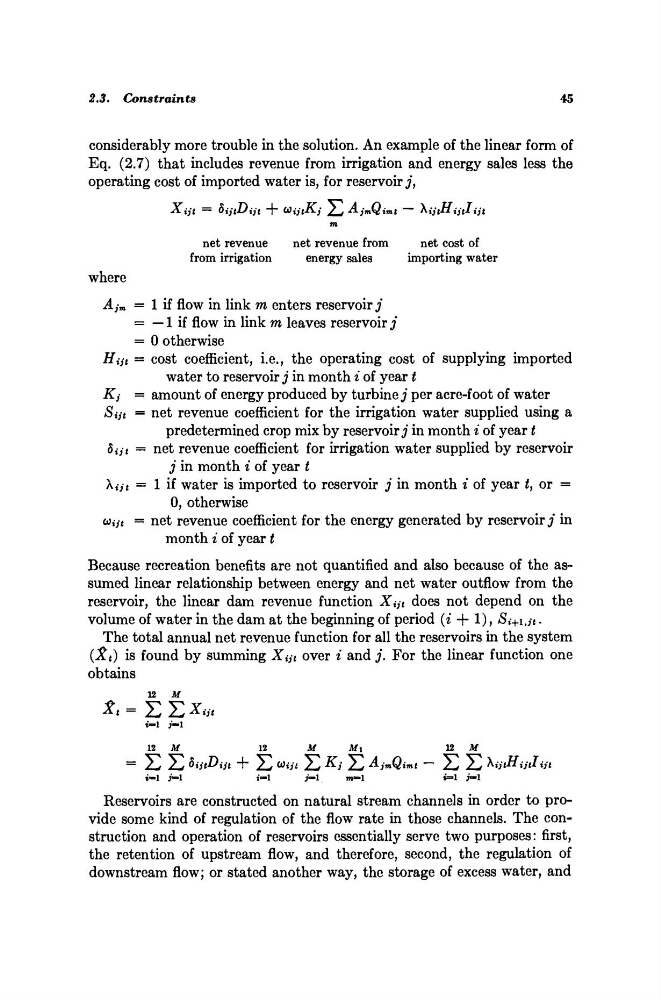
considerably more trouble in the solution. An example of the linear form of
Eq. (2.7) that includes revenue from irrigation and energy sales less the
operating cost of imported water is, for reservoir,;,
Xijt
= SijtDijt
+ (tiijtKj
Σ AjmQimt
—
y^ijtHijtlijt
m
net revenue
net revenue from
net cost of
from irrigation
energy sales
importing water
where
Aj m = 1 if flow in link m enters reservoir j
= — 1 if flow in link m leaves reservoir j
= 0 otherwise
Hijt = cost coefficient, i.e., the operating cost of supplying imported
water to reservoir j in month i of year t
Kj
= amount of energy produced by turbine j per acre-foot of water
Sijt
= net revenue coefficient for the irrigation water supplied using a
predetermined crop mix by reservoir j in month i of year t
bijt = net revenue coefficient for irrigation water supplied by reservoir
j in month i of year t
\ij t = 1 if water is imported to reservoir j in month i of year t, or =
0, otherwise
ω;,-* = net revenue coefficient for the energy generated by reservoir j in
month i of year t
Because recreation benefits are not quantified and also because of the assumed linear relationship between energy and net water outflow from the
reservoir, the linear dam revenue function Χ& does not depend on the
volume of water in the dam at the beginning of period {i + 1),
Si+ij t .
The total annual net revenue function for all the reservoirs in the system
(£ t ) is found by summing Xij t over i and j. For the linear function one
obtains
12
Μ
£t ^ ]Σ Σ
Xijt
12 Μ
12
Μ
Μι
12 Μ
=
Σ Σ &ijtDiit + Σ ω *ϊ* Σ Κ* Σ AjmQimt ~ Σ Σ ^ijtHijJijt
ν»ΐ ,7=1
ι=β1
j=l
m«l
7™1
Reservoirs are constructed on natural stream channels in order to provide some kind of regulation of the flow rate in those channels. The construction and operation of reservoirs essentially serve two purposes: first,
the retention of upstream flow, and therefore, second, the regulation of
downstream flow; or stated another way, the storage of excess water, and
Constraints
45
considerably more trouble in the solution. An example of the linear form of
Eq. (2.7) that includes revenue from irrigation and energy sales less the
operating cost of imported water is, for reservoir,;,
Xijt
= SijtDijt
+ (tiijtKj
Σ AjmQimt
—
y^ijtHijtlijt
m
net revenue
net revenue from
net cost of
from irrigation
energy sales
importing water
where
Aj m = 1 if flow in link m enters reservoir j
= — 1 if flow in link m leaves reservoir j
= 0 otherwise
Hijt = cost coefficient, i.e., the operating cost of supplying imported
water to reservoir j in month i of year t
Kj
= amount of energy produced by turbine j per acre-foot of water
Sijt
= net revenue coefficient for the irrigation water supplied using a
predetermined crop mix by reservoir j in month i of year t
bijt = net revenue coefficient for irrigation water supplied by reservoir
j in month i of year t
\ij t = 1 if water is imported to reservoir j in month i of year t, or =
0, otherwise
ω;,-* = net revenue coefficient for the energy generated by reservoir j in
month i of year t
Because recreation benefits are not quantified and also because of the assumed linear relationship between energy and net water outflow from the
reservoir, the linear dam revenue function Χ& does not depend on the
volume of water in the dam at the beginning of period {i + 1),
Si+ij t .
The total annual net revenue function for all the reservoirs in the system
(£ t ) is found by summing Xij t over i and j. For the linear function one
obtains
12
Μ
£t ^ ]Σ Σ
Xijt
12 Μ
12
Μ
Μι
12 Μ
=
Σ Σ &ijtDiit + Σ ω *ϊ* Σ Κ* Σ AjmQimt ~ Σ Σ ^ijtHijJijt
ν»ΐ ,7=1
ι=β1
j=l
m«l
7™1
Reservoirs are constructed on natural stream channels in order to provide some kind of regulation of the flow rate in those channels. The construction and operation of reservoirs essentially serve two purposes: first,
the retention of upstream flow, and therefore, second, the regulation of
downstream flow; or stated another way, the storage of excess water, and