

2.2. Formulation
of the Objective
Function
41
Therefore, the problem becomes: Given a planning horizon T m * x and a
set of alternative projects, select a period, if any, when each project will be
introduced so that the objective function will be optimized while (1)
staying within the budget limit, (2) meeting institutional constraints, (3)
meeting all demands, and (4) satisfying all physical constraints.
2.2. Formulation of the Objective Function
The criteria that are established and used for project justification will be
influenced by the instutional processes through which funds for development are authorized. In the United States, at the federal level, the agencies
in charge of water resources development present each project to the Bureau
of the Budget and to the Congress for individual authorization and approval. The main reason for carrying out an economic evaluation is to
show that the project will produce at least as much in benefits as it will
cost. Section 1.3 has discussed many of the criteria that must be considered
in formulating the objective function. We will select as the criterion the
maximization over the set of alternative projects of the sum of the discounted present value of net earnings. The objective function thus takes
cognizance of the time value of money [Lesso, 1967].
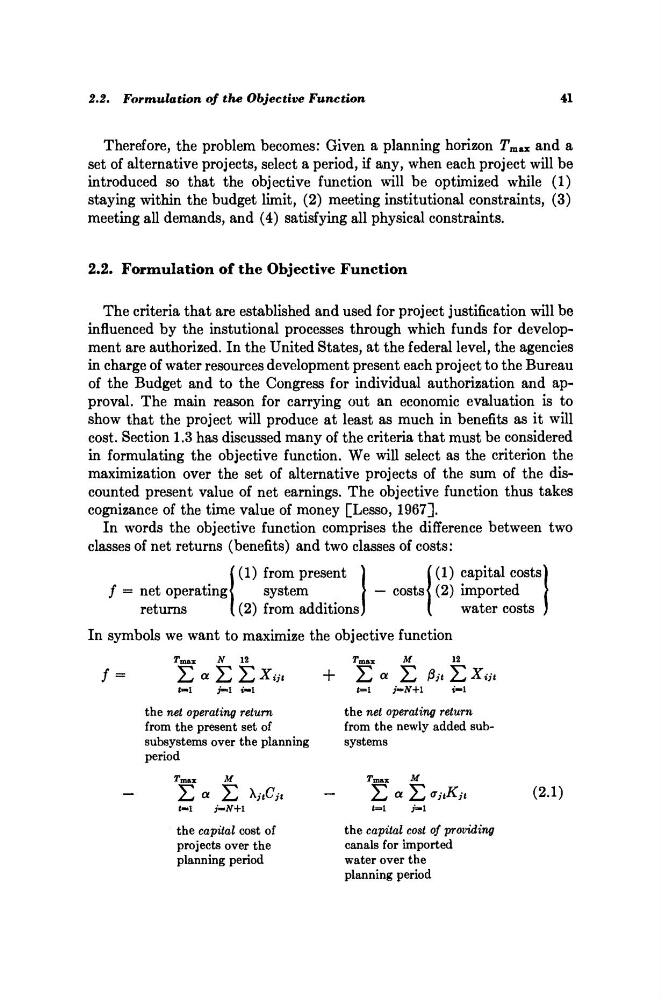
In words the objective function comprises the difference between two
classes of net returns (benefits) and two classes of costs:
i
(l) from present ]
system
> — costs
(2) from additions)
(1) capital costs]
(2) imported
j
water costs
In symbols we want to maximize the objective function
r max
ΛΓ 12
Σ
α
Σ Σ χ&
the net operating return
from the present set of
subsystems over the planning
period
+
Σ
a
Σ
0/i Σ X*J*
the net operating return
from the newly added subsystems
Σ
a
Σ
λ/tC/i
the capital cost of
projects over the
planning period
Σ
a
Σ
*itKit
the capital cost of providing
canals for imported
water over the
planning period
(2Λ)
of the Objective
Function
41
Therefore, the problem becomes: Given a planning horizon T m * x and a
set of alternative projects, select a period, if any, when each project will be
introduced so that the objective function will be optimized while (1)
staying within the budget limit, (2) meeting institutional constraints, (3)
meeting all demands, and (4) satisfying all physical constraints.
2.2. Formulation of the Objective Function
The criteria that are established and used for project justification will be
influenced by the instutional processes through which funds for development are authorized. In the United States, at the federal level, the agencies
in charge of water resources development present each project to the Bureau
of the Budget and to the Congress for individual authorization and approval. The main reason for carrying out an economic evaluation is to
show that the project will produce at least as much in benefits as it will
cost. Section 1.3 has discussed many of the criteria that must be considered
in formulating the objective function. We will select as the criterion the
maximization over the set of alternative projects of the sum of the discounted present value of net earnings. The objective function thus takes
cognizance of the time value of money [Lesso, 1967].
In words the objective function comprises the difference between two
classes of net returns (benefits) and two classes of costs:
i
(l) from present ]
system
> — costs
(2) from additions)
(1) capital costs]
(2) imported
j
water costs
In symbols we want to maximize the objective function
r max
ΛΓ 12
Σ
α
Σ Σ χ&
the net operating return
from the present set of
subsystems over the planning
period
+
Σ
a
Σ
0/i Σ X*J*
the net operating return
from the newly added subsystems
Σ
a
Σ
λ/tC/i
the capital cost of
projects over the
planning period
Σ
a
Σ
*itKit
the capital cost of providing
canals for imported
water over the
planning period
(2Λ)