

1.2. The Systems Approach to Solving Water Resources
Problems
15
DATA BASE
Inputs
Parameters
Dependent
variables
Economic,
ecological,
and social
worth of
water usage
and quality
Prices
Costs
MODEL
Equations
Inequalities
SIMULATION
OBJEC
FUNC
:TIVE
TION
OPTIMI
ALGOl
ZATION
RITHM
CASE STUDIES
Solution 1
Solution 2
OPTIMAL
SOLUTION
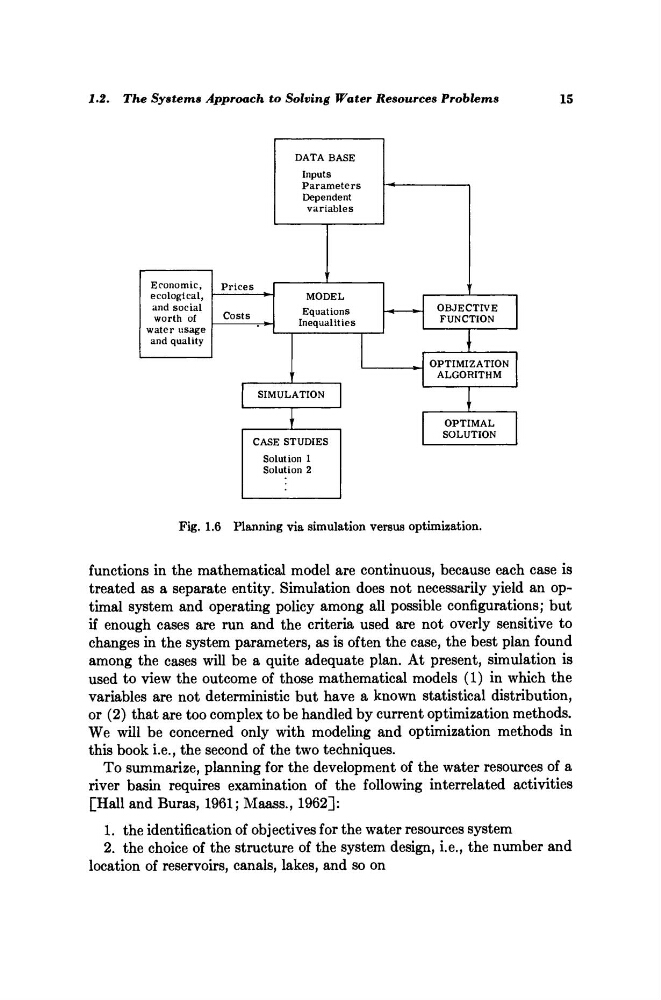
Fig. 1.6 Planning via simulation versus optimization.
functions in the mathematical model are continuous, because each case is
treated as a separate entity. Simulation does not necessarily yield an optimal system and operating policy among all possible configurations; but
if enough cases are run and the criteria used are not overly sensitive to
changes in the system parameters, as is often the case, the best plan found
among the cases will be a quite adequate plan. At present, simulation is
used to view the outcome of those mathematical models (1) in which the
variables are not deterministic but have a known statistical distribution,
or (2) that are too complex to be handled by current optimization methods.
We will be concerned only with modeling and optimization methods in
this book i.e., the second of the two techniques.
To summarize, planning for the development of the water resources of a
river basin requires examination of the following interrelated activities
[Hall and Buras, 1961; Maass., 1962]:
1. the identification of objectives for the water resources system
2. the choice of the structure of the system design, i.e., the number and
location of reservoirs, canals, lakes, and so on
Problems
15
DATA BASE
Inputs
Parameters
Dependent
variables
Economic,
ecological,
and social
worth of
water usage
and quality
Prices
Costs
MODEL
Equations
Inequalities
SIMULATION
OBJEC
FUNC
:TIVE
TION
OPTIMI
ALGOl
ZATION
RITHM
CASE STUDIES
Solution 1
Solution 2
OPTIMAL
SOLUTION
Fig. 1.6 Planning via simulation versus optimization.
functions in the mathematical model are continuous, because each case is
treated as a separate entity. Simulation does not necessarily yield an optimal system and operating policy among all possible configurations; but
if enough cases are run and the criteria used are not overly sensitive to
changes in the system parameters, as is often the case, the best plan found
among the cases will be a quite adequate plan. At present, simulation is
used to view the outcome of those mathematical models (1) in which the
variables are not deterministic but have a known statistical distribution,
or (2) that are too complex to be handled by current optimization methods.
We will be concerned only with modeling and optimization methods in
this book i.e., the second of the two techniques.
To summarize, planning for the development of the water resources of a
river basin requires examination of the following interrelated activities
[Hall and Buras, 1961; Maass., 1962]:
1. the identification of objectives for the water resources system
2. the choice of the structure of the system design, i.e., the number and
location of reservoirs, canals, lakes, and so on