

1.2. The Systems Approach to Solving Water Resources
Problems
13
must also involve water resource management at the policy level, since
most goals initially are specified in terms of somewhat generalized economic
and social quantities rather than in specific physical terms.
We now turn to the question of how to relate the concepts of systems
analysis to the problems of water resources management. There are two
major areas of application: (1) the planning and (2) the operation of
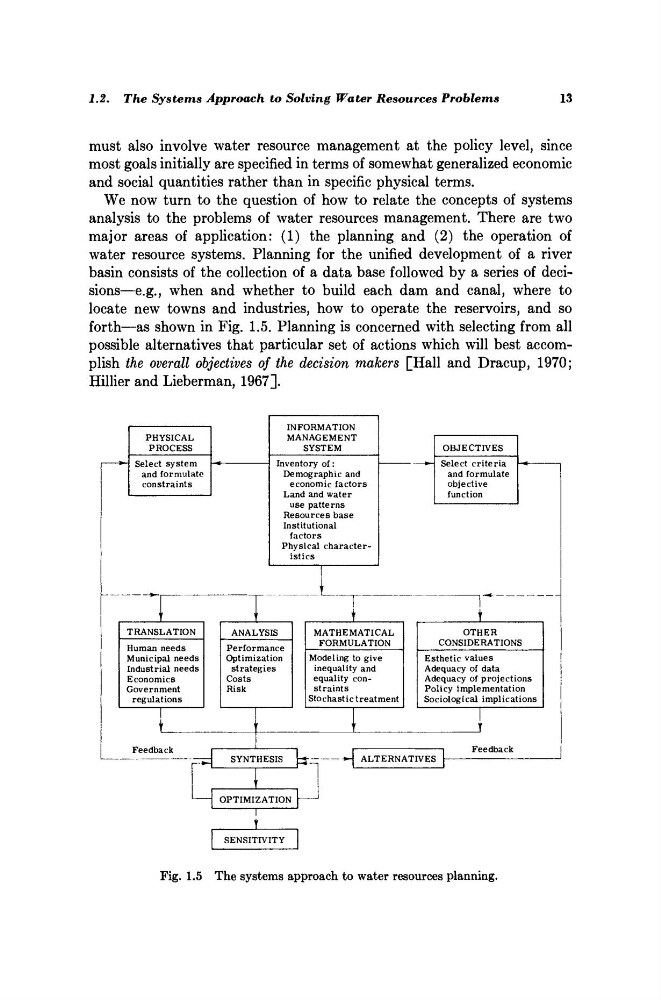
water resource systems. Planning for the unified development of a river
basin consists of the collection of a data base followed by a series of decisions—e.g., when and whether to build each dam and canal, where to
locate new towns and industries, how to operate the reservoirs, and so
forth—as shown in Fig. 1.5. Planning is concerned with selecting from all
possible alternatives that particular set of actions which will best accomplish the overall objectives of the decision makers [Hall and Dracup, 1970;
Hillier and Lieberman, 1967].
PHYSICAL
PROCESS
Select system
and formulate
constraints
INFORMATION
MANAGEMENT
SYSTEM
Inventory of:
Demographic and
economic factors
Land and water
use patterns
Resources base
Institutional
factors
Physical characteristics
OBJECTIVES
Select criteria
and formulate
objective
function
TRANSLATION
Human needs
Municipal needs
Industrial needs
Economics
Government
regulations
ANALYSIS
Performance
Optimization
strategies
Costs
Risk
MATHEMATICAL
FORMULATION
Modeling to give
inequality and
equality constraints
Stochastic treatment
OTHER
CONSIDERATIONS
Esthetic values
Adequacy of data
Adequacy of projections
Policy implementation
Sociological implications
SYNTHESIS
*-\ ALTERNATIVES
OPTIMIZATION
SENSITIVITY
Fig. 1.5 The systems approach to water resources planning.
Problems
13
must also involve water resource management at the policy level, since
most goals initially are specified in terms of somewhat generalized economic
and social quantities rather than in specific physical terms.
We now turn to the question of how to relate the concepts of systems
analysis to the problems of water resources management. There are two
major areas of application: (1) the planning and (2) the operation of
water resource systems. Planning for the unified development of a river
basin consists of the collection of a data base followed by a series of decisions—e.g., when and whether to build each dam and canal, where to
locate new towns and industries, how to operate the reservoirs, and so
forth—as shown in Fig. 1.5. Planning is concerned with selecting from all
possible alternatives that particular set of actions which will best accomplish the overall objectives of the decision makers [Hall and Dracup, 1970;
Hillier and Lieberman, 1967].
PHYSICAL
PROCESS
Select system
and formulate
constraints
INFORMATION
MANAGEMENT
SYSTEM
Inventory of:
Demographic and
economic factors
Land and water
use patterns
Resources base
Institutional
factors
Physical characteristics
OBJECTIVES
Select criteria
and formulate
objective
function
TRANSLATION
Human needs
Municipal needs
Industrial needs
Economics
Government
regulations
ANALYSIS
Performance
Optimization
strategies
Costs
Risk
MATHEMATICAL
FORMULATION
Modeling to give
inequality and
equality constraints
Stochastic treatment
OTHER
CONSIDERATIONS
Esthetic values
Adequacy of data
Adequacy of projections
Policy implementation
Sociological implications
SYNTHESIS
*-\ ALTERNATIVES
OPTIMIZATION
SENSITIVITY
Fig. 1.5 The systems approach to water resources planning.