

134
5. Sensitivity
of Planning Decisions in River Basin
Management
Suppose now that the function/depends on η parameters
i.e., / = /(x). To obtain a multiparameter sensitivity, we make use of the
first-order terms of a Taylor series or the total differential. Using the
latter we obtain
df = — dxi + · · · + — dx n
OXi
dXn
which can be rearranged as follows:
τ-Γτ^1- + ··· + ΓτΙ
ί: 1—
<
5 ·
3 >
/
If
dXlJ
Xl
If
dXnj
Xn
By analogy with Eq. (5.2) the terms in square brackets represent the
sensitivities of /(x) to each of the parameters Xi, that is,
/
dXi
Consequently we can write
df/f
= Si x (dx 1 /x l )
+ · · · + Sl n (dXn/Xn)
(5.5)
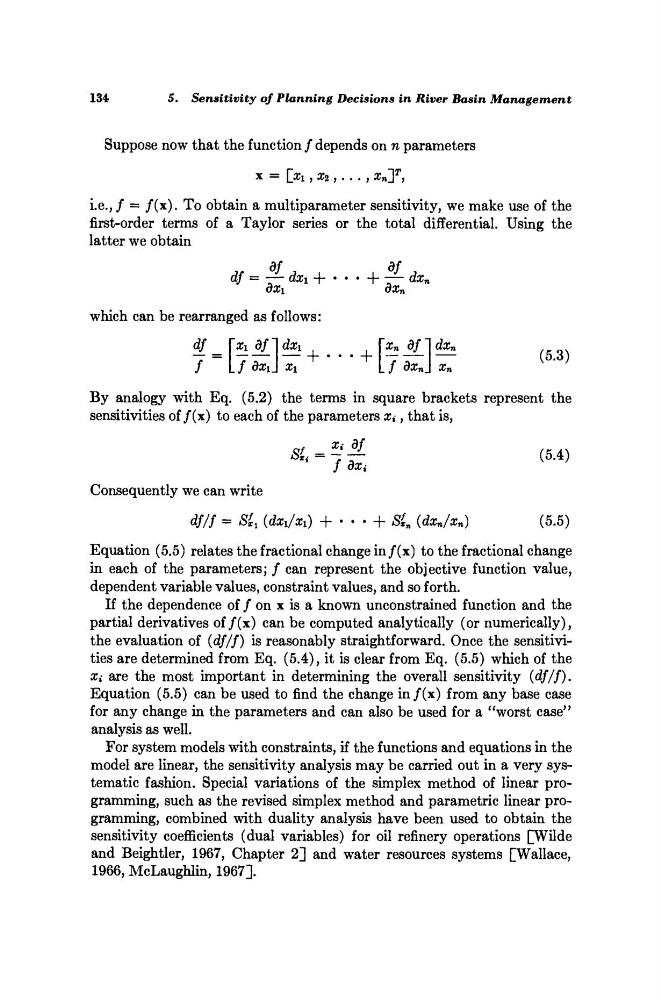
Equation (5.5) relates the fractional change in/(x) to the fractional change
in each of the parameters; / can represent the objective function value,
dependent variable values, constraint values, and so forth.
If the dependence of / on χ is a known unconstrained function and the
partial derivatives of /(x) can be computed analytically (or numerically),
the evaluation of (df/f)
is reasonably straightforward. Once the sensitivities are determined from Eq. (5.4), it is clear from Eq. (5.5) which of the
Xi
are the most important in determining the overall sensitivity
(df/f).
Equation (5.5) can be used to find the change in/(x) from any base case
for any change in the parameters and can also be used for a "worst case"
analysis as well.
For system models with constraints, if the functions and equations in the
model are linear, the sensitivity analysis may be carried out in a very systematic fashion. Special variations of the simplex method of linear programming, such as the revised simplex method and parametric linear programming, combined with duality analysis have been used to obtain the
sensitivity coefficients (dual variables) for oil refinery operations [Wilde
and Beightler, 1967, Chapter 2] and water resources systems [Wallace,
1966, McLaughlin, 1967].
5. Sensitivity
of Planning Decisions in River Basin
Management
Suppose now that the function/depends on η parameters
i.e., / = /(x). To obtain a multiparameter sensitivity, we make use of the
first-order terms of a Taylor series or the total differential. Using the
latter we obtain
df = — dxi + · · · + — dx n
OXi
dXn
which can be rearranged as follows:
τ-Γτ^1- + ··· + ΓτΙ
ί: 1—
<
5 ·
3 >
/
If
dXlJ
Xl
If
dXnj
Xn
By analogy with Eq. (5.2) the terms in square brackets represent the
sensitivities of /(x) to each of the parameters Xi, that is,
/
dXi
Consequently we can write
df/f
= Si x (dx 1 /x l )
+ · · · + Sl n (dXn/Xn)
(5.5)
Equation (5.5) relates the fractional change in/(x) to the fractional change
in each of the parameters; / can represent the objective function value,
dependent variable values, constraint values, and so forth.
If the dependence of / on χ is a known unconstrained function and the
partial derivatives of /(x) can be computed analytically (or numerically),
the evaluation of (df/f)
is reasonably straightforward. Once the sensitivities are determined from Eq. (5.4), it is clear from Eq. (5.5) which of the
Xi
are the most important in determining the overall sensitivity
(df/f).
Equation (5.5) can be used to find the change in/(x) from any base case
for any change in the parameters and can also be used for a "worst case"
analysis as well.
For system models with constraints, if the functions and equations in the
model are linear, the sensitivity analysis may be carried out in a very systematic fashion. Special variations of the simplex method of linear programming, such as the revised simplex method and parametric linear programming, combined with duality analysis have been used to obtain the
sensitivity coefficients (dual variables) for oil refinery operations [Wilde
and Beightler, 1967, Chapter 2] and water resources systems [Wallace,
1966, McLaughlin, 1967].