

108
4. Application
of the Optimization
Algorithm
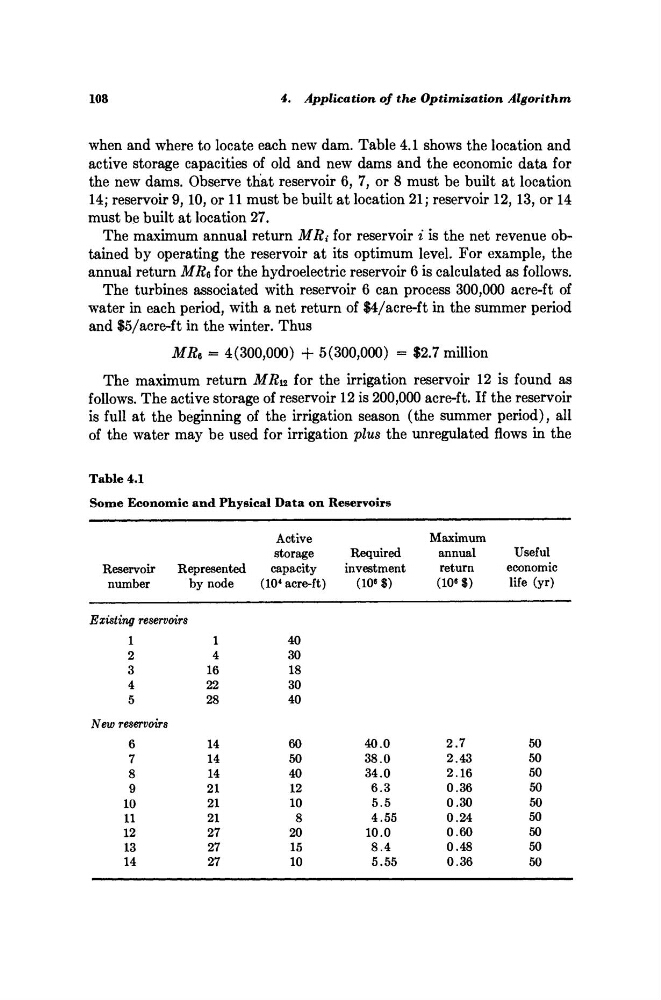
when and where to locate each new dam. Table 4.1 shows the location and
active storage capacities of old and new dams and the economic data for
the new dams. Observe that reservoir 6. 7, or 8 must be built at location
14; reservoir 9,10, or 11 must be built at location 21; reservoir 12, 13, or 14
must be built at location 27.
The maximum annual return MRi for reservoir i is the net revenue obtained by operating the reservoir at its optimum level. For example, the
annual return Μ #β for the hydroelectric reservoir 6 is calculated as follows.
The turbines associated with reservoir 6 can process 300,000 acre-ft of
w
r ater in each period, with a net return of $4/acre-ft in the summer period
and $5/acre-ft in the winter. Thus
Μ Re = 4(300,000) + 5(300,000) = $2.7 million
The maximum return MRn for the irrigation reservoir 12 is found as
follows. The active storage of reservoir 12 is 200,000 acre-ft. If the reservoir
is full at the beginning of the irrigation season (the summer period), all
of the water may be used for irrigation plus the unregulated flows in the
Table 4.1
Some Economic and Physical Data on Reservoirs
Active
Maximum
storage
Required
annual
Useful
Reservoir
Represented
capacity
investment
return
economic
number
by node
(10
4 acre-ft)
(10« $)
(10« $)
life (yr)
Existing reservoirs
1
1
40
2
4
30
3
16
18
4
22
30
5
28
40
New reservoirs
6
14
60
40.0
2.7
50
7
14
50
38.0
2.43
50
8
14
40
34.0
2.16
50
9
21
12
6.3
0.36
50
10
21
10
5.5
0.30
50
11
21
8
4.55
0.24
50
12
27
20
10.0
0.60
50
13
27
15
8.4
0.48
50
14
27
10
5.55
0.36
50
4. Application
of the Optimization
Algorithm
when and where to locate each new dam. Table 4.1 shows the location and
active storage capacities of old and new dams and the economic data for
the new dams. Observe that reservoir 6. 7, or 8 must be built at location
14; reservoir 9,10, or 11 must be built at location 21; reservoir 12, 13, or 14
must be built at location 27.
The maximum annual return MRi for reservoir i is the net revenue obtained by operating the reservoir at its optimum level. For example, the
annual return Μ #β for the hydroelectric reservoir 6 is calculated as follows.
The turbines associated with reservoir 6 can process 300,000 acre-ft of
w
r ater in each period, with a net return of $4/acre-ft in the summer period
and $5/acre-ft in the winter. Thus
Μ Re = 4(300,000) + 5(300,000) = $2.7 million
The maximum return MRn for the irrigation reservoir 12 is found as
follows. The active storage of reservoir 12 is 200,000 acre-ft. If the reservoir
is full at the beginning of the irrigation season (the summer period), all
of the water may be used for irrigation plus the unregulated flows in the
Table 4.1
Some Economic and Physical Data on Reservoirs
Active
Maximum
storage
Required
annual
Useful
Reservoir
Represented
capacity
investment
return
economic
number
by node
(10
4 acre-ft)
(10« $)
(10« $)
life (yr)
Existing reservoirs
1
1
40
2
4
30
3
16
18
4
22
30
5
28
40
New reservoirs
6
14
60
40.0
2.7
50
7
14
50
38.0
2.43
50
8
14
40
34.0
2.16
50
9
21
12
6.3
0.36
50
10
21
10
5.5
0.30
50
11
21
8
4.55
0.24
50
12
27
20
10.0
0.60
50
13
27
15
8.4
0.48
50
14
27
10
5.55
0.36
50