

44
3.
FIXATION
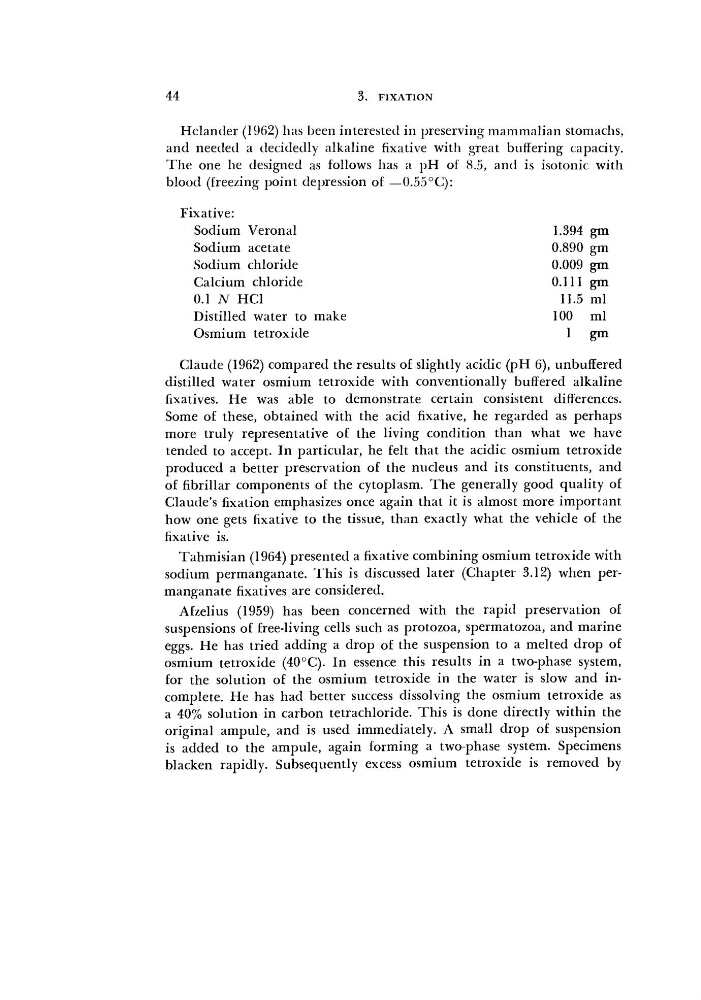
Helander (1962) has been interested in preserving mammalian stomachs,
and needed a decidedly alkaline fixative with great buffering capacity.
The one he designed as follows has a pH of 8.5, and is isotonic with
blood (freezing point depression of —0.55°C):
Claude (1962) compared the results of slightly acidic (pH 6), unbuffered
distilled water osmium tetroxide with conventionally buffered alkaline
fixatives.
He was able to demonstrate certain consistent differences.
Some of these, obtained with the acid fixative, he regarded as perhaps
more truly representative of the living condition than what we have
tended to accept. In particular, he felt that the acidic osmium tetroxide
produced a better preservation of the nucleus and its constituents, and
of fibrillar components of the cytoplasm. The generally good quality of
Claude's fixation emphasizes once again that it is almost more important
how one gets fixative to the tissue, than exactly what the vehicle of the
fixative
is.
Tahmisian (1964) presented a fixative combining osmium tetroxide with
sodium permanganate. This is discussed later (Chapter 3.12) when permanganate fixatives are considered.
Afzelius (1959) has been concerned with the rapid preservation of
suspensions of free-living cells such as protozoa, spermatozoa, and marine
eggs. He has tried adding a drop of the suspension to a melted drop of
osmium tetroxide (40°C). In essence this results in a two-phase system,
for the solution of the osmium tetroxide in the water is slow and incomplete. He has had better success dissolving the osmium tetroxide as
a 40% solution in carbon tetrachloride. This is done directly within the
original ampule, and is used immediately. A small drop of suspension
is added to the ampule, again forming a two-phase system. Specimens
blacken rapidly. Subsequently excess osmium tetroxide is removed by
Fixative:
Sodium Veronal
Sodium acetate
Sodium chloride
Calcium chloride
0.1 N HC1
Distilled water to make
Osmium tetroxide
1.394 gm
0.890 gm
0.009 gm
0.111 gm
11.5 ml
100
ml
1
gm
3.
FIXATION
Helander (1962) has been interested in preserving mammalian stomachs,
and needed a decidedly alkaline fixative with great buffering capacity.
The one he designed as follows has a pH of 8.5, and is isotonic with
blood (freezing point depression of —0.55°C):
Claude (1962) compared the results of slightly acidic (pH 6), unbuffered
distilled water osmium tetroxide with conventionally buffered alkaline
fixatives.
He was able to demonstrate certain consistent differences.
Some of these, obtained with the acid fixative, he regarded as perhaps
more truly representative of the living condition than what we have
tended to accept. In particular, he felt that the acidic osmium tetroxide
produced a better preservation of the nucleus and its constituents, and
of fibrillar components of the cytoplasm. The generally good quality of
Claude's fixation emphasizes once again that it is almost more important
how one gets fixative to the tissue, than exactly what the vehicle of the
fixative
is.
Tahmisian (1964) presented a fixative combining osmium tetroxide with
sodium permanganate. This is discussed later (Chapter 3.12) when permanganate fixatives are considered.
Afzelius (1959) has been concerned with the rapid preservation of
suspensions of free-living cells such as protozoa, spermatozoa, and marine
eggs. He has tried adding a drop of the suspension to a melted drop of
osmium tetroxide (40°C). In essence this results in a two-phase system,
for the solution of the osmium tetroxide in the water is slow and incomplete. He has had better success dissolving the osmium tetroxide as
a 40% solution in carbon tetrachloride. This is done directly within the
original ampule, and is used immediately. A small drop of suspension
is added to the ampule, again forming a two-phase system. Specimens
blacken rapidly. Subsequently excess osmium tetroxide is removed by
Fixative:
Sodium Veronal
Sodium acetate
Sodium chloride
Calcium chloride
0.1 N HC1
Distilled water to make
Osmium tetroxide
1.394 gm
0.890 gm
0.009 gm
0.111 gm
11.5 ml
100
ml
1
gm