

40
3.
FIXATION
alkali, the pH can be adjusted easily between 5.4 and 8.0 without
changing
the tonicity of the medium.
The buffer is designed to have the same
freezing point depression as mammalian blood plasma, i.e., —0.56°C. It
has a pH of 7.3 when the amount of sodium hydroxide indicated below
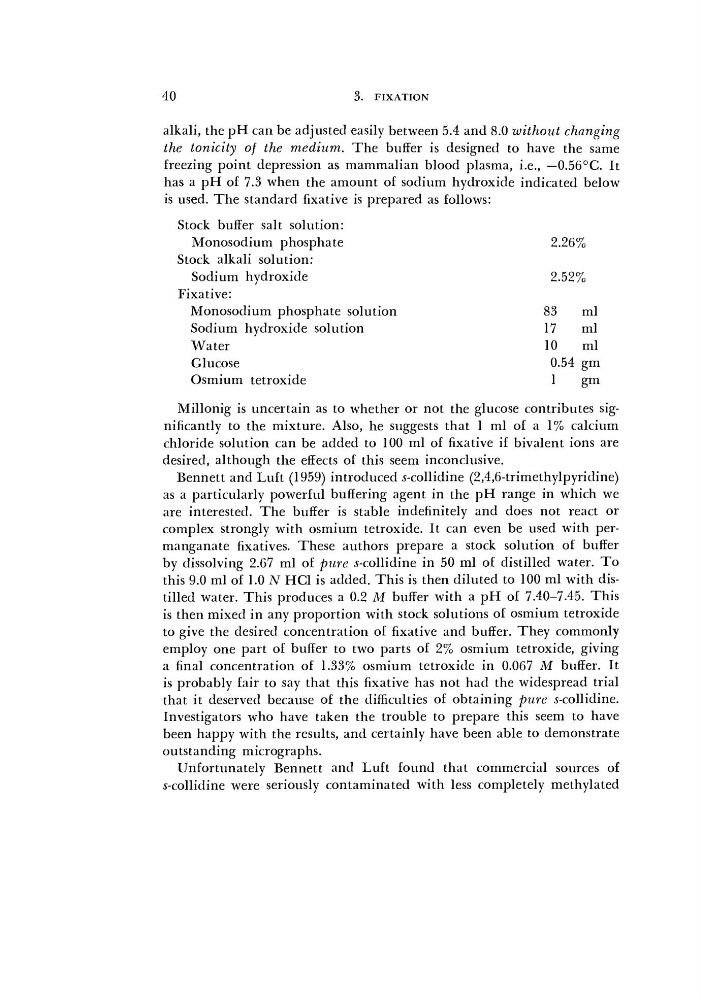
is used. The standard fixative is prepared as follows:
Stock buffer salt solution:
Monosodium phosphate
2.26%
Stock alkali solution:
Sodium hydroxide
2.52%
Millonig is uncertain as to whether or not the glucose contributes significantly to the mixture. Also, he suggests that 1 ml of a 1% calcium
chloride solution can be added to 100 ml of fixative if bivalent ions are
desired, although the effects of this seem inconclusive.
Bennett and Luft (1959) introduced s-collidine (2,4,6-trimethylpyridine)
as a particularly powerful buffering agent in the pH range in which we
are interested. The buffer is stable indefinitely and does not react or
complex strongly with osmium tetroxide. It can even be used with permanganate fixatives. These authors prepare a stock solution of buffer
by dissolving 2.67 ml of pure s-collidine in 50 ml of distilled water. To
this 9.0 ml of 1.0 N HC1 is added. This is then diluted to 100 ml with distilled water. This produces a 0.2 M buffer with a pH of 7.40-7.45. This
is then mixed in any proportion with stock solutions of osmium tetroxide
to give the desired concentration of fixative and buffer. They commonly
employ one part of buffer to two parts of 2% osmium tetroxide, giving
a final concentration of 1.33% osmium tetroxide in 0.067 M buffer. It
is probably fair to say that this fixative has not had the widespread trial
that it deserved because of the difficulties of obtaining pure s-collidine.
Investigators who have taken the trouble to prepare this seem to have
been happy with the results, and certainly have been able to demonstrate
outstanding micrographs.
Unfortunately Bennett and Luft found that commercial sources of
s-collidine were seriously contaminated with less completely methylated
Fixative:
Monosodium phosphate solution
Sodium hydroxide solution
83
ml
17
ml
10
ml
0.54 gm
1
gm
Water
Glucose
Osmium tetroxide
3.
FIXATION
alkali, the pH can be adjusted easily between 5.4 and 8.0 without
changing
the tonicity of the medium.
The buffer is designed to have the same
freezing point depression as mammalian blood plasma, i.e., —0.56°C. It
has a pH of 7.3 when the amount of sodium hydroxide indicated below
is used. The standard fixative is prepared as follows:
Stock buffer salt solution:
Monosodium phosphate
2.26%
Stock alkali solution:
Sodium hydroxide
2.52%
Millonig is uncertain as to whether or not the glucose contributes significantly to the mixture. Also, he suggests that 1 ml of a 1% calcium
chloride solution can be added to 100 ml of fixative if bivalent ions are
desired, although the effects of this seem inconclusive.
Bennett and Luft (1959) introduced s-collidine (2,4,6-trimethylpyridine)
as a particularly powerful buffering agent in the pH range in which we
are interested. The buffer is stable indefinitely and does not react or
complex strongly with osmium tetroxide. It can even be used with permanganate fixatives. These authors prepare a stock solution of buffer
by dissolving 2.67 ml of pure s-collidine in 50 ml of distilled water. To
this 9.0 ml of 1.0 N HC1 is added. This is then diluted to 100 ml with distilled water. This produces a 0.2 M buffer with a pH of 7.40-7.45. This
is then mixed in any proportion with stock solutions of osmium tetroxide
to give the desired concentration of fixative and buffer. They commonly
employ one part of buffer to two parts of 2% osmium tetroxide, giving
a final concentration of 1.33% osmium tetroxide in 0.067 M buffer. It
is probably fair to say that this fixative has not had the widespread trial
that it deserved because of the difficulties of obtaining pure s-collidine.
Investigators who have taken the trouble to prepare this seem to have
been happy with the results, and certainly have been able to demonstrate
outstanding micrographs.
Unfortunately Bennett and Luft found that commercial sources of
s-collidine were seriously contaminated with less completely methylated
Fixative:
Monosodium phosphate solution
Sodium hydroxide solution
83
ml
17
ml
10
ml
0.54 gm
1
gm
Water
Glucose
Osmium tetroxide