

334
10.
PARTICULATE SPECIMENS
evaporating source, and the deposit observed as it builds up on this.
Experience, then, will tell when the current should be shut off. When
the substance to be evaporated is in the form of a wire, it is easy to
standardize the deposit by cutting off and completely evaporating a
particular length of wire, while keeping the specimen distance constant.
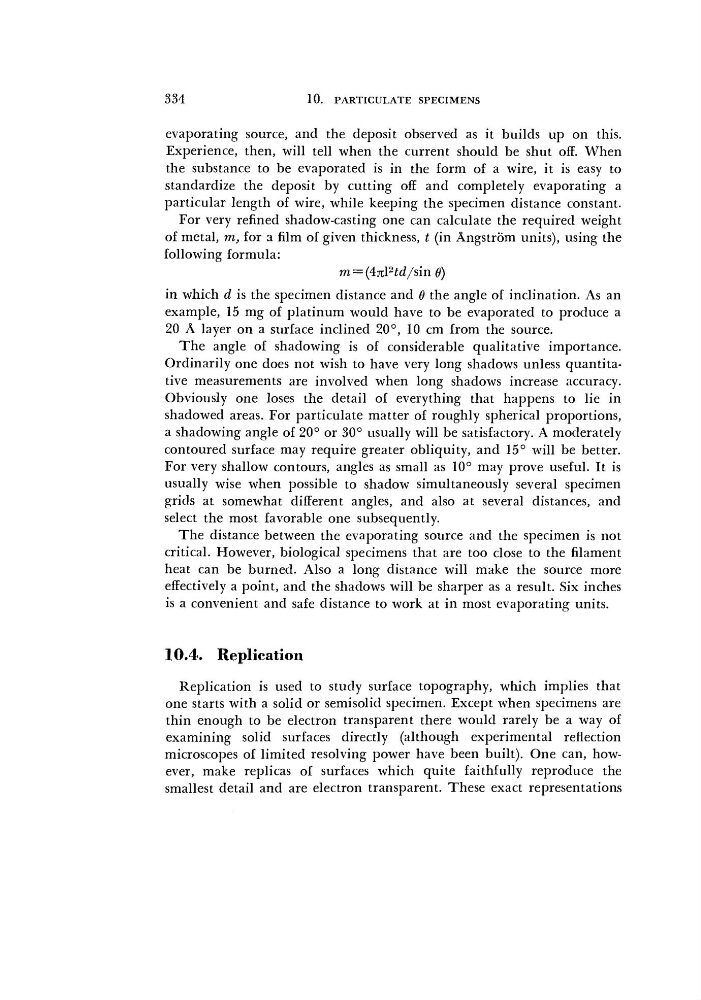
For very refined shadow-casting one can calculate the required weight
of metal, m, for a film of given thickness, t (in Angstrom units), using the
following formula:
ra = (4jtl
2 £d/sin 6)
in which d is the specimen distance and 6 the angle of inclination. As an
example, 15 mg of platinum would have to be evaporated to produce a
20 A layer on a surface inclined 20°, 10 cm from the source.
The angle of shadowing is of considerable qualitative importance.
Ordinarily one does not wish to have very long shadows unless quantitative measurements are involved when long shadows increase accuracy.
Obviously one loses the detail of everything that happens to lie in
shadowed areas. For particulate matter of roughly spherical proportions,
a shadowing angle of 20° or 30° usually will be satisfactory. A moderately
contoured surface may require greater obliquity, and 15° will be better.
For very shallow contours, angles as small as 10° may prove useful. It is
usually wise when possible to shadow simultaneously several specimen
grids at somewhat different angles, and also at several distances, and
select the most favorable one subsequently.
The distance between the evaporating source and the specimen is not
critical. However, biological specimens that are too close to the filament
heat can be burned. Also a long distance will make the source more
effectively a point, and the shadows will be sharper as a result. Six inches
is a convenient and safe distance to work at in most evaporating units.
10.4.
Replication
Replication is used to study surface topography, which implies that
one starts with a solid or semisolid specimen. Except when specimens are
thin enough to be electron transparent there would rarely be a way of
examining solid surfaces directly (although experimental
reflection
microscopes of limited resolving power have been built). One can, however, make replicas of surfaces which quite faithfully reproduce the
smallest detail and are electron transparent. These exact representations
10.
PARTICULATE SPECIMENS
evaporating source, and the deposit observed as it builds up on this.
Experience, then, will tell when the current should be shut off. When
the substance to be evaporated is in the form of a wire, it is easy to
standardize the deposit by cutting off and completely evaporating a
particular length of wire, while keeping the specimen distance constant.
For very refined shadow-casting one can calculate the required weight
of metal, m, for a film of given thickness, t (in Angstrom units), using the
following formula:
ra = (4jtl
2 £d/sin 6)
in which d is the specimen distance and 6 the angle of inclination. As an
example, 15 mg of platinum would have to be evaporated to produce a
20 A layer on a surface inclined 20°, 10 cm from the source.
The angle of shadowing is of considerable qualitative importance.
Ordinarily one does not wish to have very long shadows unless quantitative measurements are involved when long shadows increase accuracy.
Obviously one loses the detail of everything that happens to lie in
shadowed areas. For particulate matter of roughly spherical proportions,
a shadowing angle of 20° or 30° usually will be satisfactory. A moderately
contoured surface may require greater obliquity, and 15° will be better.
For very shallow contours, angles as small as 10° may prove useful. It is
usually wise when possible to shadow simultaneously several specimen
grids at somewhat different angles, and also at several distances, and
select the most favorable one subsequently.
The distance between the evaporating source and the specimen is not
critical. However, biological specimens that are too close to the filament
heat can be burned. Also a long distance will make the source more
effectively a point, and the shadows will be sharper as a result. Six inches
is a convenient and safe distance to work at in most evaporating units.
10.4.
Replication
Replication is used to study surface topography, which implies that
one starts with a solid or semisolid specimen. Except when specimens are
thin enough to be electron transparent there would rarely be a way of
examining solid surfaces directly (although experimental
reflection
microscopes of limited resolving power have been built). One can, however, make replicas of surfaces which quite faithfully reproduce the
smallest detail and are electron transparent. These exact representations