

5.22.
SECTIONING
181
developed the trick of using only the ball of the thumb during the
cutting phase of the cycle. This is his only contact with the microtome
during this critical part of the cycle. It is easy to forget to maintain a
light grip and regress to longer-established patterns.
Physical deformation of the microtome, of course, may be brought
about by extraneous vibrations, some of which have already been considered. The operator, though, may be guilty. He must not have his elbow
on the microtome table; nor should his foot be hooked over a table rung.
The operator, in fact, should have no contact with the microtome table
during sectioning other than his fingertips on the handle of the microtome
itself if the instrument is being cycled by hand. Under these circumstances, the operator is forced to use his shoulder and elbow joints rather
than his wrist in the cycling of the microtome. In spite of this being
rather tiring, it is highly desirable; for an unsupported wrist does not
seem capable of producing sufficiently delicate movements at the slow
tempo required for sectioning. On the other hand, the shoulder does this
admirably.
Good sections, of course, must be sufficiently thin, and this can be
ascertained by observing their interference colors as indicated in Chapter
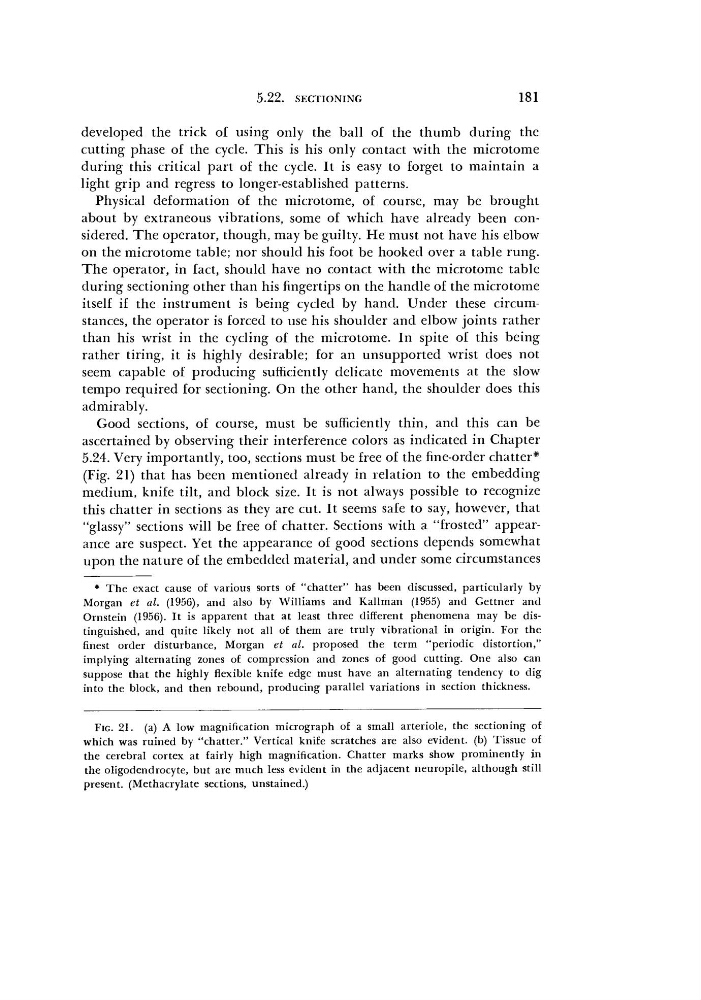
5.24. Very importantly, too, sections must be free of the fine-order chatter*
(Fig. 21) that has been mentioned already in relation to the embedding
medium, knife tilt, and block size. It is not always possible to recognize
this chatter in sections as they are cut. It seems safe to say, however, that
"glassy" sections will be free of chatter. Sections with a "frosted" appearance are suspect. Yet the appearance of good sections depends somewhat
upon the nature of the embedded material, and under some circumstances
* The exact cause of various sorts of "chatter" has been discussed, particularly by
Morgan et al. (1956), and also by Williams and Kallman (1955) and Gettner and
Ornstein (1956). It is apparent that at least three different phenomena may be distinguished, and quite likely not all of them are truly vibrational in origin. For the
finest
order disturbance, Morgan et al. proposed the term "periodic distortion,"
implying alternating zones of compression and zones of good cutting. One also can
suppose that the highly flexible knife edge must have an alternating tendency to dig
into the block, and then rebound, producing parallel variations in section thickness.
FIG. 21. (a) A low magnification micrograph of a small arteriole, the sectioning of
which was ruined by "chatter." Vertical knife scratches are also evident, (b) Tissue of
the cerebral cortex at fairly high magnification. Chatter marks show prominently in
the oligodendrocyte, but are much less evident in the adjacent neuropile, although still
present. (Methacrylate sections, unstained.)
SECTIONING
181
developed the trick of using only the ball of the thumb during the
cutting phase of the cycle. This is his only contact with the microtome
during this critical part of the cycle. It is easy to forget to maintain a
light grip and regress to longer-established patterns.
Physical deformation of the microtome, of course, may be brought
about by extraneous vibrations, some of which have already been considered. The operator, though, may be guilty. He must not have his elbow
on the microtome table; nor should his foot be hooked over a table rung.
The operator, in fact, should have no contact with the microtome table
during sectioning other than his fingertips on the handle of the microtome
itself if the instrument is being cycled by hand. Under these circumstances, the operator is forced to use his shoulder and elbow joints rather
than his wrist in the cycling of the microtome. In spite of this being
rather tiring, it is highly desirable; for an unsupported wrist does not
seem capable of producing sufficiently delicate movements at the slow
tempo required for sectioning. On the other hand, the shoulder does this
admirably.
Good sections, of course, must be sufficiently thin, and this can be
ascertained by observing their interference colors as indicated in Chapter
5.24. Very importantly, too, sections must be free of the fine-order chatter*
(Fig. 21) that has been mentioned already in relation to the embedding
medium, knife tilt, and block size. It is not always possible to recognize
this chatter in sections as they are cut. It seems safe to say, however, that
"glassy" sections will be free of chatter. Sections with a "frosted" appearance are suspect. Yet the appearance of good sections depends somewhat
upon the nature of the embedded material, and under some circumstances
* The exact cause of various sorts of "chatter" has been discussed, particularly by
Morgan et al. (1956), and also by Williams and Kallman (1955) and Gettner and
Ornstein (1956). It is apparent that at least three different phenomena may be distinguished, and quite likely not all of them are truly vibrational in origin. For the
finest
order disturbance, Morgan et al. proposed the term "periodic distortion,"
implying alternating zones of compression and zones of good cutting. One also can
suppose that the highly flexible knife edge must have an alternating tendency to dig
into the block, and then rebound, producing parallel variations in section thickness.
FIG. 21. (a) A low magnification micrograph of a small arteriole, the sectioning of
which was ruined by "chatter." Vertical knife scratches are also evident, (b) Tissue of
the cerebral cortex at fairly high magnification. Chatter marks show prominently in
the oligodendrocyte, but are much less evident in the adjacent neuropile, although still
present. (Methacrylate sections, unstained.)