

52
WALLACE H. FULLER
Prismatic
Columnar
Angular
Subangular
blocky
blocky
Platy
Granular
Single grain
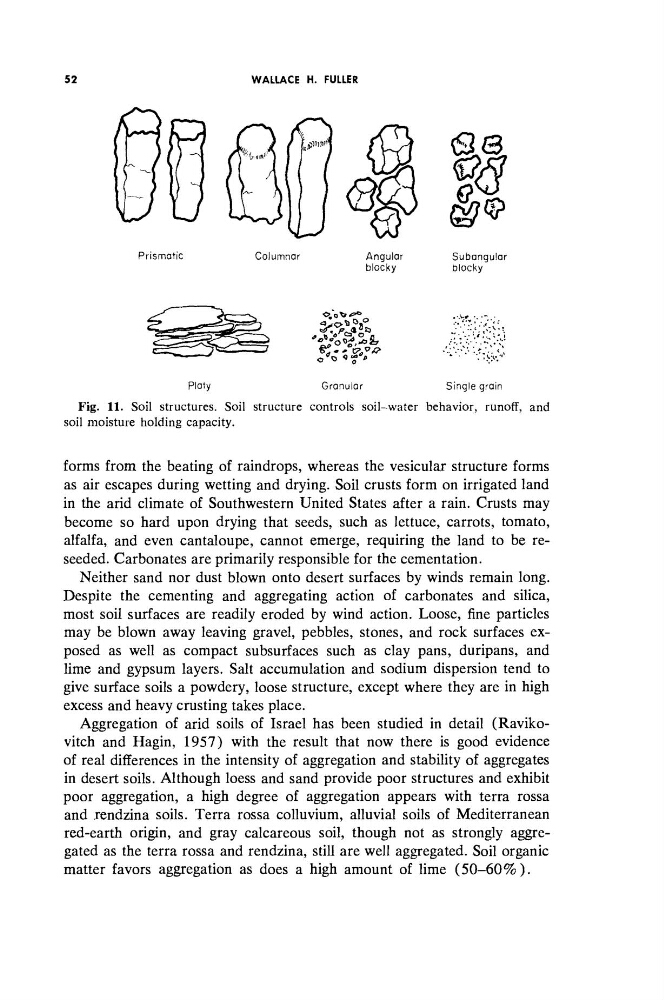
Fig. 11. Soil structures. Soil structure controls soil-water behavior, runoff, and
soil moisture holding capacity.
forms from the beating of raindrops, whereas the vesicular structure forms
as air escapes during wetting and drying. Soil crusts form on irrigated land
in the arid climate of Southwestern United States after a rain. Crusts may
become so hard upon drying that seeds, such as lettuce, carrots, tomato,
alfalfa, and even cantaloupe, cannot emerge, requiring the land to be reseeded. Carbonates are primarily responsible for the cementation.
Neither sand nor dust blown onto desert surfaces by winds remain long.
Despite the cementing and aggregating action of carbonates and silica,
most soil surfaces are readily eroded by wind action. Loose, fine particles
may be blown away leaving gravel, pebbles, stones, and rock surfaces exposed as well as compact subsurfaces such as clay pans, duripans, and
lime and gypsum layers. Salt accumulation and sodium dispersion tend to
give surface soils a powdery, loose structure, except where they are in high
excess and heavy crusting takes place.
Aggregation of arid soils of Israel has been studied in detail (Ravikovitch and Hagin, 1957) with the result that now there is good evidence
of real differences in the intensity of aggregation and stability of aggregates
in desert soils. Although loess and sand provide poor structures and exhibit
poor aggregation, a high degree of aggregation appears with terra rossa
and rendzina soils. Terra rossa colluvium, alluvial soils of Mediterranean
red-earth origin, and gray calcareous soil, though not as strongly aggregated as the terra rossa and rendzina, still are well aggregated. Soil organic
matter favors aggregation as does a high amount of lime ( 5 0 - 6 0 % ) .
WALLACE H. FULLER
Prismatic
Columnar
Angular
Subangular
blocky
blocky
Platy
Granular
Single grain
Fig. 11. Soil structures. Soil structure controls soil-water behavior, runoff, and
soil moisture holding capacity.
forms from the beating of raindrops, whereas the vesicular structure forms
as air escapes during wetting and drying. Soil crusts form on irrigated land
in the arid climate of Southwestern United States after a rain. Crusts may
become so hard upon drying that seeds, such as lettuce, carrots, tomato,
alfalfa, and even cantaloupe, cannot emerge, requiring the land to be reseeded. Carbonates are primarily responsible for the cementation.
Neither sand nor dust blown onto desert surfaces by winds remain long.
Despite the cementing and aggregating action of carbonates and silica,
most soil surfaces are readily eroded by wind action. Loose, fine particles
may be blown away leaving gravel, pebbles, stones, and rock surfaces exposed as well as compact subsurfaces such as clay pans, duripans, and
lime and gypsum layers. Salt accumulation and sodium dispersion tend to
give surface soils a powdery, loose structure, except where they are in high
excess and heavy crusting takes place.
Aggregation of arid soils of Israel has been studied in detail (Ravikovitch and Hagin, 1957) with the result that now there is good evidence
of real differences in the intensity of aggregation and stability of aggregates
in desert soils. Although loess and sand provide poor structures and exhibit
poor aggregation, a high degree of aggregation appears with terra rossa
and rendzina soils. Terra rossa colluvium, alluvial soils of Mediterranean
red-earth origin, and gray calcareous soil, though not as strongly aggregated as the terra rossa and rendzina, still are well aggregated. Soil organic
matter favors aggregation as does a high amount of lime ( 5 0 - 6 0 % ) .