

446
JAMES E. DEACON AND W. L. MINCKLEY
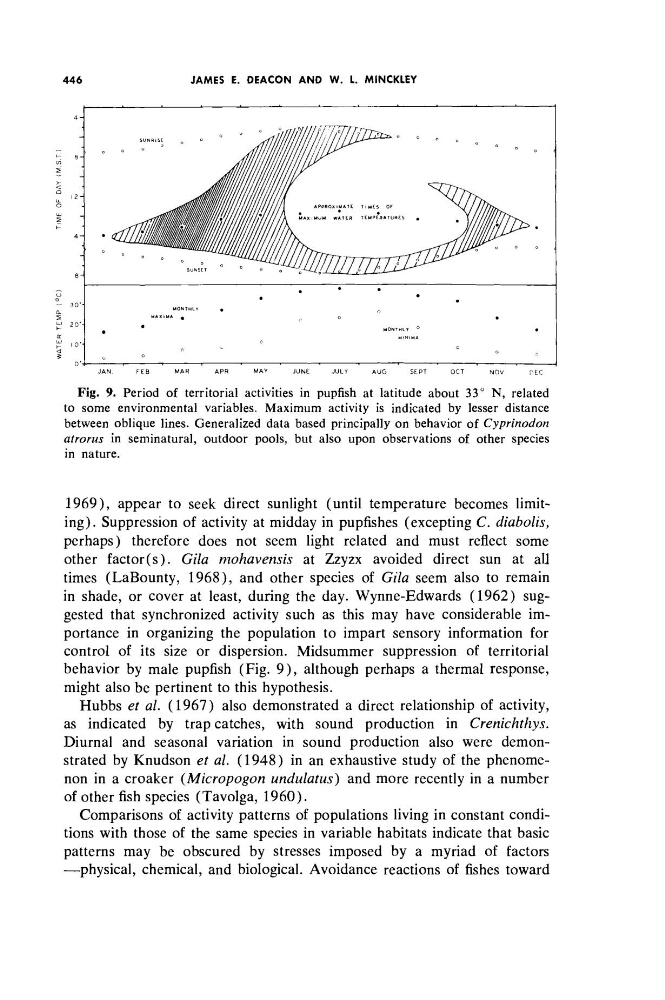
Fig. 9. Period of territorial activities in pupfish at latitude about 33° N, related
to some environmental variables. Maximum activity is indicated by lesser distance
between oblique lines. Generalized data based principally on behavior of Cyprinodon
atrorus in seminatural, outdoor pools, but also upon observations of other species
in nature.
1969), appear to seek direct sunlight (until temperature becomes limiting). Suppression of activity at midday in pupfishes (excepting C. diabolis,
perhaps) therefore does not seem light related and must reflect some
other factor(s). Gila mohavensis at Zzyzx avoided direct sun at all
times (LaBounty, 1968), and other species of Gila seem also to remain
in shade, or cover at least, during the day. Wynne-Edwards (1962) suggested that synchronized activity such as this may have considerable importance in organizing the population to impart sensory information for
control of its size or dispersion. Midsummer suppression of territorial
behavior by male pupfish (Fig. 9 ) , although perhaps a thermal response,
might also be pertinent to this hypothesis.
Hubbs et al. (1967) also demonstrated a direct relationship of activity,
as indicated by trap catches, with sound production in Crenichthys.
Diurnal and seasonal variation in sound production also were demonstrated by Knudson et al. (1948) in an exhaustive study of the phenomenon in a croaker (Micropogon undulatus) and more recently in a number
of other fish species (Tavolga, 1960).
Comparisons of activity patterns of populations living in constant conditions with those of the same species in variable habitats indicate that basic
patterns may be obscured by stresses imposed by a myriad of factors
—physical, chemical, and biological. Avoidance reactions of fishes toward
JAMES E. DEACON AND W. L. MINCKLEY
Fig. 9. Period of territorial activities in pupfish at latitude about 33° N, related
to some environmental variables. Maximum activity is indicated by lesser distance
between oblique lines. Generalized data based principally on behavior of Cyprinodon
atrorus in seminatural, outdoor pools, but also upon observations of other species
in nature.
1969), appear to seek direct sunlight (until temperature becomes limiting). Suppression of activity at midday in pupfishes (excepting C. diabolis,
perhaps) therefore does not seem light related and must reflect some
other factor(s). Gila mohavensis at Zzyzx avoided direct sun at all
times (LaBounty, 1968), and other species of Gila seem also to remain
in shade, or cover at least, during the day. Wynne-Edwards (1962) suggested that synchronized activity such as this may have considerable importance in organizing the population to impart sensory information for
control of its size or dispersion. Midsummer suppression of territorial
behavior by male pupfish (Fig. 9 ) , although perhaps a thermal response,
might also be pertinent to this hypothesis.
Hubbs et al. (1967) also demonstrated a direct relationship of activity,
as indicated by trap catches, with sound production in Crenichthys.
Diurnal and seasonal variation in sound production also were demonstrated by Knudson et al. (1948) in an exhaustive study of the phenomenon in a croaker (Micropogon undulatus) and more recently in a number
of other fish species (Tavolga, 1960).
Comparisons of activity patterns of populations living in constant conditions with those of the same species in variable habitats indicate that basic
patterns may be obscured by stresses imposed by a myriad of factors
—physical, chemical, and biological. Avoidance reactions of fishes toward