

VII. DESERT FISHES
439
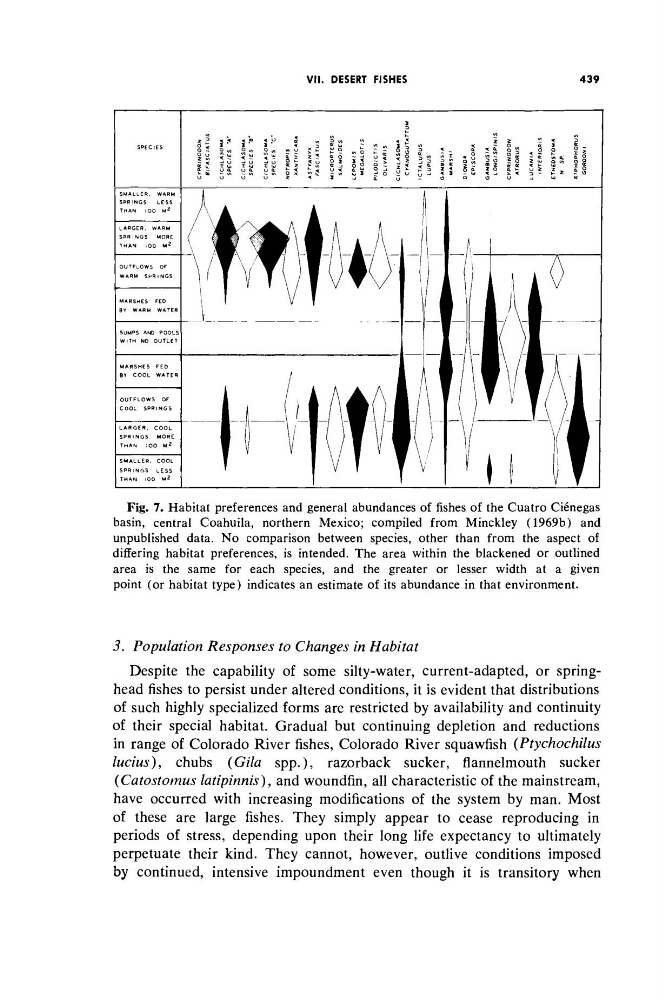
Fig. 7. Habitat preferences and general abundances of fishes of the Cuatro Ciénegas
basin, central Coahuila, northern Mexico; compiled from Minckley (1969b) and
unpublished data. No comparison between species, other than from the aspect of
differing habitat preferences, is intended. The area within the blackened or outlined
area is the same for each species, and the greater or lesser width at a given
point (or habitat type) indicates an estimate of its abundance in that environment.
3. Population Responses to Changes in Habitat
Despite the capability of some silty-water, current-adapted, or springhead fishes to persist under altered conditions, it is evident that distributions
of such highly specialized forms are restricted by availability and continuity
of their special habitat. Gradual but continuing depletion and reductions
in range of Colorado River fishes, Colorado River squawfish (Ptychochilus
lucius), chubs (Gila spp.), razorback sucker, flannelmouth sucker
(Catostomus latipinnis), and woundfin, all characteristic of the mainstream,
have occurred with increasing modifications of the system by man. Most
of these are large fishes. They simply appear to cease reproducing in
periods of stress, depending upon their long life expectancy to ultimately
perpetuate their kind. They cannot, however, outlive conditions imposed
by continued, intensive impoundment even though it is transitory when
439
Fig. 7. Habitat preferences and general abundances of fishes of the Cuatro Ciénegas
basin, central Coahuila, northern Mexico; compiled from Minckley (1969b) and
unpublished data. No comparison between species, other than from the aspect of
differing habitat preferences, is intended. The area within the blackened or outlined
area is the same for each species, and the greater or lesser width at a given
point (or habitat type) indicates an estimate of its abundance in that environment.
3. Population Responses to Changes in Habitat
Despite the capability of some silty-water, current-adapted, or springhead fishes to persist under altered conditions, it is evident that distributions
of such highly specialized forms are restricted by availability and continuity
of their special habitat. Gradual but continuing depletion and reductions
in range of Colorado River fishes, Colorado River squawfish (Ptychochilus
lucius), chubs (Gila spp.), razorback sucker, flannelmouth sucker
(Catostomus latipinnis), and woundfin, all characteristic of the mainstream,
have occurred with increasing modifications of the system by man. Most
of these are large fishes. They simply appear to cease reproducing in
periods of stress, depending upon their long life expectancy to ultimately
perpetuate their kind. They cannot, however, outlive conditions imposed
by continued, intensive impoundment even though it is transitory when