

II. DESERT SOILS
33
pie, some desert Lithosols occur as typical, shallow, broken-rock surfaces
overlying bedrock and Regosols occur as shifting sand dunes. Other surfaces are encrusted with salt or constitute deep beds of lime or gypsum.
Although deserts are noted for physical surfaces that do not represent mature soils in the classical sense, in this chapter the term "soil" will be used
rather than "surface materials" (Dregne, 1967) since most surfaces of
deserts will fit into the classification scheme as envisaged in the U.S. Department of Agriculture Seventh Approximation System (U.S. Soil Conservation Service, 1960, 1967).
Desert soils are found under extreme arid, arid, and semiarid climatic
conditions of low rainfall. Arid soils receive less than 25 cm precipitation
per year, although there are those in equatorial and other areas that may
receive up to 50 cm. Certain coastal deserts may go rainless for several
years. Precipitation in the desert is characterized most often as torrential
although many exceptions can be cited. A year's supply can fall all at one
time. Heaviest showers often occur during the summer months. Erosion,
runoff, and evaporation seriously reduce the effectiveness of the rainfall
for supporting plant life and leaching salts from the surface horizon. Some
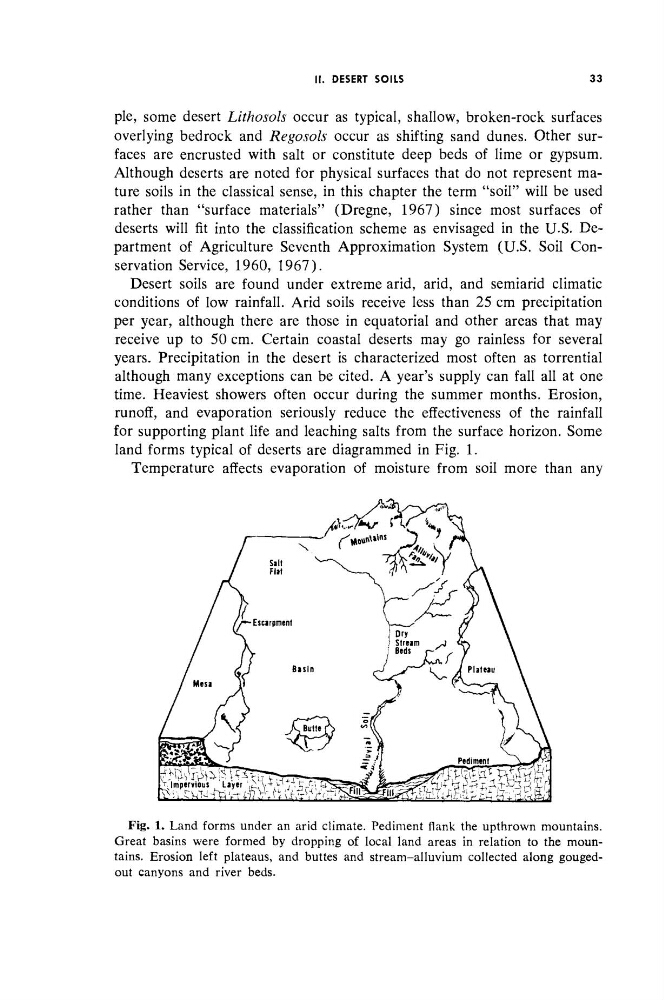
land forms typical of deserts are diagrammed in Fig. 1.
Temperature affects evaporation of moisture from soil more than any
Fig. 1. Land forms under an arid climate. Pediment flank the upthrown mountains.
Great basins were formed by dropping of local land areas in relation to the mountains. Erosion left plateaus, and buttes and stream-alluvium collected along gougedout canyons and river beds.
33
pie, some desert Lithosols occur as typical, shallow, broken-rock surfaces
overlying bedrock and Regosols occur as shifting sand dunes. Other surfaces are encrusted with salt or constitute deep beds of lime or gypsum.
Although deserts are noted for physical surfaces that do not represent mature soils in the classical sense, in this chapter the term "soil" will be used
rather than "surface materials" (Dregne, 1967) since most surfaces of
deserts will fit into the classification scheme as envisaged in the U.S. Department of Agriculture Seventh Approximation System (U.S. Soil Conservation Service, 1960, 1967).
Desert soils are found under extreme arid, arid, and semiarid climatic
conditions of low rainfall. Arid soils receive less than 25 cm precipitation
per year, although there are those in equatorial and other areas that may
receive up to 50 cm. Certain coastal deserts may go rainless for several
years. Precipitation in the desert is characterized most often as torrential
although many exceptions can be cited. A year's supply can fall all at one
time. Heaviest showers often occur during the summer months. Erosion,
runoff, and evaporation seriously reduce the effectiveness of the rainfall
for supporting plant life and leaching salts from the surface horizon. Some
land forms typical of deserts are diagrammed in Fig. 1.
Temperature affects evaporation of moisture from soil more than any
Fig. 1. Land forms under an arid climate. Pediment flank the upthrown mountains.
Great basins were formed by dropping of local land areas in relation to the mountains. Erosion left plateaus, and buttes and stream-alluvium collected along gougedout canyons and river beds.